Explore the 9 most beautiful Tashkent metro stations for photography in this complete guide. Discover one of the most beautiful metro systems in Asia and the world.
When I first visited Tashkent, I did not expect to find one of the most beautiful metro systems in the world. As a travel photographer, I enjoy visiting metro systems, and over the years, I have photographed fascinating stations all over the world. From the beautiful and modern Stockholm metro to some unique stations in Singapore, Bangkok or Tokyo.
In this photography guide, I will share how to explore the Tashkent metro system, its nine best stations for photography, and many practical tips on how to explore a hidden gem in Uzbekistan. Finally, I will also share my suggested itinerary and optimal route.
Tashkent metro photography guide: practical tips
Surprisingly, there’s quite a lot of online information on the Tashkent metro system. However, after visiting it, there are a few important things to consider, especially if you are travelling for photography.
How safe is the Tashkent metro?
Very safe. Just like the rest of the country, I had no security concerns when visiting Taskhent. Some of the trains are old, but reliable and safe. Moreover, I did not experience any pickpocketing situation (with me or others). Although I can’t generalise, the Tashkent metro felt safe, clean and efficient.
Moreover, at almost every station I stopped at, there was a security control for those bringing larger bags. Thus, if you are bringing a camera bag, you might need to show its contents. However, I did not have any problem passing the controls.
How expensive is the Tashkent metro?
Not expensive at all. A ticket will cost you around 0,15$, 1400 Uzbekistani Som, so riding the Tashkent metro system is “almost” free for Westerners. Thus, do not attempt to jump in the metro without paying, it’s not worth it.
Where can I buy my tickets for the Tashkent metro?
One of my favourite things about the Taskhent metro system is that as of 2024-2025, you can tap and go. I used a travel debit card and forgot about knowing my final destination or having to communicate with the personnel. If you prefer to use cash and get a physical ticket, you can, but the language barrier will be real.
Can I photograph the Tashkent metro?
This was my main worry when I visited Tashkent. I had read some old reports about people being kicked out of the metro for trying to take photos of its stations. Thus, I approached the mission to take photos on the Taskhent metro with caution. Long story short, I could take photos without (almost) any problem.
What I did was approach the security guard of each station (there will be many) and tell them that I wanted to take photos of the station, but not of the people in it. No need to speak Russian or Uzbekistani, it was quite easy to explain it with simple English words. In all of the cases, they said that if I did not include people, there was no problem. Also, I wasn’t using a tripod, as I know in many places these are forbidden, and I imagined using one would reduce the chances of getting a yes.
Thus, I would not recommend doing street photography in the Tashkent metro, as you might get into trouble with some security guards. Otherwise, you should be safe to photograph the Tashkent metro. While I was photographing it, I was the only one with a camera or who looked like a tourist, so you will definitely stand out.
Best Tashkent metro stations for photography
The Tashkent metro system has 4 lines: the Chilanzar line (red line), the Uzbekistan line (blue line), the Yunusabad line (green line) and the Avobeground Ring (technically a metro, but not considered in this guide, yellow line). Most of the stations listed in this guide are between the blue and green lines, as they are the more central and historical ones.
Kosmonavtlar
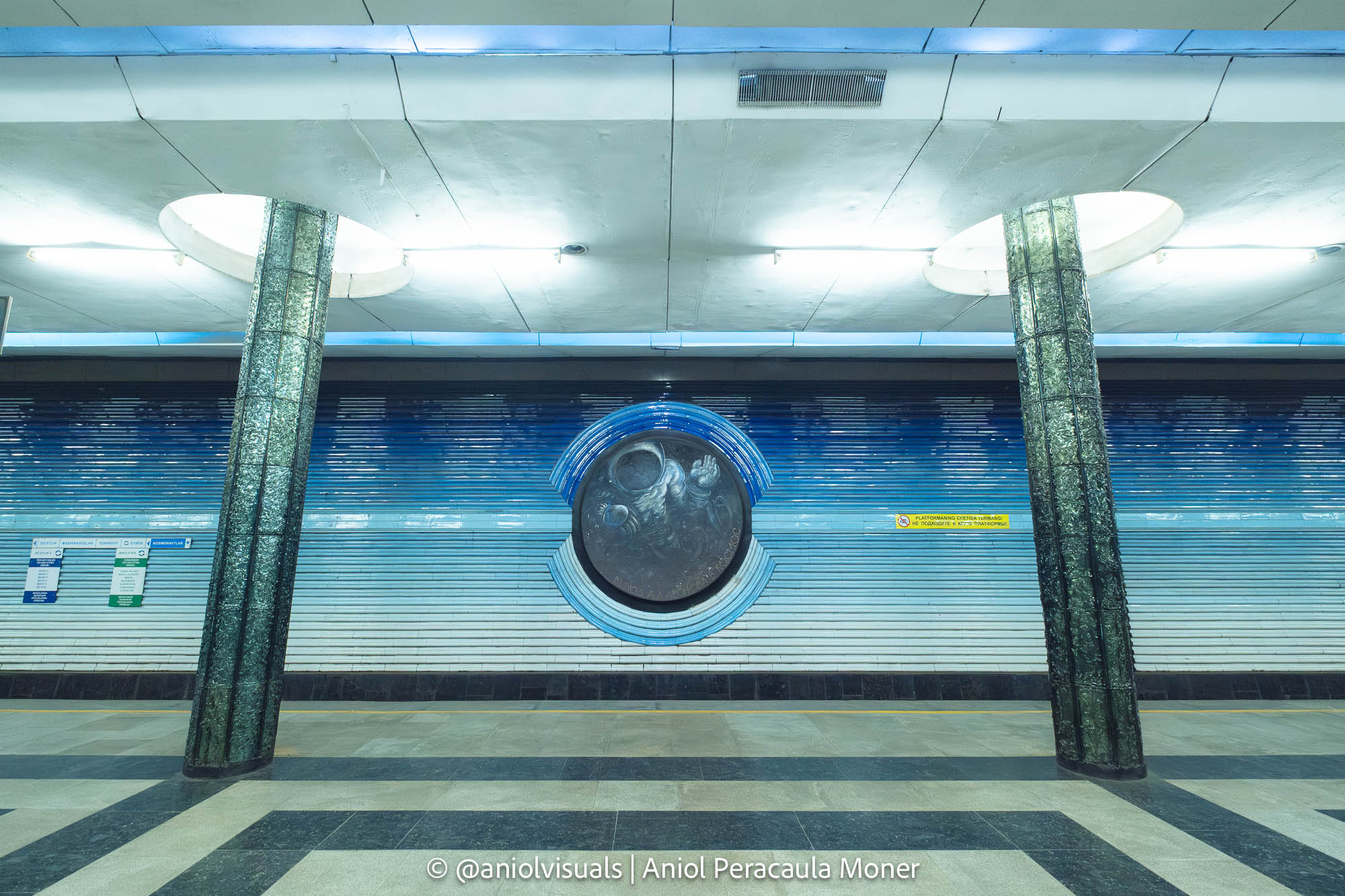
Let’s start with one of the most famous Tashkent metro stations, and a fantastic photography spot. The Kosmonavtlar (aka Cosmonauts) station is dedicated to the first man and woman in space, Yuri Gagarin and Valentina Tereshkova. This station’s main characteristic element is the enormous depictions of the cosmonauts on the walls of the station.
The whole station is in a deep blue tone that matches that of the metro wagons, and that, combined, makes for nice photos. The main problem with this station, in my opinion, is its floor. The ceiling has some cool lighting, but the floor doesn’t really match. Nonetheless, it’s a must-visit spot, even if you are not into photography.
It’s located at a very prime location in the Tashkent metro system, so it’s very easy to reach.

Uzbekistan
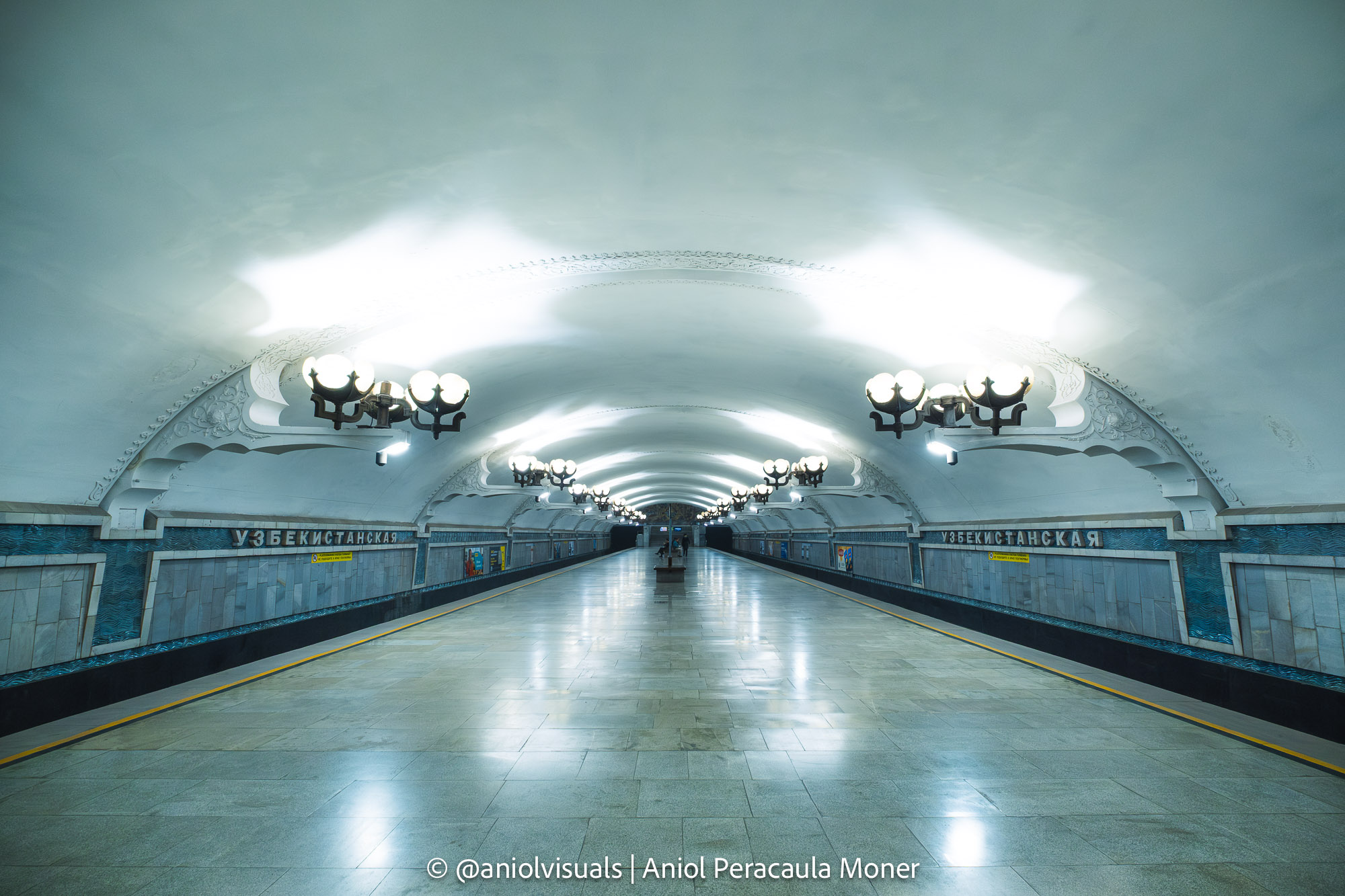
This station is named after the country, but unlike the next one on the list, it doesn’t have many recognisable elements. What makes it interesting are the massive lights, in a sort of chandelier, that give the station a very unique touch. Unlike the previous one, this is not that frequented (at least based on my experience), and it’s possible to take a great symmetrical photo there.
It can be a bit tricky to get a good photo because of the shadows vs highlights situation. It’s a quite dark station, with very powerful light sources. Thus, be careful when exposing the image, because it might end up being too dark or too bright. If you use a tripod (which, as I said above, I do not recommend as I don’t know how people would react to it), you could try to do some exposure bracketing. Make sure to add it to your list, as it’s one of the stations I liked the most for photography in the Tashkent metro.
Tashkent
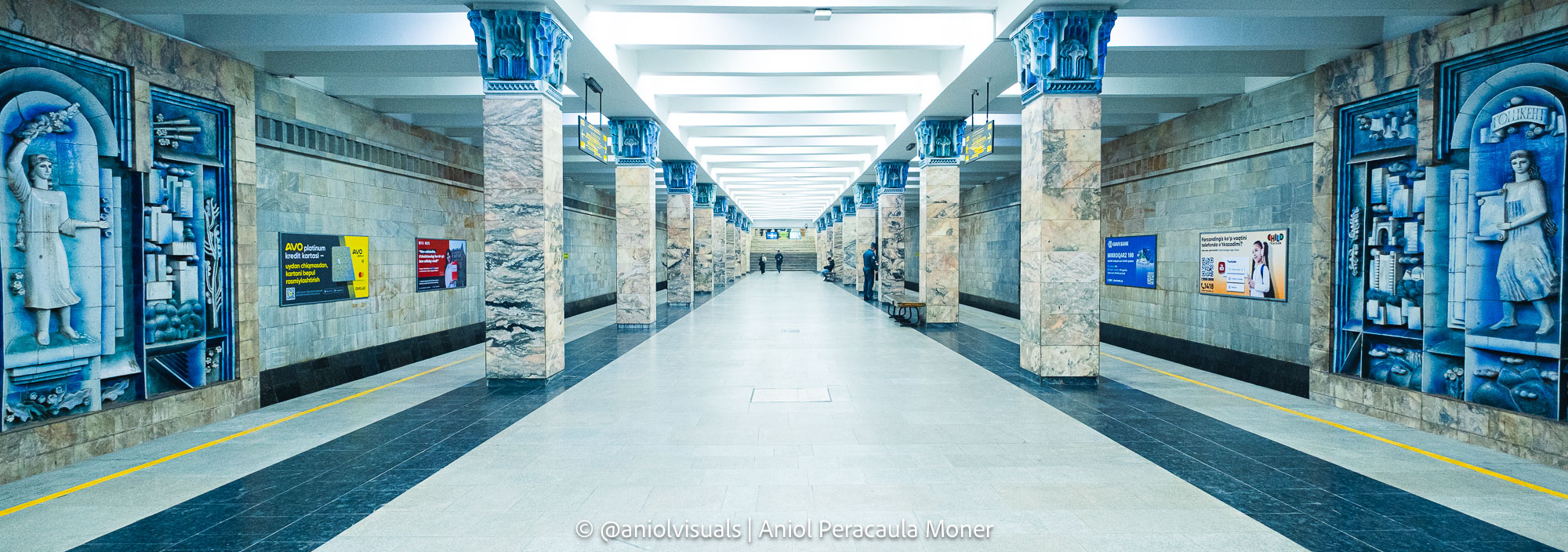
The Tashkent metro station is not that unique. However, there are two reasons why I list it in this guide. First, because of its motives, illustrating the city of Tashkent in a bright blue tone. Second, because even if it’s not the most beautiful one, it’s an important one in the system, and it’s at a very convenient location, just at the North Train Station.
While not all trains leave from there, it’s a station I recommend visiting if you are looking for a more post-Soviet vibe.
Bodomzor
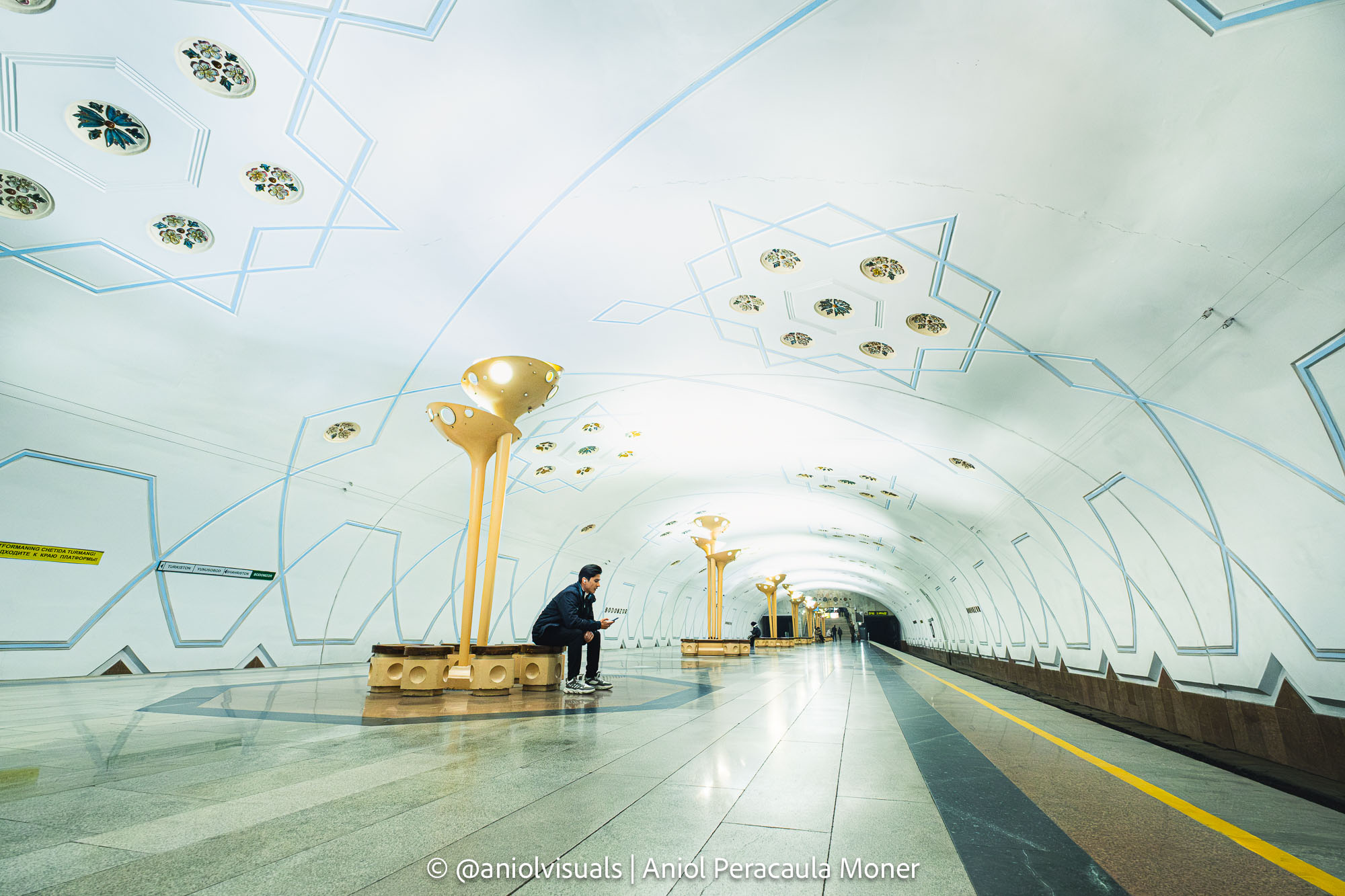
This is probably my favourite station for photography in the Tashkent metro. As you can see below, it’s a very different station, especially if you compare it with the other ones that are listed in this guide. Its semi-circular shape, mixed with the unique lights and seating structures, helps create unique images.
I am not 100% happy with my photos from this station. I have seen some very nice ones online, but when I was there, it was difficult to get the station for myself. The main reason to visit this station, besides being an amazing photography spot, is that it’s quite close to the Tashkent TV tower and the Plov Center. This is my favourite place in all of Uzbekistan to try Plov, one of the most well-known Central Asian dishes.
If you want to get it by yourself, avoid rush hour or times when people go out to eat, as I think this was my mistake when visiting this station.
Abdulla Kodiriy
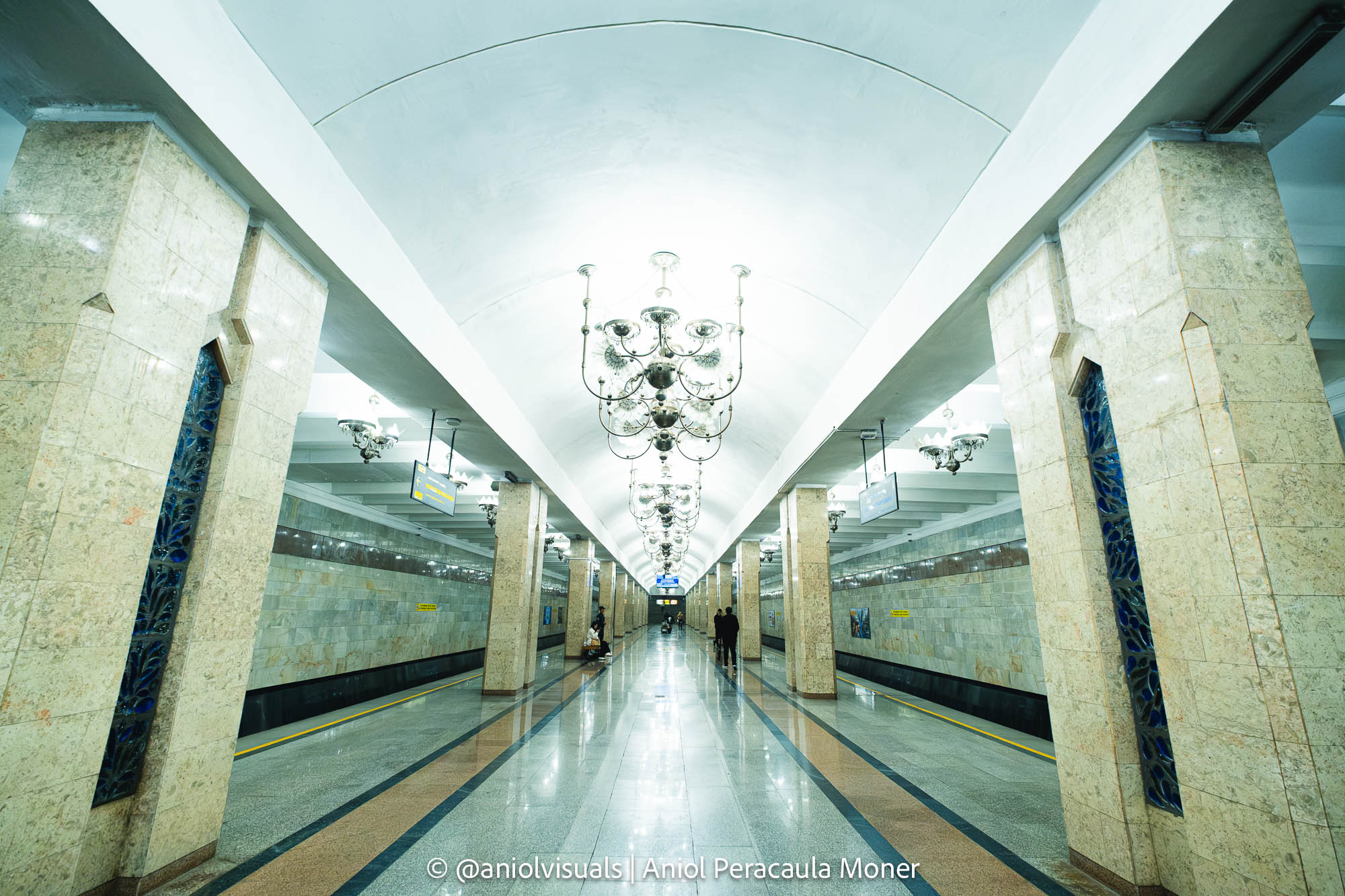
This is a station I was not planning on visiting. However, one of the security guards at another station recommended it to me. While it’s not the most beautiful one, I definitely understand why he recommended it to me. The first thing that will strike you there are the chandeliers on the ceiling. In fact, this is the main thing about this spot. To make the most out of them, though, you will need to get low, as the floor is perfect for reflections, and the chandeliers help create a very nice effect.
Besides that, there’s not much to be done in this station. However, it’s on the way back from Bodomzor, so it’s worth stopping for a few minutes and taking a photo. To see a complete itinerary on how to explore and photograph the Tashkent metro system, check the last section of this guide!
Yunus Rajabi
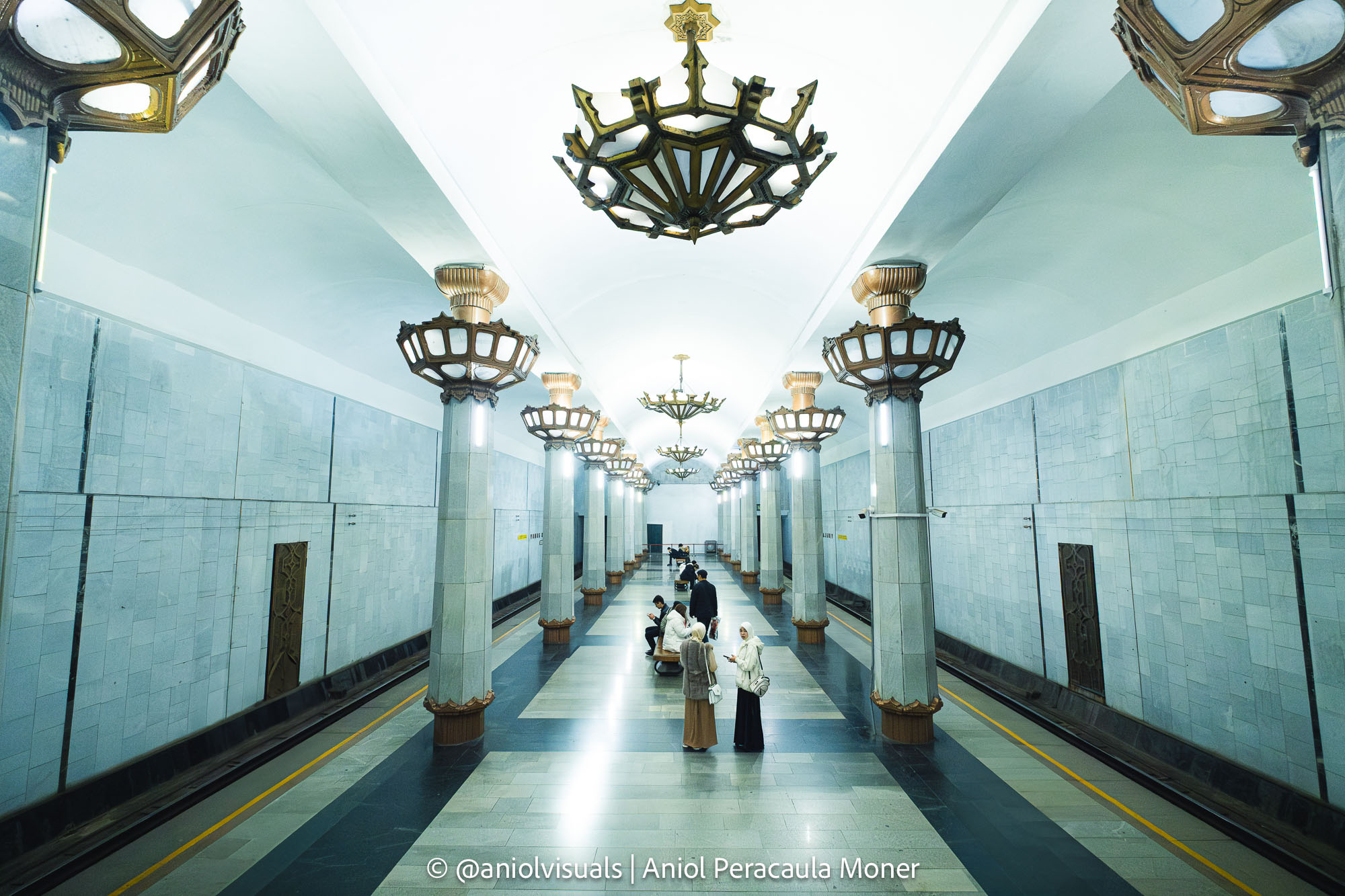
This is the station where you can commute from the green to the red line. However, this station is only serving the green line, so if you stop at the red, you’ll need to walk a bit underground to get there. Just one long tunnel and a set of stairs.
What I particularly liked about this station is that you can get to an elevated spot to take the photo. At the centre of the station, there are the stairs you take to go to the red line. From there, it’s possible to take a great photo. However, the problem here is that it’s always crowded. It’s at the heart of Tashkent, and there are 2 lines, which means double the people. There are a lot of commuters, so be patient, take your time, and make sure not to bother the passersby.
Mustakillik
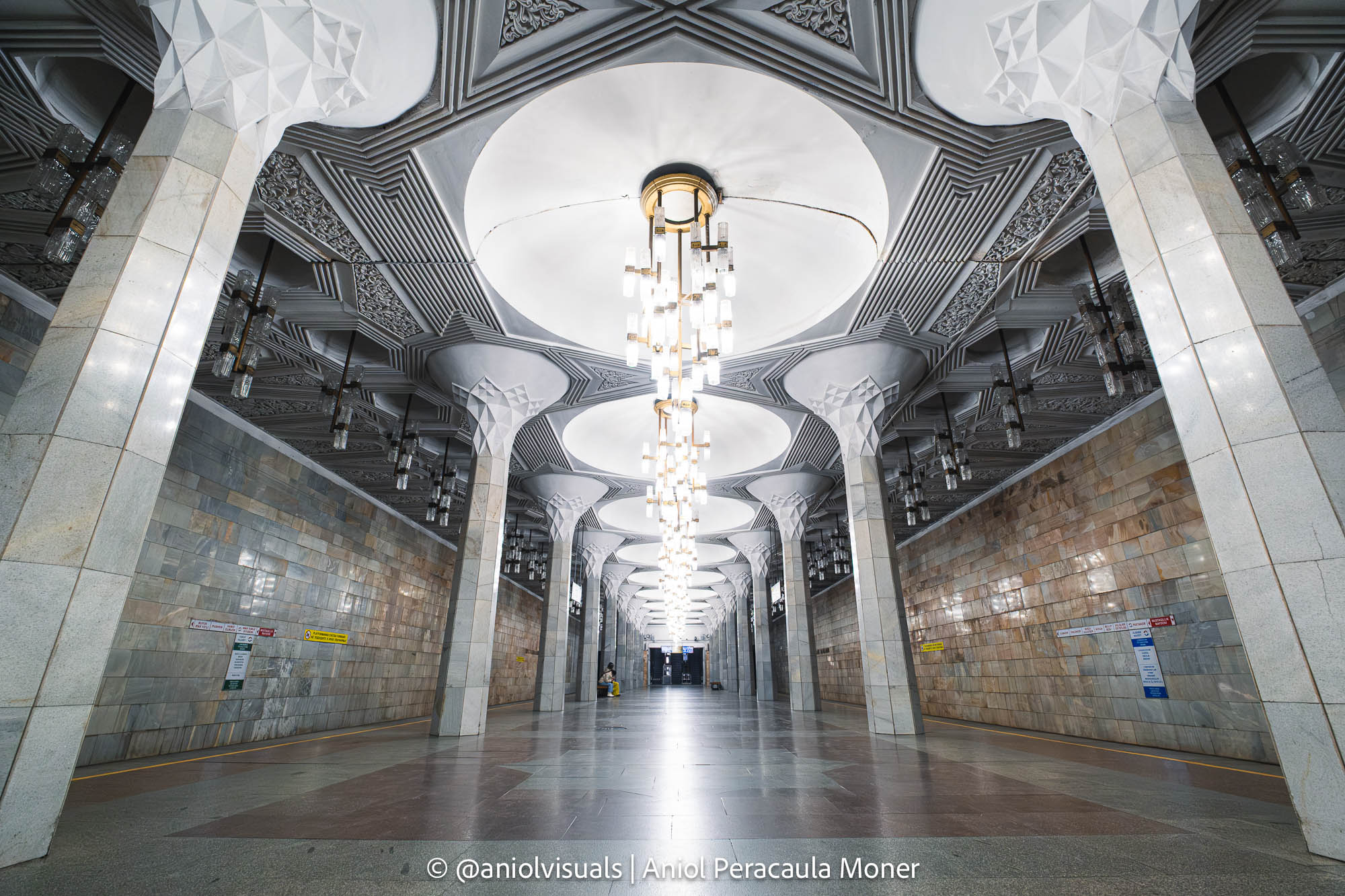
The final 3 stations that I will present are the ones that surprised me the most. Although I did some research, I wasn’t expecting what I found there. First, Mustakillik station. This station feels like a video game scenery. Tall massive columns, enormous chandeliers and intricate ceiling decorations that create a unique photo location.
Unfortunately, the lights on the sides were not lit up when I visited, but it did not make it any less impressive. This station is the nearest to Mustakillik square, one of my highlighted Tashkent photography spots, so if you decide to go there, it might be worth it to exit to the surface. After, though, you might want to go back to the metro, so you don’t miss the next station.
Alisher Navoi
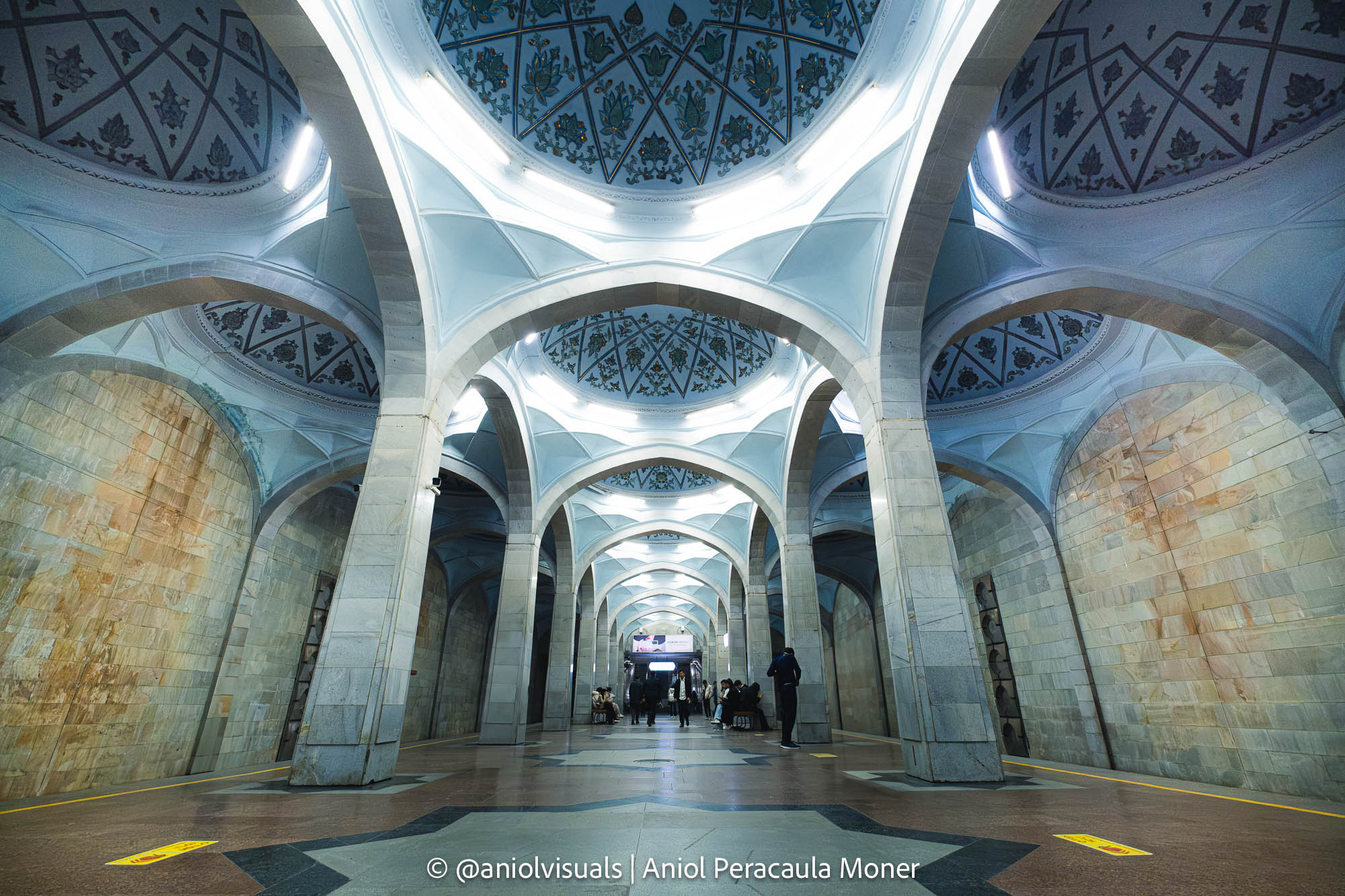
This is probably the most photogenic Tashkent metro station. Compared to Mustakillik, there are two main differences. First, the cupulas. It feels like a kind of religious space, with the three sets of cupolas in the station and the decorations that each has. Second, because of the illumination. It has a slightly blue tone that, mixed with the colour of the cupula, creates a very different ambience in the station.
What I did not like about Alisher Navoi is that it’s a station that, like Yunus Rajab, allows commuting between different lines. In this case, between the red and the blue line. Thus, it’s a very busy station, and it will be difficult to get a clean shot without some post-production help. However, even with this consideration is a must-visit, as you can see in the picture below.
Gafur Gulom
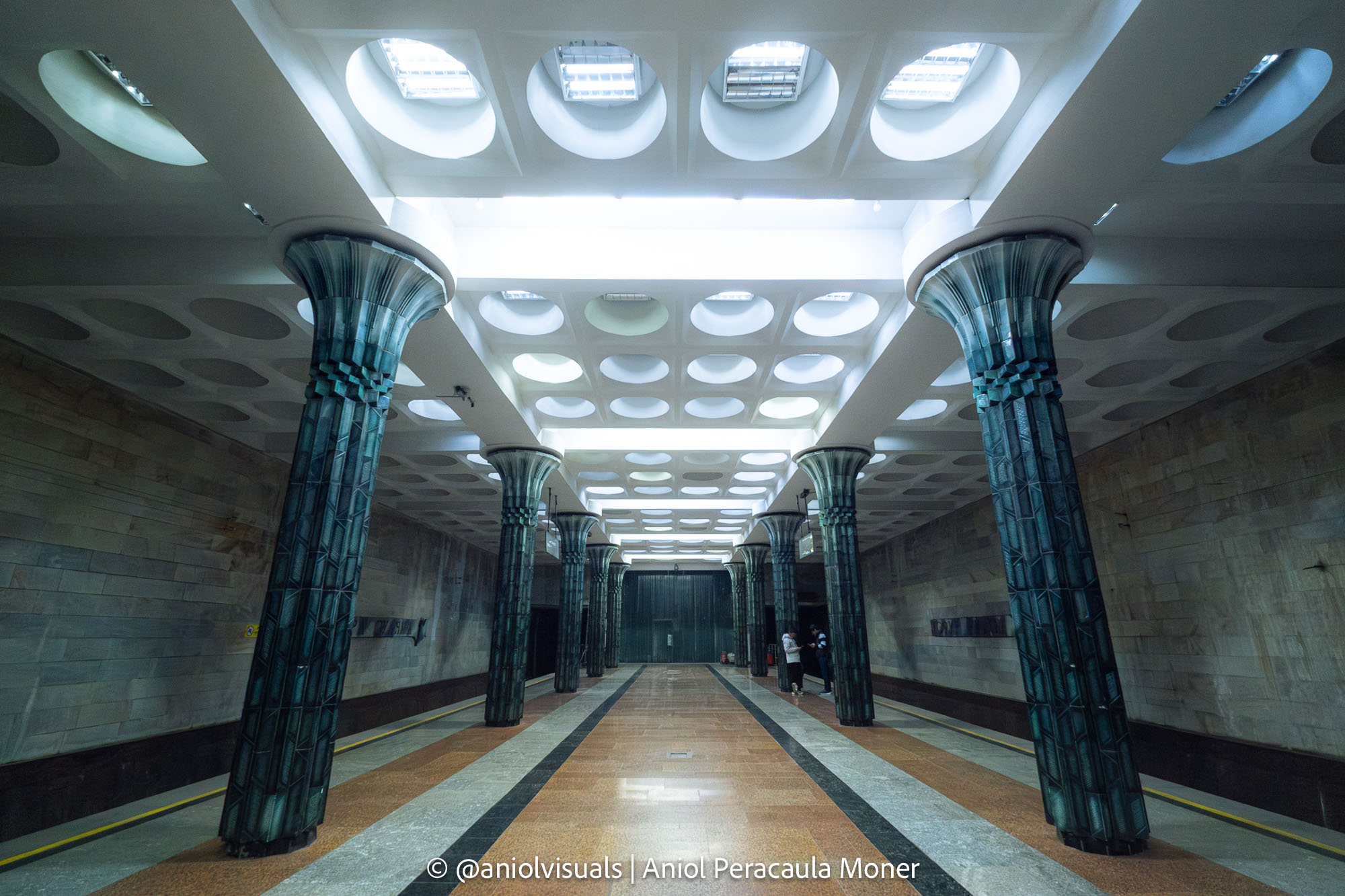
To close this list of the best Tashkent metro stations for photography, there’s Gafur Gulom. What makes this spot great for photography is its ceiling, with the lit-up circular openings. Mixed with the blueish columns, it creates a distinct scenery. It felt like what modernity would have been 20 or 30 years ago.
Unlike the previous station, this is a quiet one, with fewer people commuting, allowing for great photos without passersby in them. Usually, I would aim for people in the photos, but as I explained above, most security guards allowed me to take photos as long as people were not in them.
Tashkent metro guide: a photography itinerary
The Tashkent metro is easy to navigate. However, if you want to optimise your itinerary and have a perfect experience, here is a suggested itinerary on how to explore the Tashkent metro for photography.
The blue line is the line with the most stations on this guide: Tashkent, Kosmonavtlar, Uzbekistan, Alisher Navoi and Gafur Galom are located on it. On the red line, you only have Mustakillik, but besides being a must, it is at a very central location, and very convenient to move between lines. The green line has Bodomzor, Abdulla Kodiriy, and Yunus Rajabi.
You can do this itinerary in the same direction I suggest, or reverse it completely.
Suggested Tashkent metro itinerary
Start by going to the Tashkent metro station. From there, take the blue line, and stop at Kosmonavtlar, Uzbekistan and then go directly to Gafur Galom. Then backtrack one station to Alisher Navoi. After photographing it, change platform and line, and go to the red line for just one stop, at the Mustakillik. Take the metro again for another stop (Amir Temur station) and change lines to the green line, as you’ll already be at the Yunus Rajabi station. Take the green line, and go up, stopping at Abdulla Kodiriy, and finally at Bodomzor.
After that, you have two options. One is to backtrack and go back to the surface at your most convenient spot. The other one is to go out in Bodomzor, walk for around 20 minutes and have lunch/dinner at the Besh Qozon (aka Plov Center), for one of the best Plovs in Uzbekistan. It is a perfect way to finish your Tashkent metro route!
This concludes my Tashkent metro photography guide, with the best stations and spots to capture a very unique metro system. If you want to learn more about Uzbekistan, you can check my other guides or schedule a 30-minute call with me!
26 best Romania photography spots: a complete guide
Best Frankfurt photography spots: a complete guide
Best Bucharest photography spots: complete guide (10+ spots)
What are the best Hamburg photography spots? 28 locations
The 17 best Salzburg photography spots: a complete guide