Discover Uzbekistan’s most iconic city and the heart of the Silk Route with this Samarkand photography spots guide, including a complete list of photo opportunities and locations.
Samarkand is the city where 1001 Nights, the famous tale that almost every kid in the world has heard at some point, is located. Samarkand is even more famous than the country it belongs to: Uzbekistan. In this Samarkand photography spots guide, you will find out what the best photo opportunities are in the city that was once the heart of the Silk Road. A city that connects Asia and Europe, with astonishing photography spots.
Before jumping into the main Samarkand photography spots, here is a list of photography-related FAQs. Practical aspects that I asked myself before visiting Samarkand, and which can help you plan your trip. However, planning a trip to Uzbekistan can be challenging. If that’s the case, you can schedule a call with me using the links on this page.
Samarkand photography guide: FAQs
How to get to Samarkand?
Getting to Samarkand is easy. As probably the most touristy city in the country, it is well connected both with the capital city, Tashkent, and other countries. Although Tashkent is the capital of the country, some tourists only visit Samarkand, mostly due to its popularity and the famous Registan Square.
Samarkand’s international airport has regular connections with Russia, China, Azerbaijan, and Turkey. Turkish Airlines flies frequently to Samarkand, as well as to Tashkent.
If you land in Tashkent, instead of Samarkand, great news. There’s a high-speed train that connects both cities. The trip takes around 2 hours, and it is really affordable. Moreover, other cities in the country, like Bukhara, are also served by the same line, making it easy to move around.
Once you arrive at the Samarkand train station, the best way to get to the old town is by taking a taxi (using the app Yandex). This is also really affordable.

Is it worth it to photograph Samarkand?
As you will see in this Samarkand photography spots guide, it is worth photographing the city. Although it is not as beautiful as cities like Khiva, or does not have the volume of sights that Bukhara has, Samarkand is a must. Registan Square is one of those places in the world where, when you see it, you need to spend some time admiring it.
Besides that, though, the city has more to offer. Beautiful mausoleums, impressive madrasahs, and one of my favourite photography spots in all of Uzbekistan, Shah-i-Zinda.
No one skips Samarkand on a trip to Uzbekistan, and it’s for a good reason.
How many days are needed to visit and photograph Samarkand?
Finding the right balance in Samarkand is key. The city is big, but the main attractions are quite close to one another. Some people online recommend using Samarkand as a base to visit Bukhara, or even other cities. I don’t.
Each city deserves at least a night, and in my opinion, you need at least two nights in Samarkand, because you need two sunsets (minimum). One at Registan Square, to admire the light show and take night photos, and one at Shah-i-Zinda, to see the transition between day and night. There are enough places to visit to fill two or three busy days.
You could take day trips from Samarkand, but only to closer locations, not Bukhara or Tashkent. Two or three days are the sweet spot in my opinion. Of course, if you are a slow traveller, Samarkand has a lot to offer. I’d love to spend one or two weeks there, and walk the non-touristy parts of the city. I did it in some other Uzbekistan cities, and the contrasts are amazing.
Is Samarkand, Uzbekistan, safe?
Yes, Uzbekistan is very safe. A country ending in -stan is usually linked with topics like terrorism, violence, and poverty,… While Uzbekistan is not a rich country, it is extremely safe. I didn’t feel threatened at any point during my trip, in Samarkand or anywhere else.
I took photos at night, in non-touristy areas, and everyone was friendly. I found it safer than most European countries I’ve been to (almost all of them), and I consider Europe a very safe place to be, in general.
Samarkand is very safe, and while exercising the usual precautions, you should not have any problems at all.

Where to stay in Samarkand?
As a photographer, this is an important question. Being close to the right spots is key, especially in a city like Samarkand, where I recommend shooting until sunset and during the early hours of the night.
All Samarkand photography spots listed in this guide are within walking distance. Not 2-minute walks, but 20-minute walks, still within walking distance. My recommendation is to stay close to Registan Square. It’s the heart of the tourist area, and the other two areas with spots are at a similar distance from the Square.
Samarkand (and Uzbekistan in general) has many guesthouses and small hotels. These are family-run, small accommodations, and although they don’t have the luxuries of 5-star hotels, they are extremely affordable and offer a way to connect with locals. I stayed in multiple guesthouses during my Uzbekistan trip, and I was very pleased with all of them.

Samarkand photography spots
In this Samarkand photography spots guide, the locations listed are not presented in any specific order. I have a love-hate relationship with photography spots lists, as any city is much more than just a list of 10 spots. I encourage you to explore the city, keep your camera ready, and capture your version of Samarkand.
Registan Square
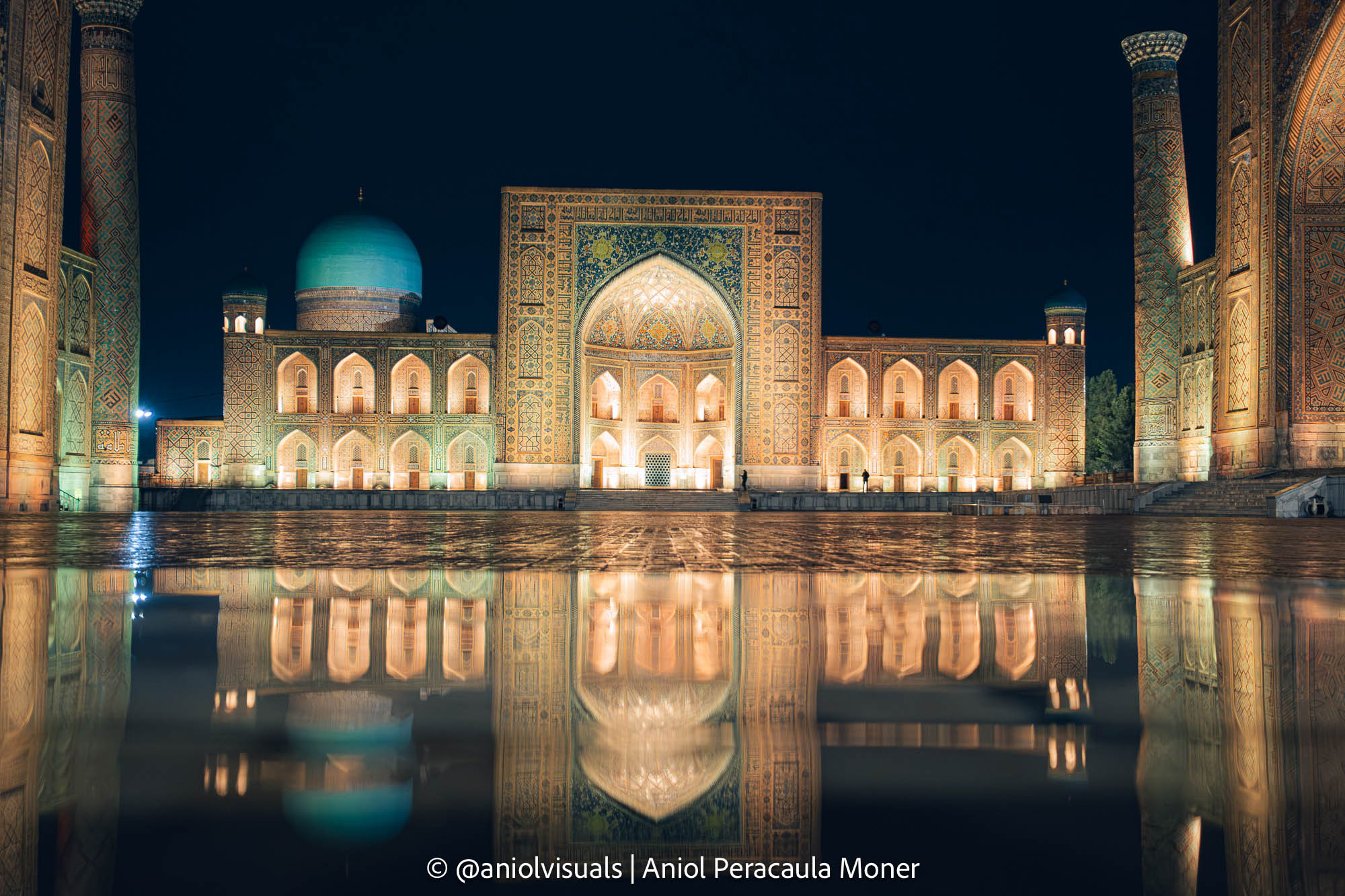
This is one of the most well-known Samarkand photography spots, and probably the most visited place in Samarkand (and maybe Uzbekistan). This spot is divided into 4: the square and the 3 madrasahs. It’s worth spending some time with each of them, as there are many photography opportunities in such a small area.
Accessing the square and the 3 madrasahs is not free. You can get a free view from a viewing platform, and get close to the square, but accessing it costs 50.000 SOM. Both views are worth considering from a photography point of view. The one from a distance helps show the massive size of the 3 Madrasahs, while within the square, besides visiting them, you can also capture more details.
Another reason to access the square is to have fewer people in the frame. Especially early in the morning or in the evening (excepting during the lights show), the square is almost empty, and you can take a photo of all 3 madrasahs.
Best conditions for photographing Registan Square
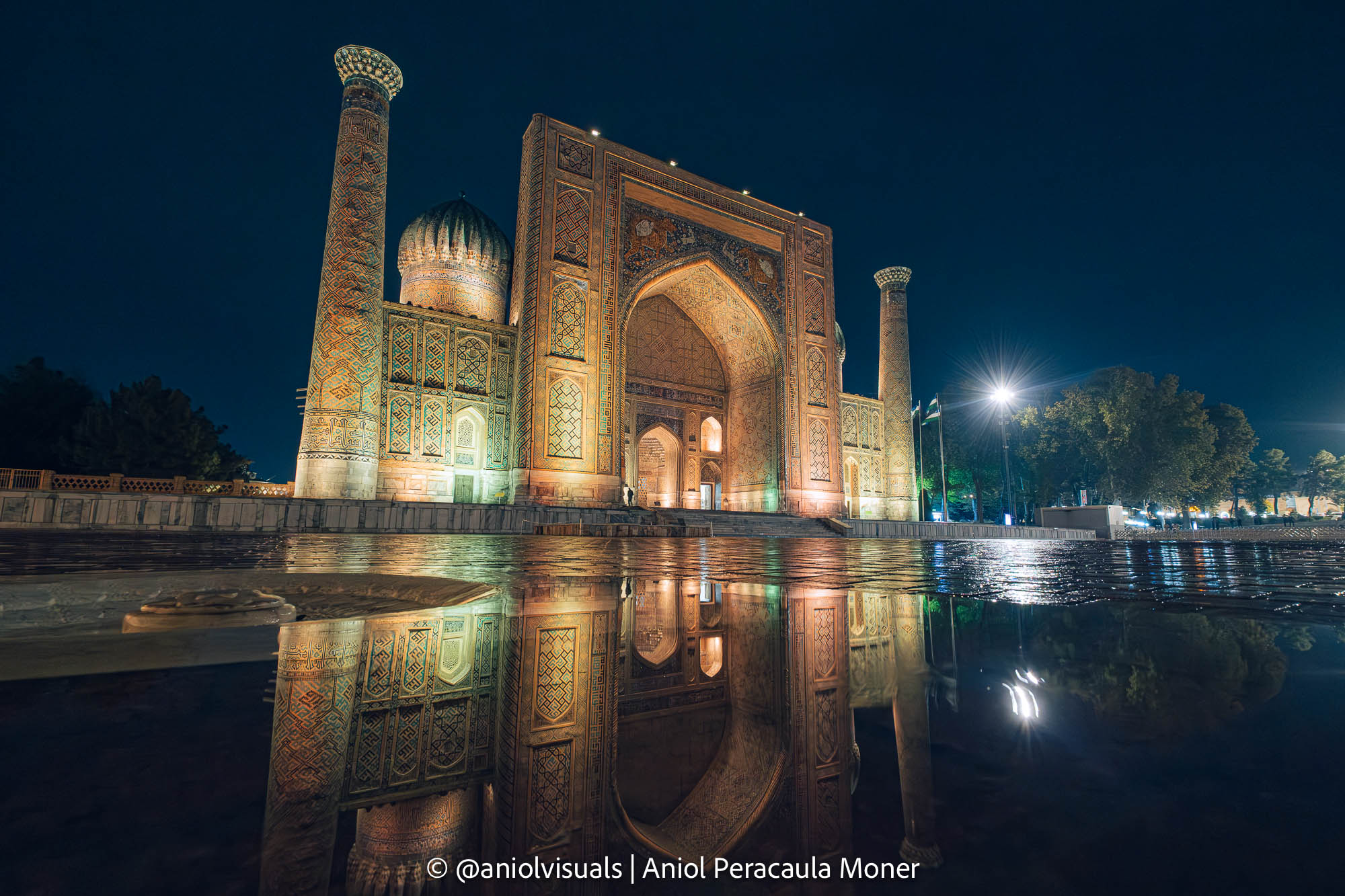
My favourite time to visit Registan Square is just after a heavy rainstorm. I was lucky enough to be alone in the square while it rained, and the reflections in the water puddles helped me create some amazing photos.
Note that you need to pay to access Registan Square every time you enter it. Thus, if you want to photograph it during the daytime and nighttime (as I recommend), you’ll need to pay twice.

Ulugh Beg Madrasa
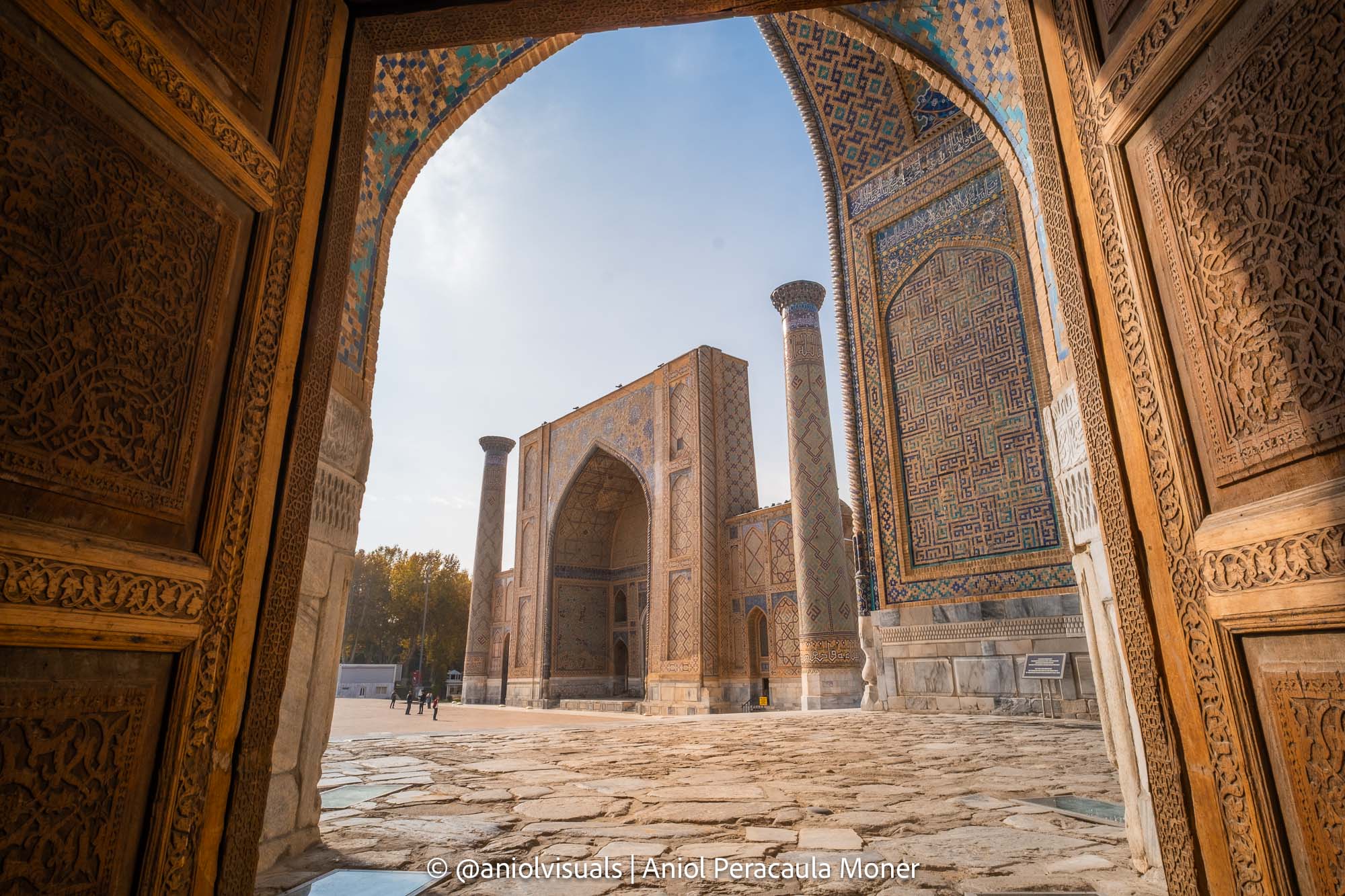
When standing in front of Registan Square, the Ulugh Beg Madrasa is the one on the left. It’s the only of the 3 madrasahs that doesn’t have a blue cupola. Built in the 15th century, it is, in my opinion, the least photogenic of the 3. However, this doesn’t mean that it’s not worth shooting.
Anywhere else in the world, it would be the most beautiful building in the area, but as part of Registan Square, I preferred using it as a frame for the other madrasahs rather than focusing too much on it. The interior is nice, but as you’ll read below, there’s one that is better for photography.
Tilya-Kori Madrasa
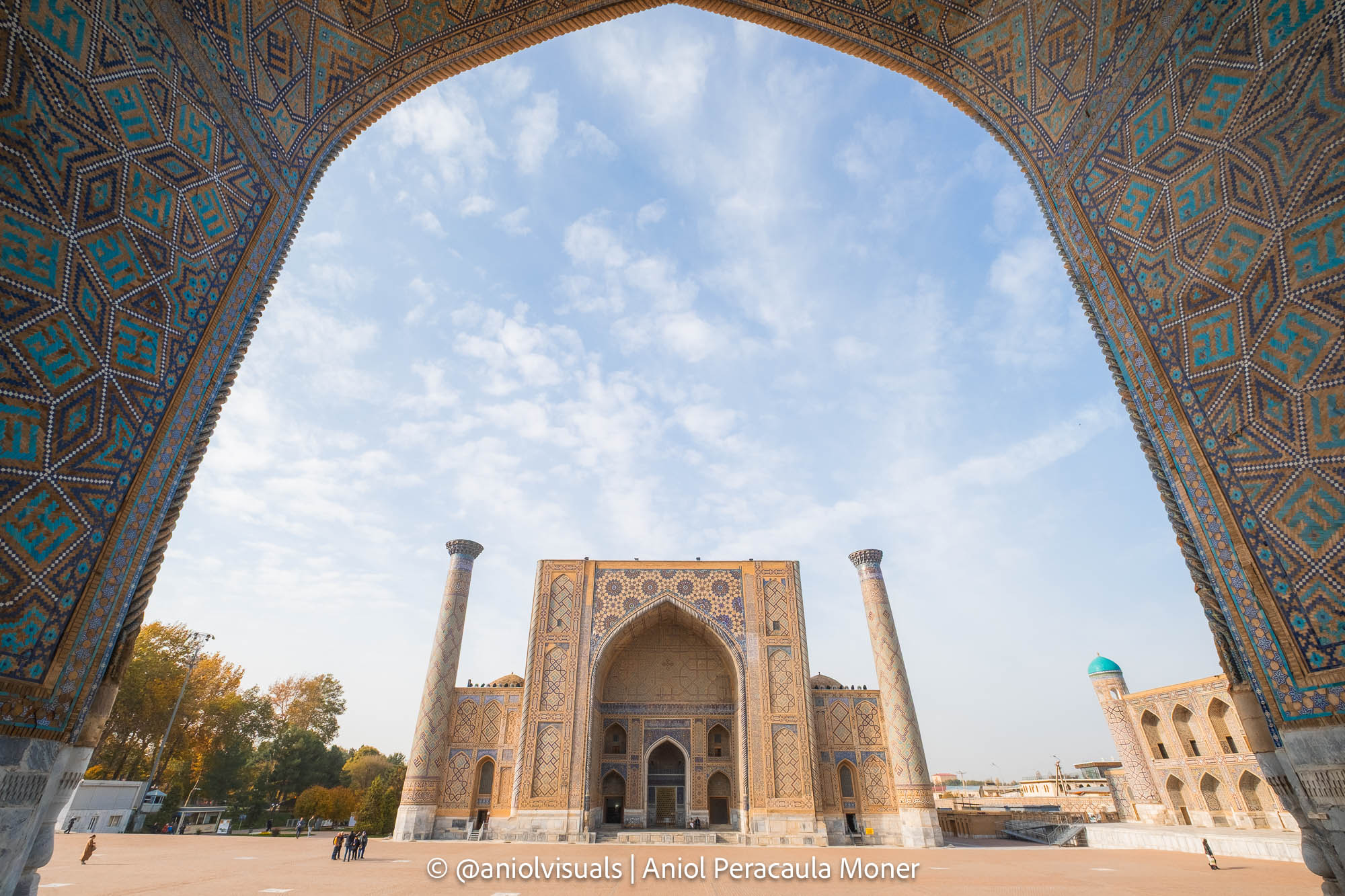
This is the madrasah at the end of the square, and the one with the most beautiful interior (possibly one of the most beautiful interiors in all of Uzbekistan, not just Samarkand). The patio of the madrasah is full of small shops selling silk products, crafts,… but what makes it among the best Samarkand photography spots is the interior chamber with the golden dome.
For shooting at this madrasah (and any other), you’ll need a good wide-angle lens. I had a 10mm, and still in some areas, I felt I needed a bit more. Make sure to check all the interior spaces of the madrasah, even the small stores located inside the chambers on the patio. Even if you are not planning to buy anything, it’s nice to see their interiors.

Sherdor Madrasa
This madrasah is the one on the right. It’s very easy to recognise because of the two lions/tigers on the façade. This is what makes it the most beautiful of the three to shoot from the exterior, in my opinion.
The madrasah has two minarets on the side. Officially, it’s not possible to visit them. However, while I was shooting in the rain, one of the security guards approached me and offered to let me climb to the top for around 50.000 SOM. I denied, but if you are curious about it, you could approach someone and ask if there’s a chance to get to the top (unless it’s not a thing anymore when you visit).
Shah-i-Zinda
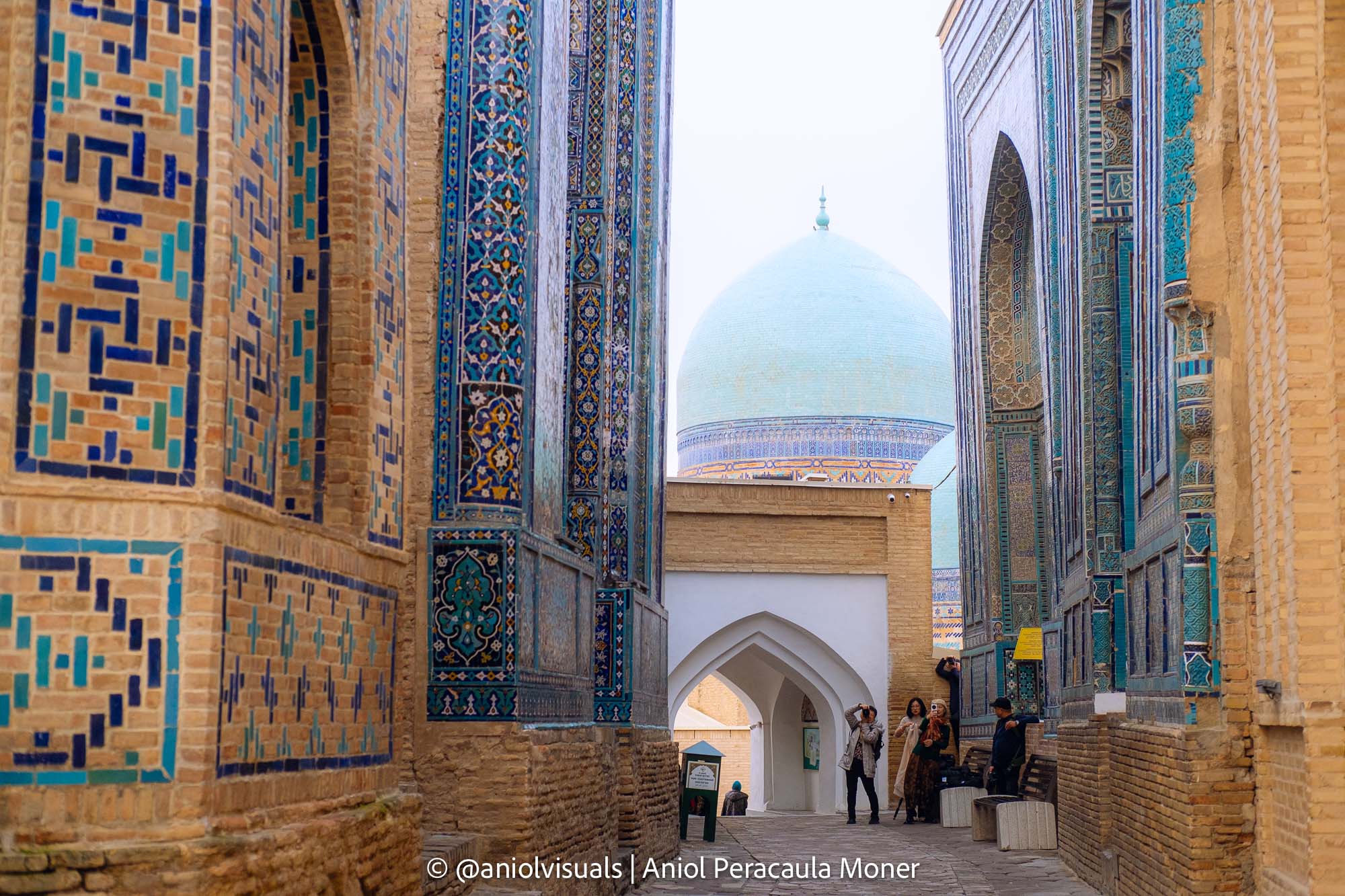
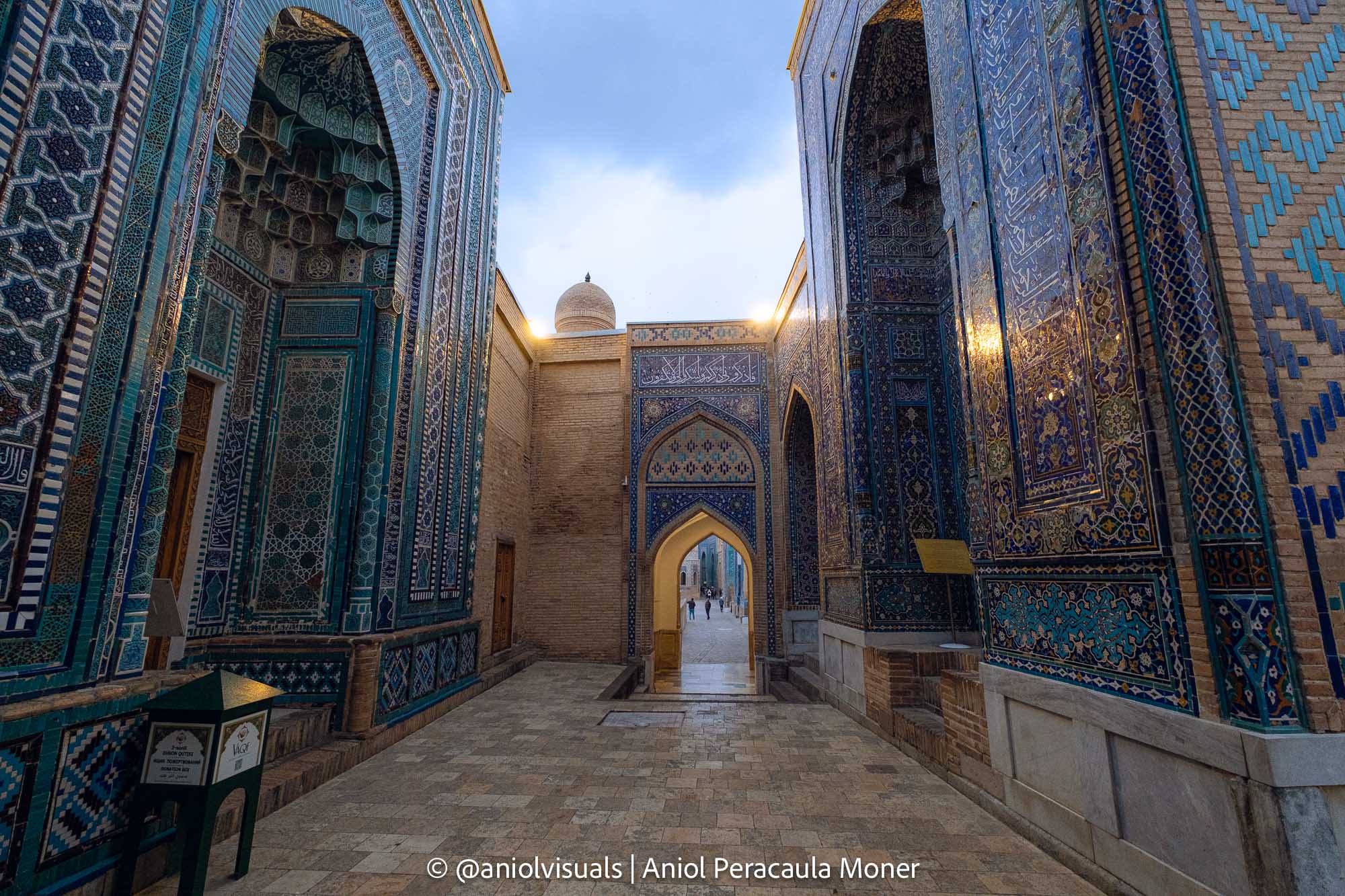
This is one of the two best Samarkand photography spots. I might even prefer it to Registan Square. Shah-i-Zinda is a necropolis, located in the northeast of the city, quite close to the Bazaar (see below). After paying the ticket to visit it, you’ll start climbing some stairs until you arrive at a long path with multiple mausoleums.
At the end of the path, there’s my favourite place to take photos in Samarkand. 3 mausoleums, facing each other, and if you turn around, a perfect arch and view over the rest of the mausoleums.
Shah-i-Zinda requires some time to visit. I recommend getting there before sunset and staying at least until the blue hour. When the mausoleums are lit up, the blue tones are even more impressive, and it’s possible to take amazing photos.
The downside is that it’s not a large area, so if there are groups visiting, you’ll either get people in your photos or need to wait for the right moment. Don’t miss the interior of any of the mausoleums; you can take great photos there.
Beware that there’s one specific point where no photos are allowed. It’s one mausoleum, and it’s clearly indicated. I couldn’t choose only one photo of Shah-i-Zinda. Below you can see why it is one of the best Samarkand photography spots.
Siyob Bazaar
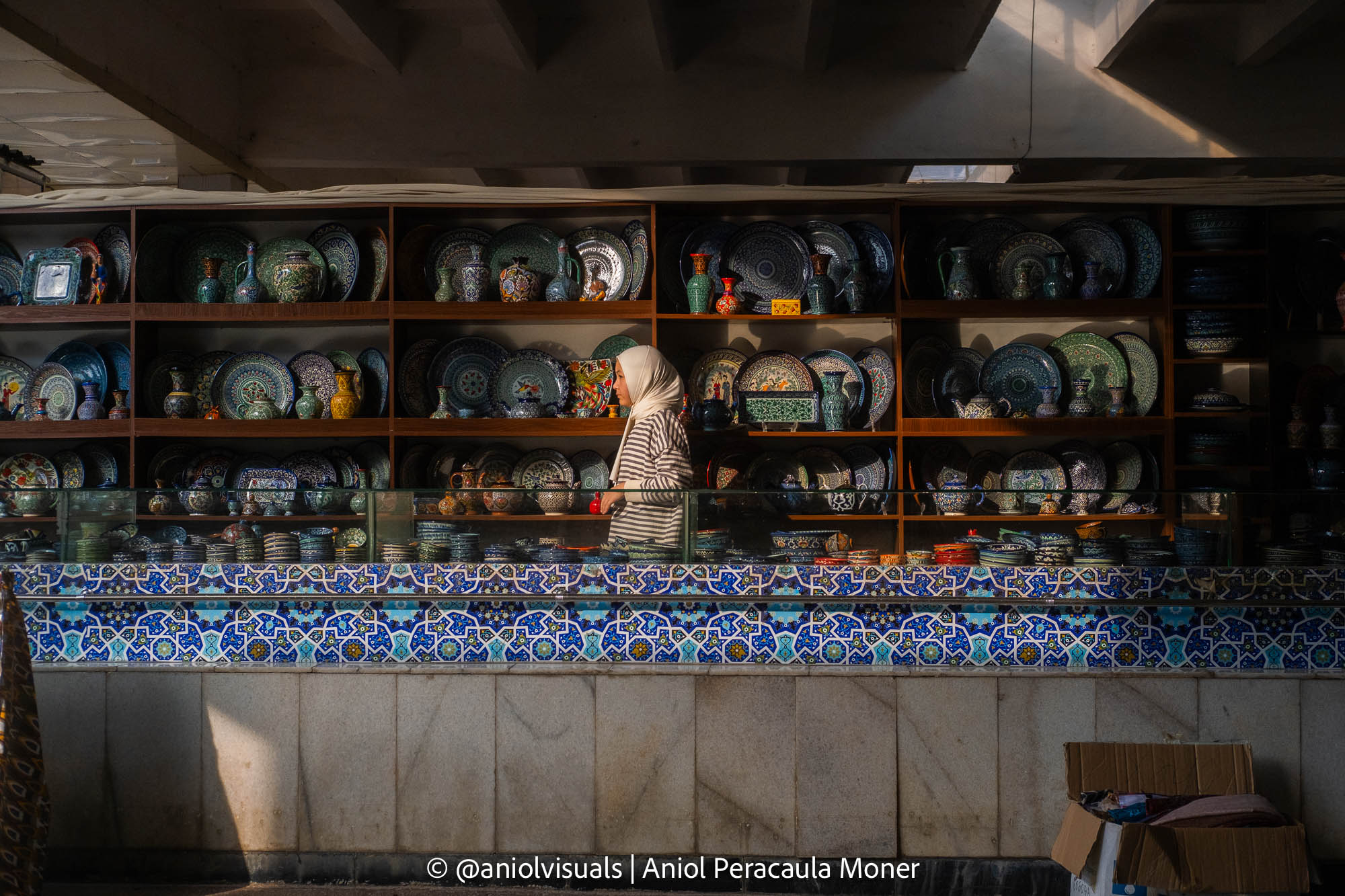
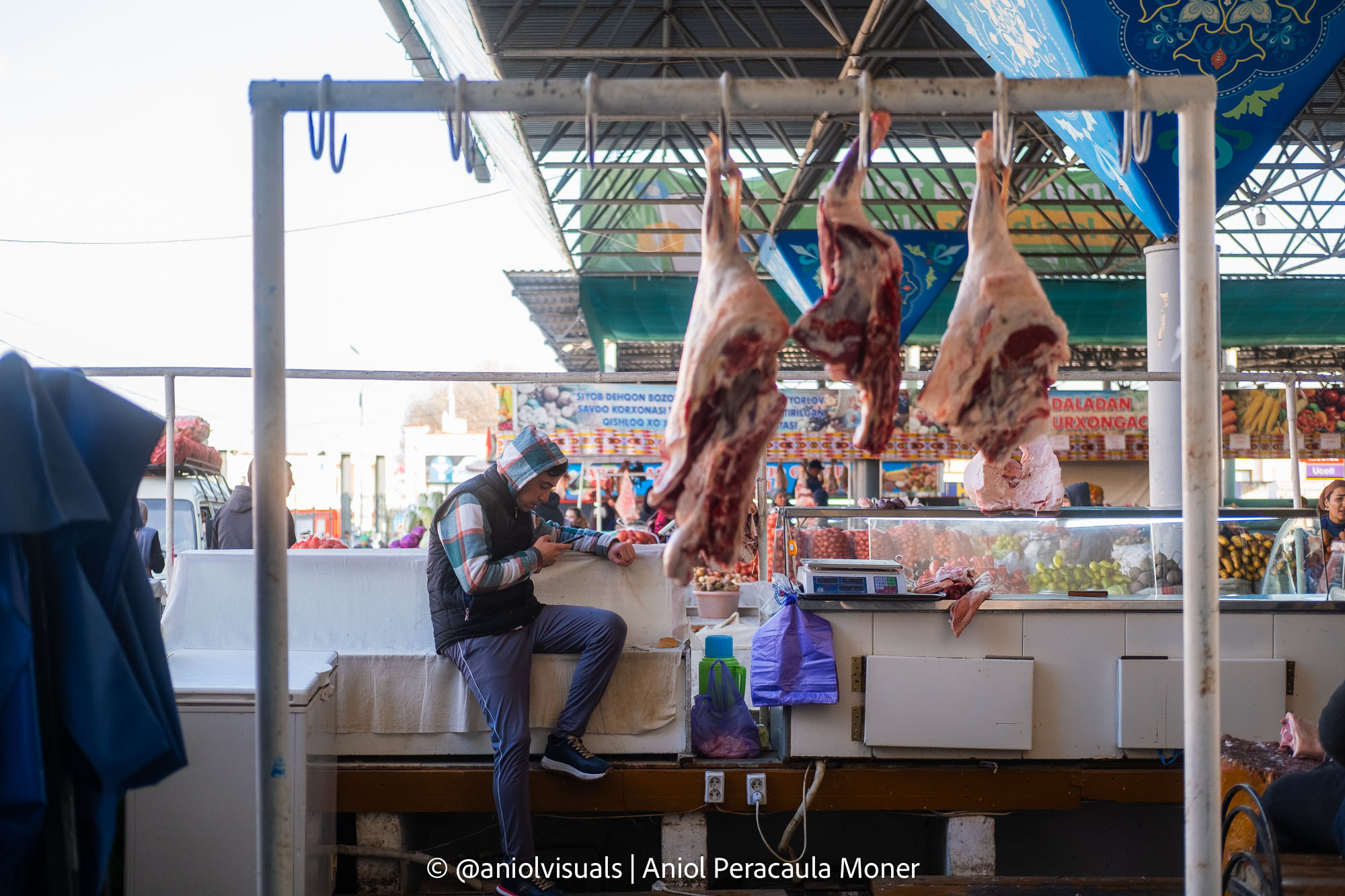
If you read any of my other Uzbekistan photography guides, you’ll see that I mention bazaars in almost all of them. Unlike other places in the world, where markets at the heart of the city are now tailored only to tourists, in Uzbekistan, they are still catering to locals. The Siyob Bazaar has two parts: the one where they sell products to tourists, and the part where locals go to buy fresh products. The part I recommend in this Samarkand photography spots guide is the second one, but don’t overlook the first one.
An area of the market I really enjoyed visiting (and photographing) was the dairy products section, where you could see all the different types of kurt balls, a very typical food/snack in Central Asia.
Another cool thing to photograph is the famous Samarkand bread. I first learned about it when I was on the 16h train from Tashkent to Nukus. The moment the train stopped at Samarkand, everyone in the train hopped off to buy some Samarkand bread. The people I was sharing a sleeping compartment with made me buy one, and I ended up with bread for days. It has a really characteristic shape. Bread is like a religion in Uzbekistan, so make sure to check it out.
Ruhabad Mausoleum
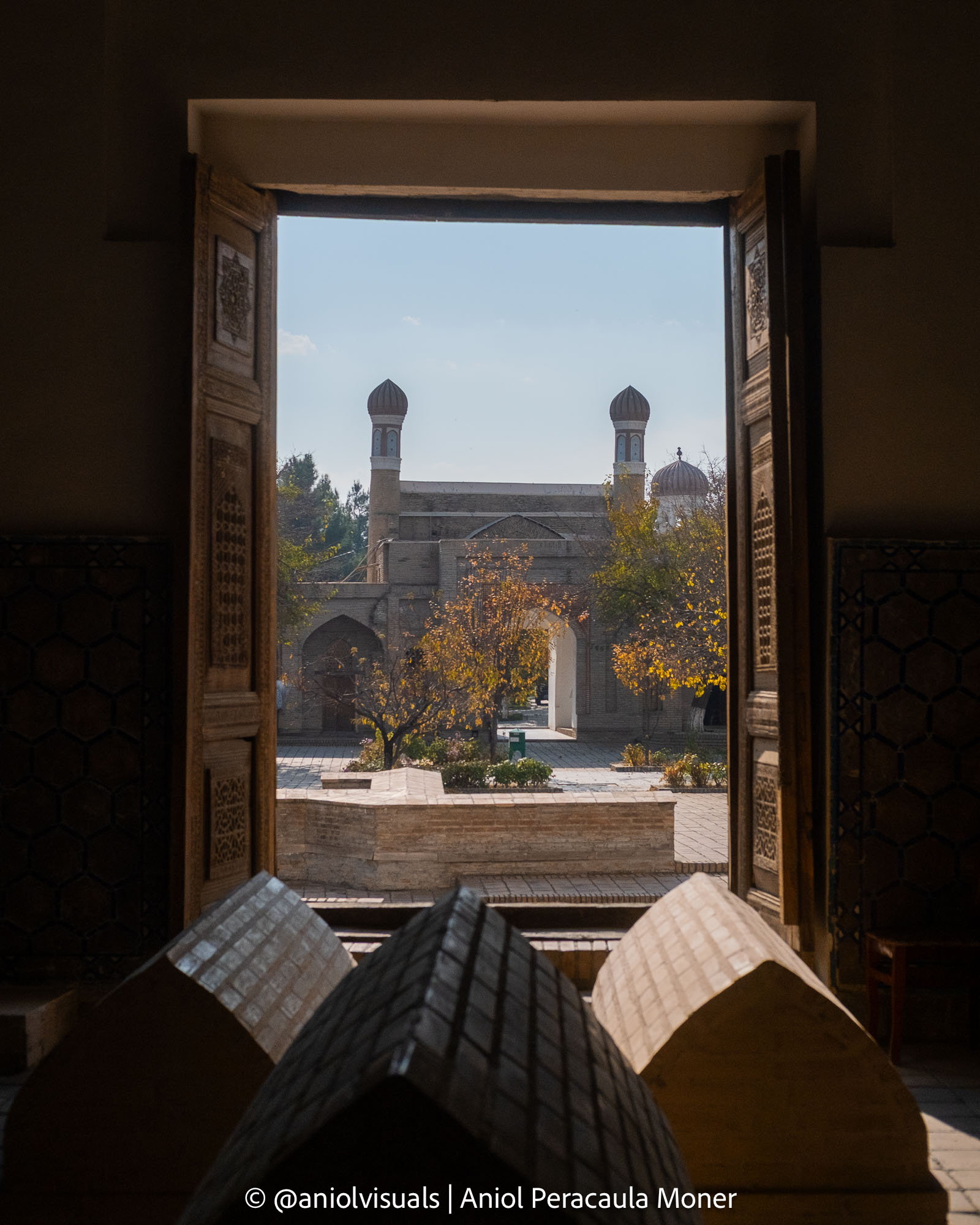
The next two Samarkand photography spots listed in this guide are really close to one another. This is the least impressive of the two. Yet, I include it because I think it has a really interesting photo opportunity. The Ruhabad Mausoleum dates back to the 14th century, and it’s a very humble structure, with a few tombs inside.
However, I found the photo from the interior, with the 3 tombs, very interesting, which is why it is listed here. If you decide to skip it, though, do not skip the next element on the list, which is next to it.
Gur-e-Amir Tomb (Mausoleum of Amir Temur)
The name of Amir Temur is everywhere in Uzbekistan. As a European, I had only overheard his name. My time in Uzbekistan told me a lot about him. He was a conqueror, and his empire, with Samarkand as its capital, ranged from Turkey to India and Pakistan, including all of Central Asia, and had connections with many other nations.
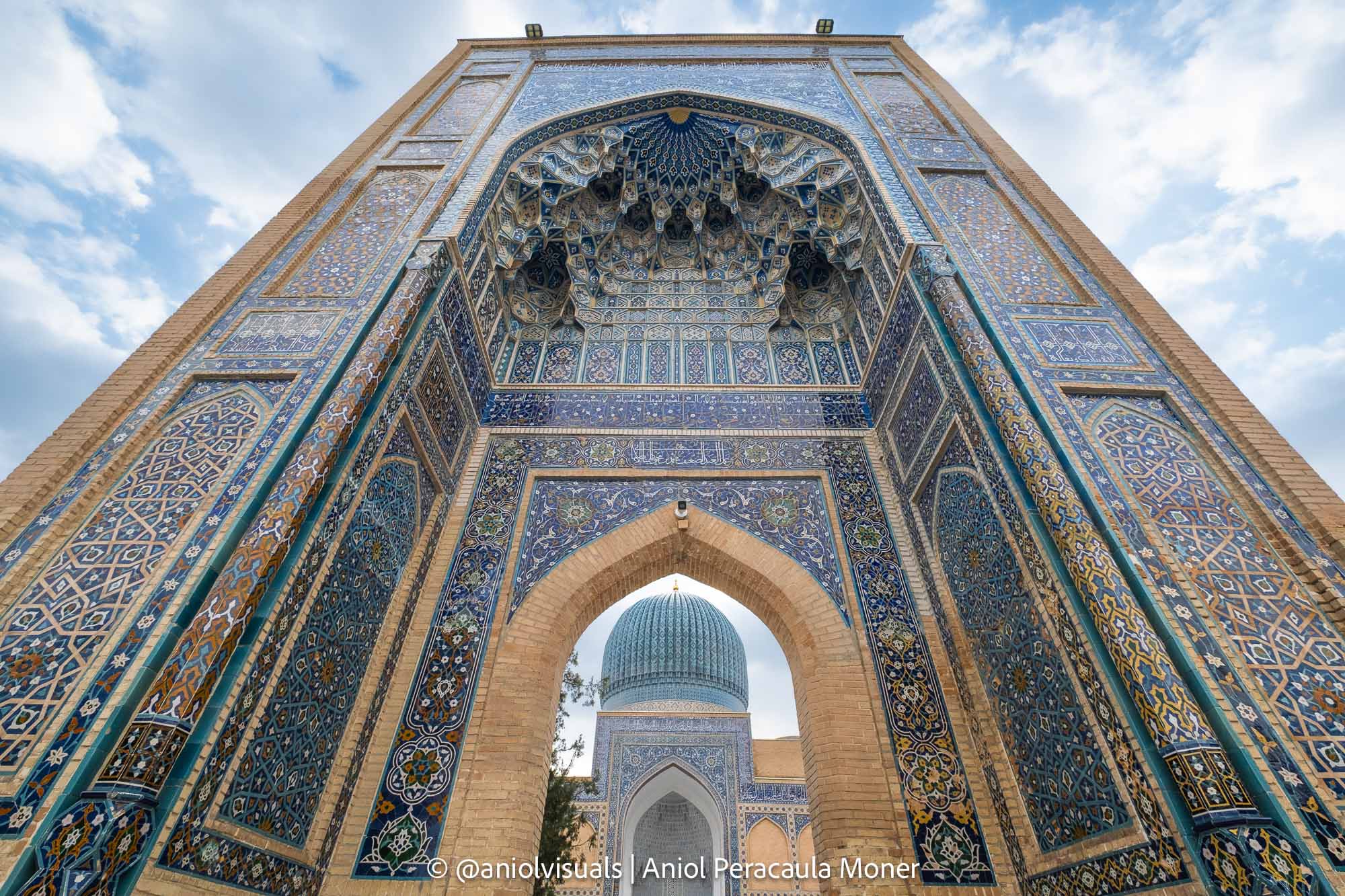
Amir Temur is a really important figure in Uzbekistan, and his mausoleum is in Samarkand. Also known as the Gur-e-Amir tomb, this is one of the best Samarkand photography spots. The whole mausoleum area is impressive, but the interior of the room where Amir Temur is buried is the main highlight.
As an interesting fact, while Temur is buried there, most of his family is buried in Shah-i-Zinda, the other mausoleum in this list. This mausoleum is impressive but has fewer things to explore compared to Shah-i-Zinda, which contains more tombs and smaller mausoleums.
It’s one of the most visited spots in Samarkand, which makes it a bit tricky if you want to recreate some of the photos online, showing the arches of the mausoleum without anyone in front of them.
Street life
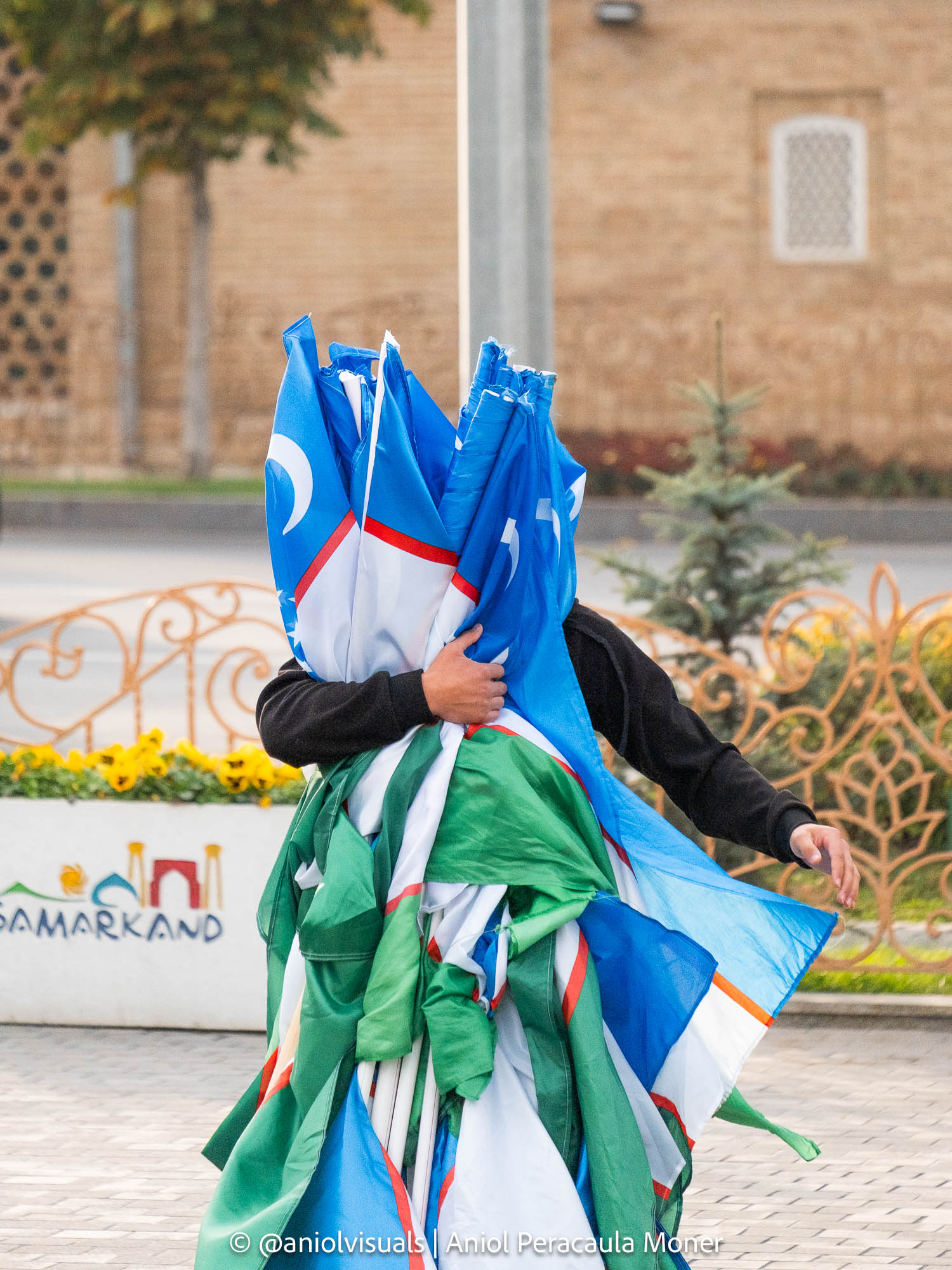
Compared to other cities in Uzbekistan, like Khiva, the area of Samarkand where most tourist attractions are is also home to many locals. They live, work, and walk there, which generates great opportunities for street photography.
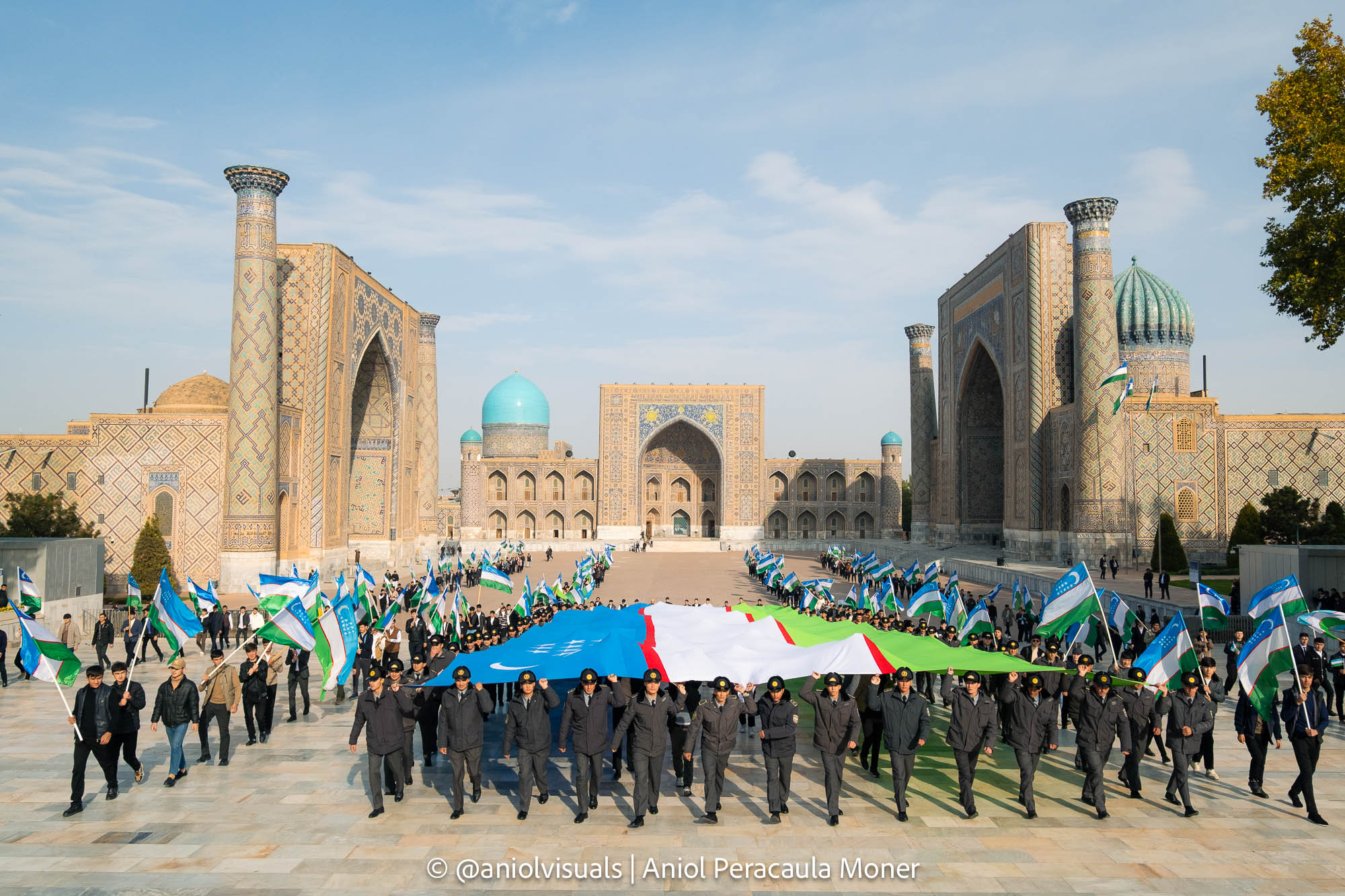
I was lucky to be in Samarkand on National Flag Day. Besides an impressive military show in Registan Square, I found many other street photography opportunities, not only on that day but also on the other days I was in Samarkand.
Most guides don’t list street photography as a Samarkand photography spots or opportunity, but keep your camera ready. Samarkand is much more than just the Registan and its main buildings.
Bibi-Khanym Mosque
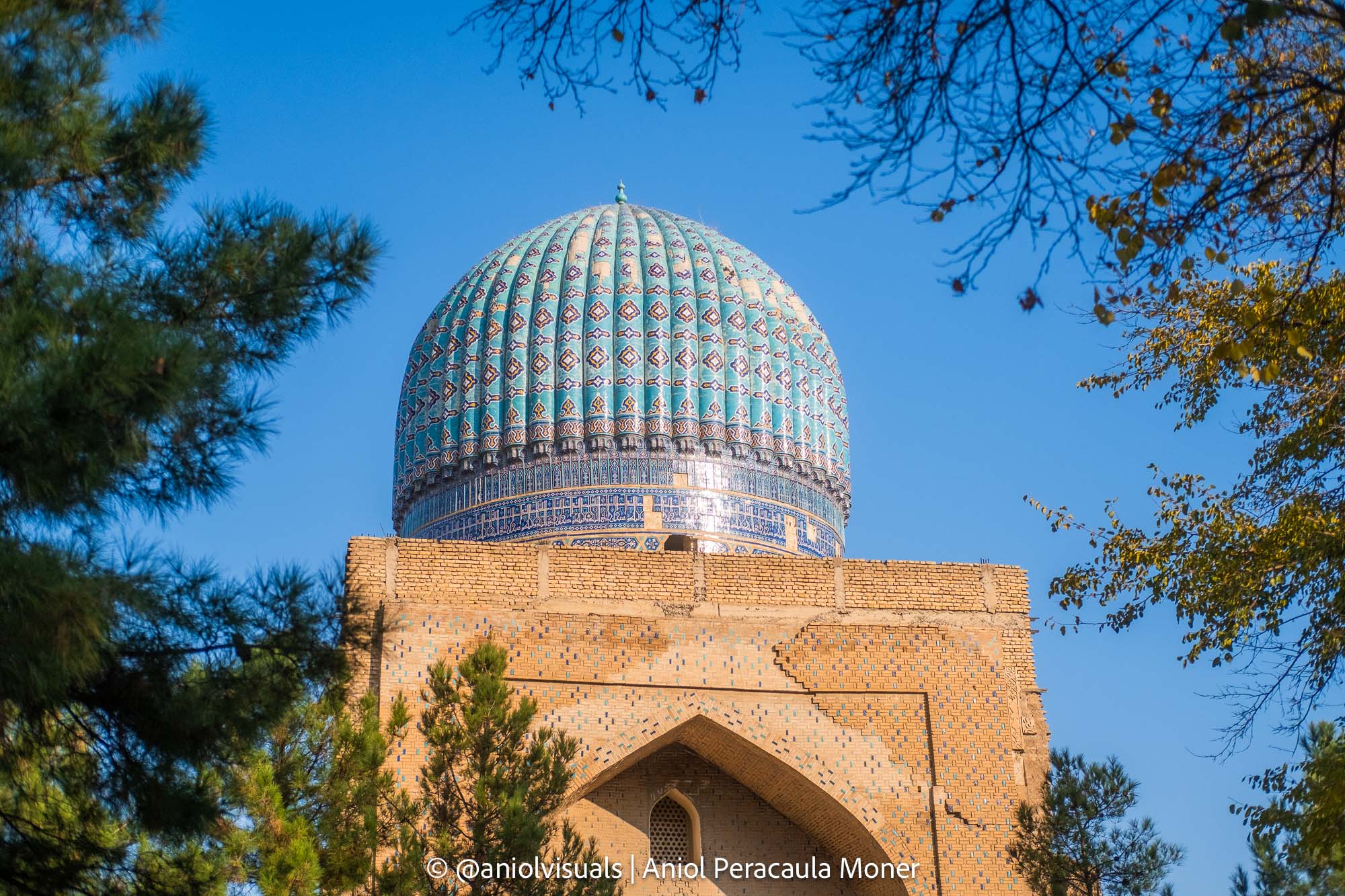
The last of the Samarkand photography spots in this list is the Bibi-Khanym Mosque. Located almost next to the Siyob Bazaar, it’s a must-visit. This ancient mosque, restored during the Soviet period, it ranks lower on the list for a simple reason: it’s really difficult to photograph.
It’s beautiful, it’s impressive, but I couldn’t find a great angle. The fact that it’s partially restored doesn’t help, as there’s an interior courtyard that partially blocks the full view. Nonetheless, the mosque is majestic and a must-visit. There’s a small fee to enter, but it’s worth it.
This concludes my Samarkand photography spots guide. If you want help planning your photography trip to Uzbekistan, you can schedule a call with me using the links below. Otherwise, you can follow my trips and find some travel inspiration on my Instagram (@aniolvisuals).
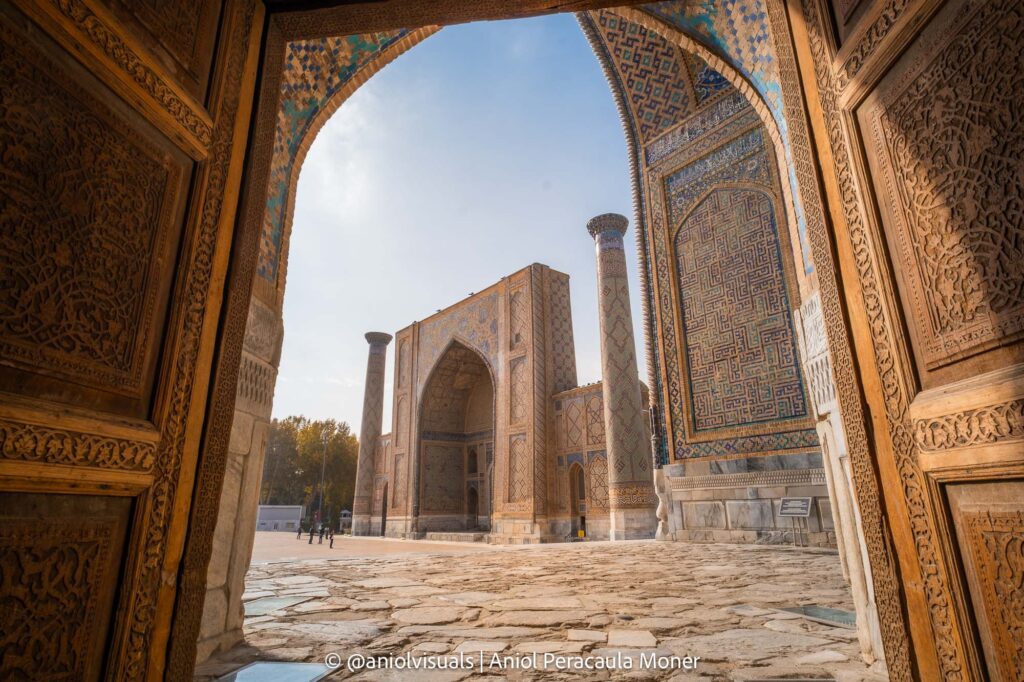
30+ best Uzbekistan photography spots: ultimate travel guide
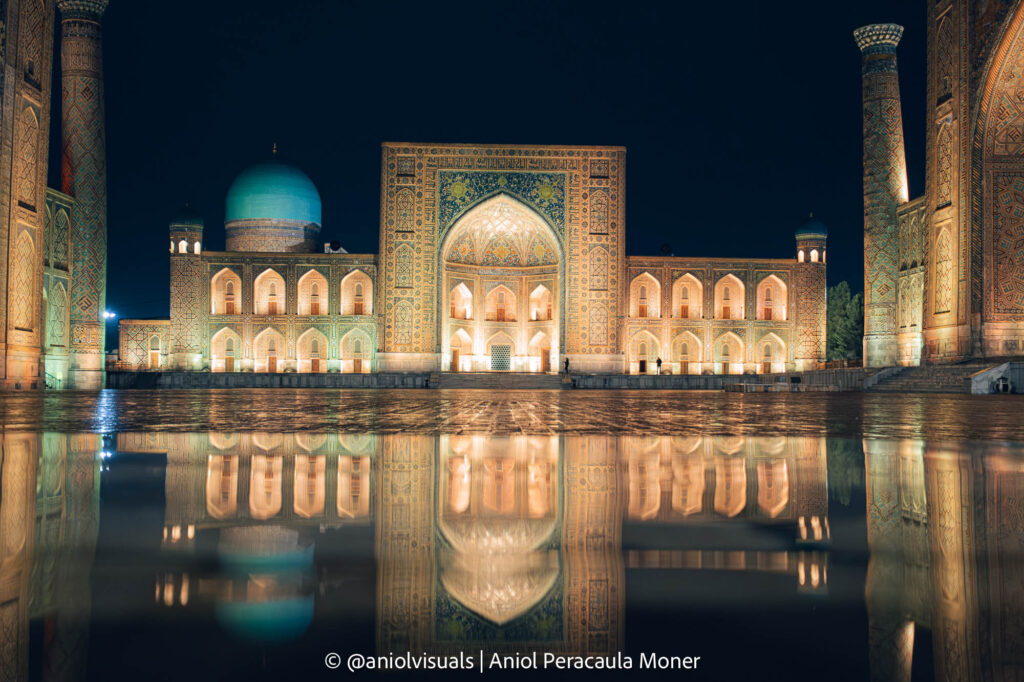
10 best Samarkand photography spots: a complete guide
18 best Bukhara photography spots: a complete guide
Best Khiva photography spots and photo opportunities: a complete guide
10 best Tashkent photography spots: an ultimate travel guide
Moynaq and Aral sea photography spots: a complete guide