Find the best Lisbon photography spots in this guide, created by a photographer who spent 3 months exploring the city!
I have been to Lisbon more times than I can remember. My first time was in 2017. One of my best friends moved there, and since then, almost every year, I have been visiting and photographing it. I fell in love with the city, and back in 2023, I spent 3 months living there, with one main goal: photograph Lisbon.
In this photography guide, you will find more than Lisbon photography spots. I have classified the city into areas, and for each of them I’ll share opportunities, best times ot visit, and of course specific photos you can take.
Got more questions? Schedule a 1-on-1 call with me, and get answers to all your doubts. Like ChatGPT, but with a human being!
Alfama photography spots
Alfama is the heart of Lisbon. Its cobblestone streets, narrow alleys and trams are what I think of when someone says Lisboa. There are endless photography spots in this rather small Lisbon area, but in this list, you will find a selection of them.
Sé de Lisboa
One of the first things you will see in Alfama will be the Sé de Lisboa or Lisbon Cathedral. I have a soft spot for religious buildings. What makes this one interesting is that it can be seen from multiple places. First, from the long uphill street that goes to its door. The view differs a lot depending on where in the street you are.
Moreover, its interior is also worth it, although if I had to choose, I’d stay with the exterior. If you visit some of the viewpoints over Lisbon from the side of Chiado and Barrio Alto, you’ll see how the Cathedral is a very prominent building in the “skyline” of the city.
Trams
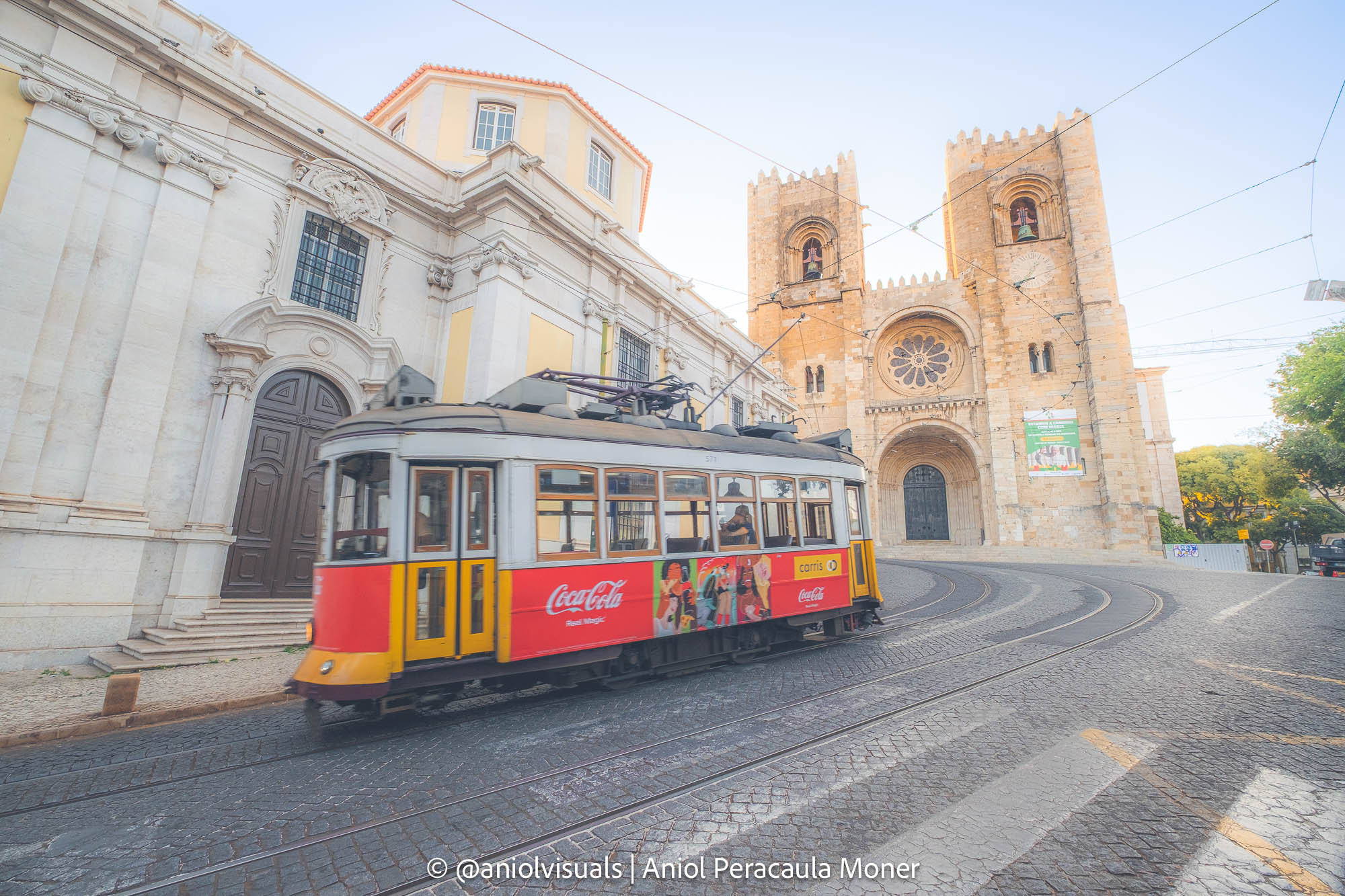
To me, Alfama is about trams, and trams are some of the most well-known Lisbon photography spots. They are everywhere, and it’s one of the greatest places to take photos of them. There is one specific street (see next spot) that I love, but in general, keep an eye out for trams while in Alfama.
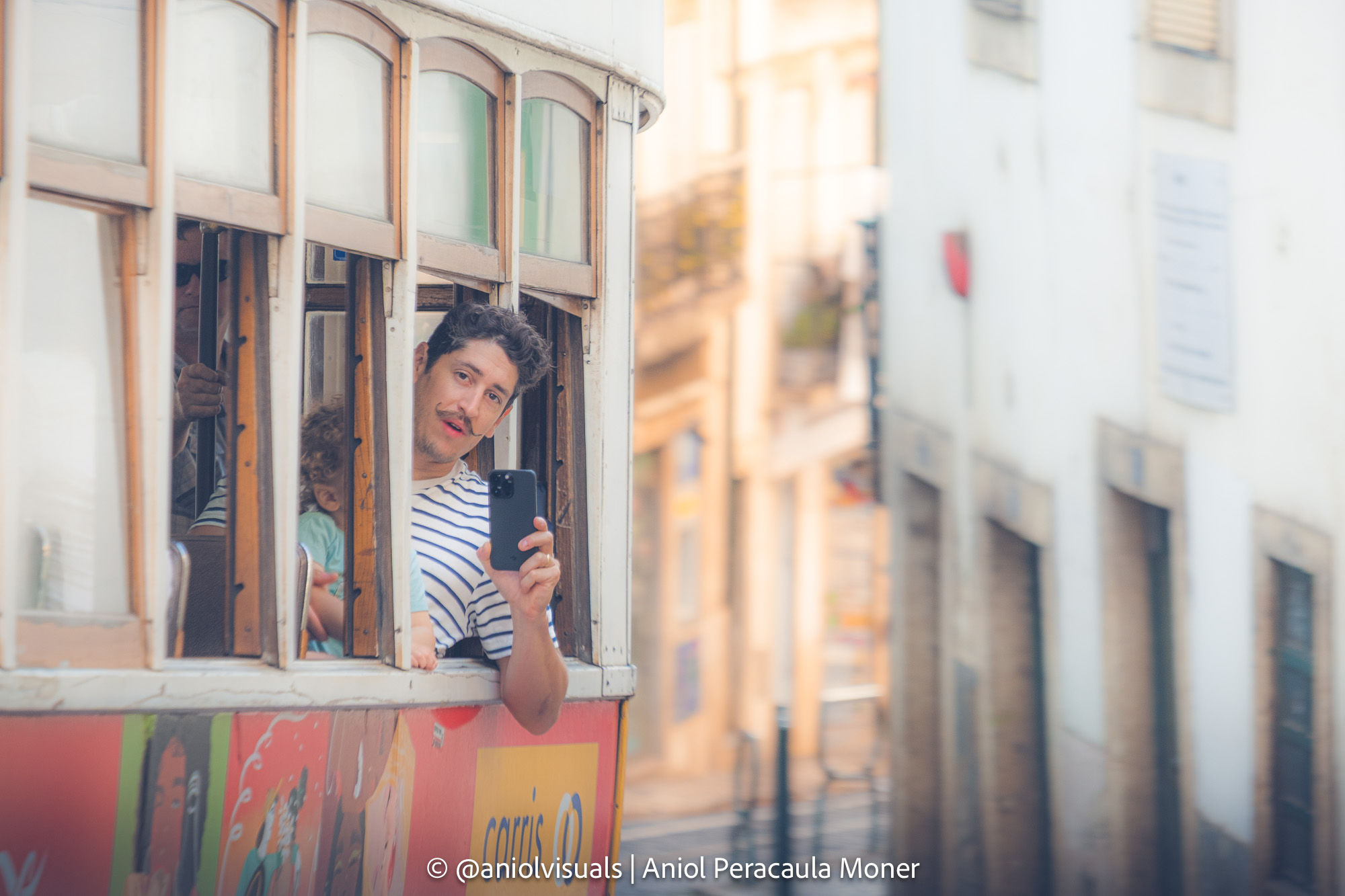
The cool part about trams is that you know exactly where they will be, so you can be ready and compose the photo for the right moment. However, don’t focus only on the tram itself. I particularly enjoy taking photos of people riding the trams, mostly tourists, like in the photo below.
Calçada de São Vicente
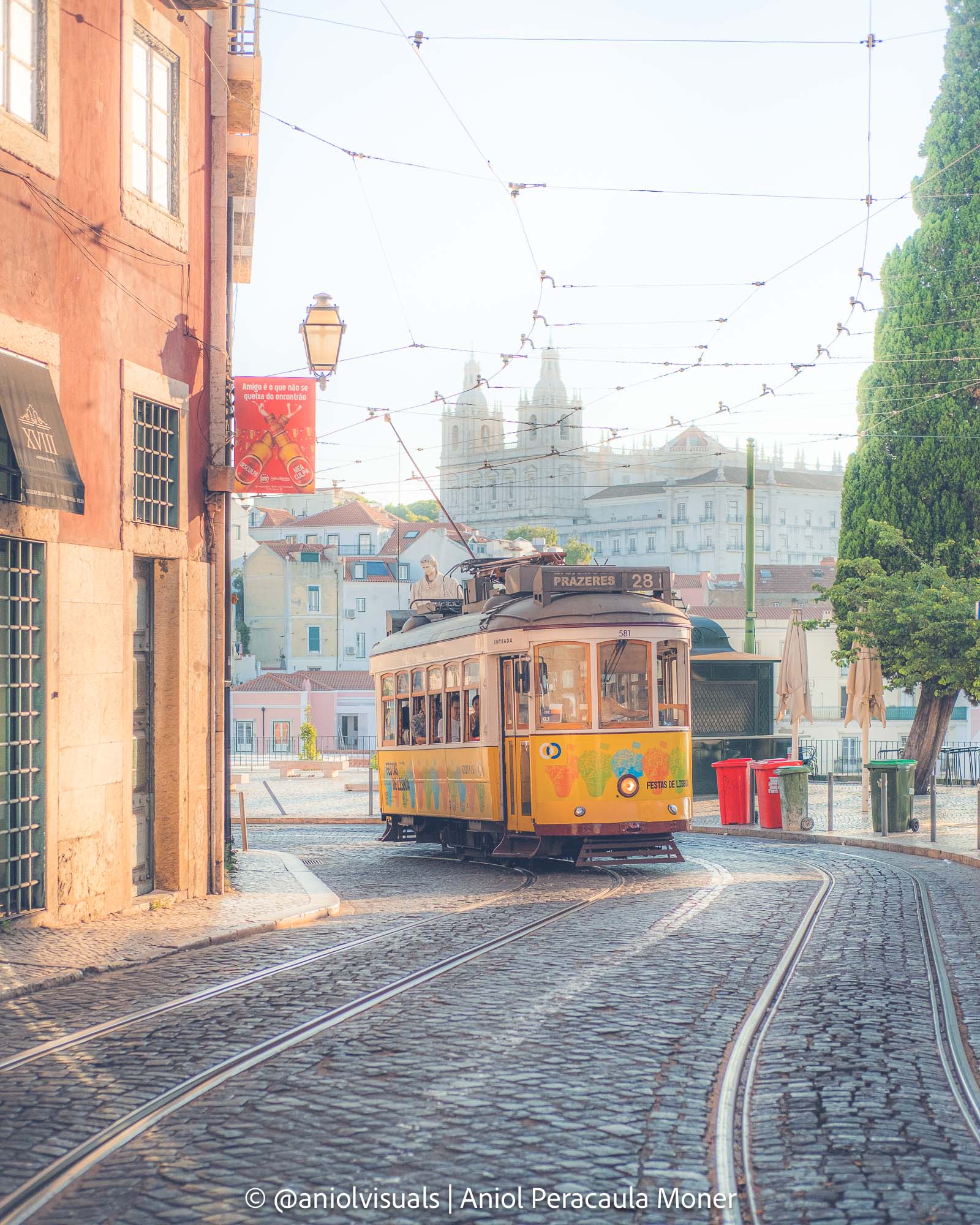
This is one of my favourite spots for tram photography in Lisbon. But not only for trams. In general, I found this street extremely photogenic. The only catch is that to take good photos there, you have to wake up very early. And by very early, I mean around or before sunrise. Not that the street changes after it, but that’s when tourists go out.
Waking up early is essential if you want to visit some of the Lisbon photography spots listed in this guide.
Alleys
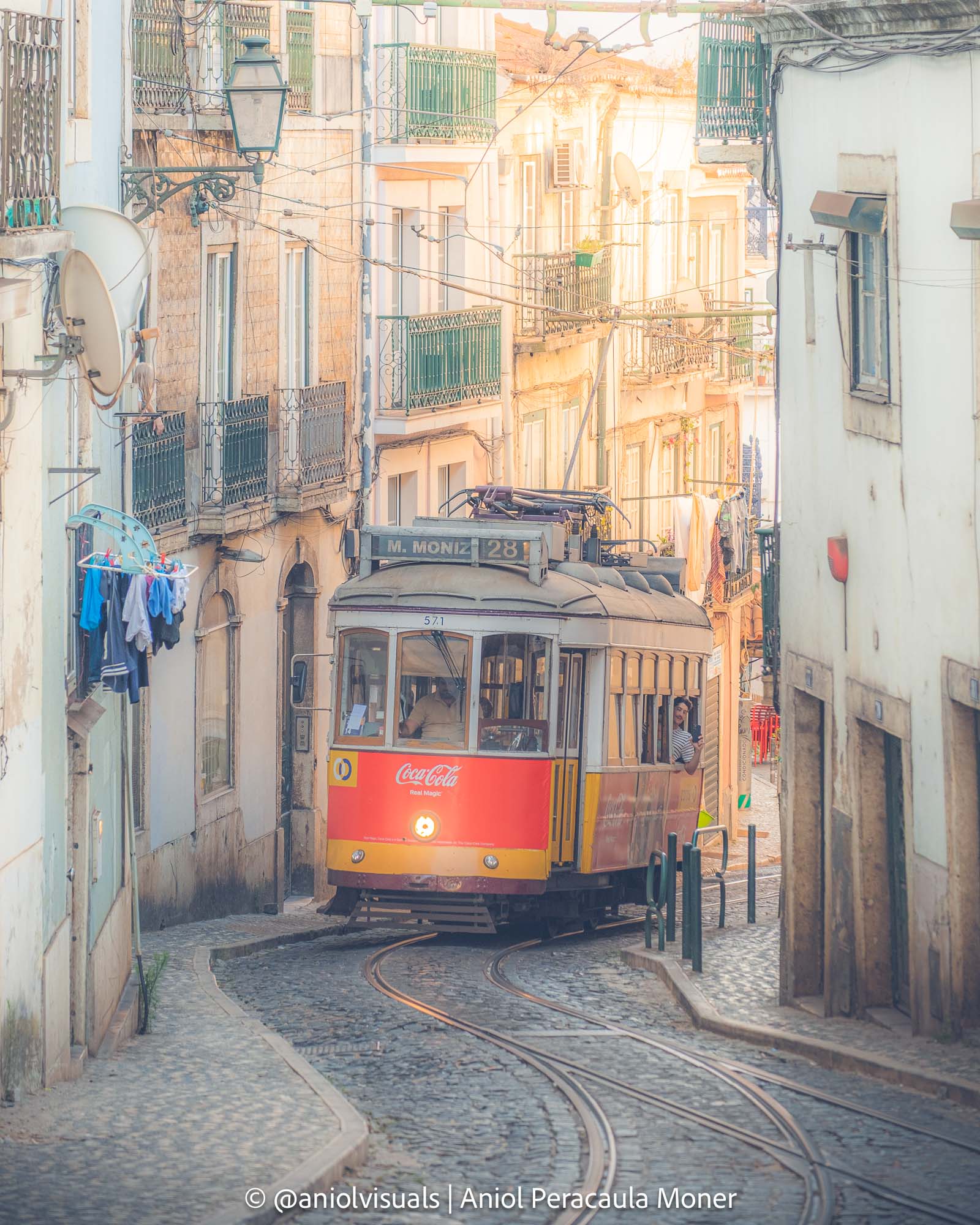
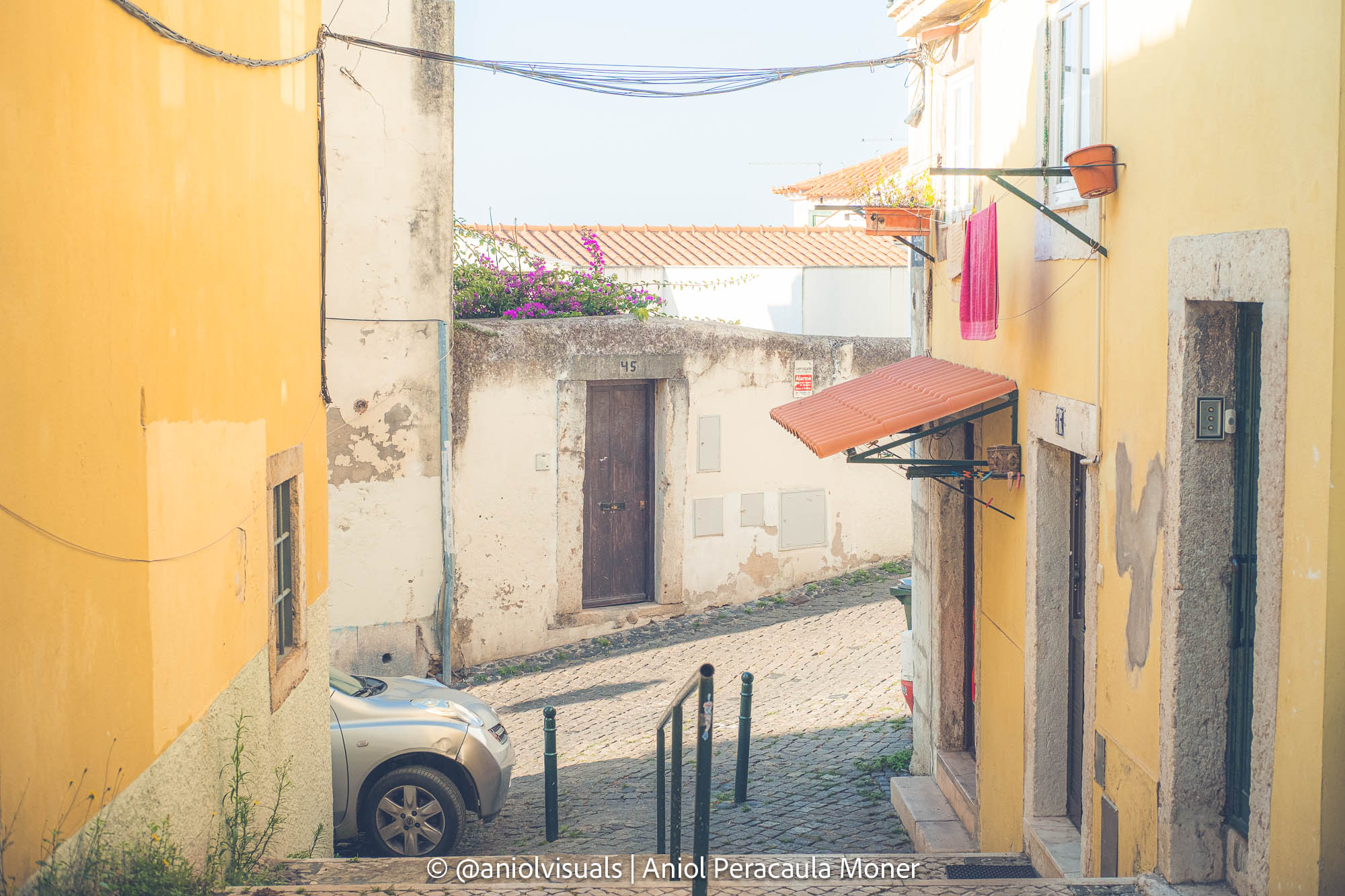
Alfama is all about the trams and the alleys. Being such a hilly neighbourhood, this means there are a lot of narrow and steep alleys, which are perfect for street photography. In fact, Alfama might be the best area for street photography in Lisbon if you are looking for a more traditional vibe. Shadows and light, drying clothes, colourful streets…
I don’t have a specific alley to share. Just walk around, get lost and be ready with your camera.
Miradouro da Santa Luzia
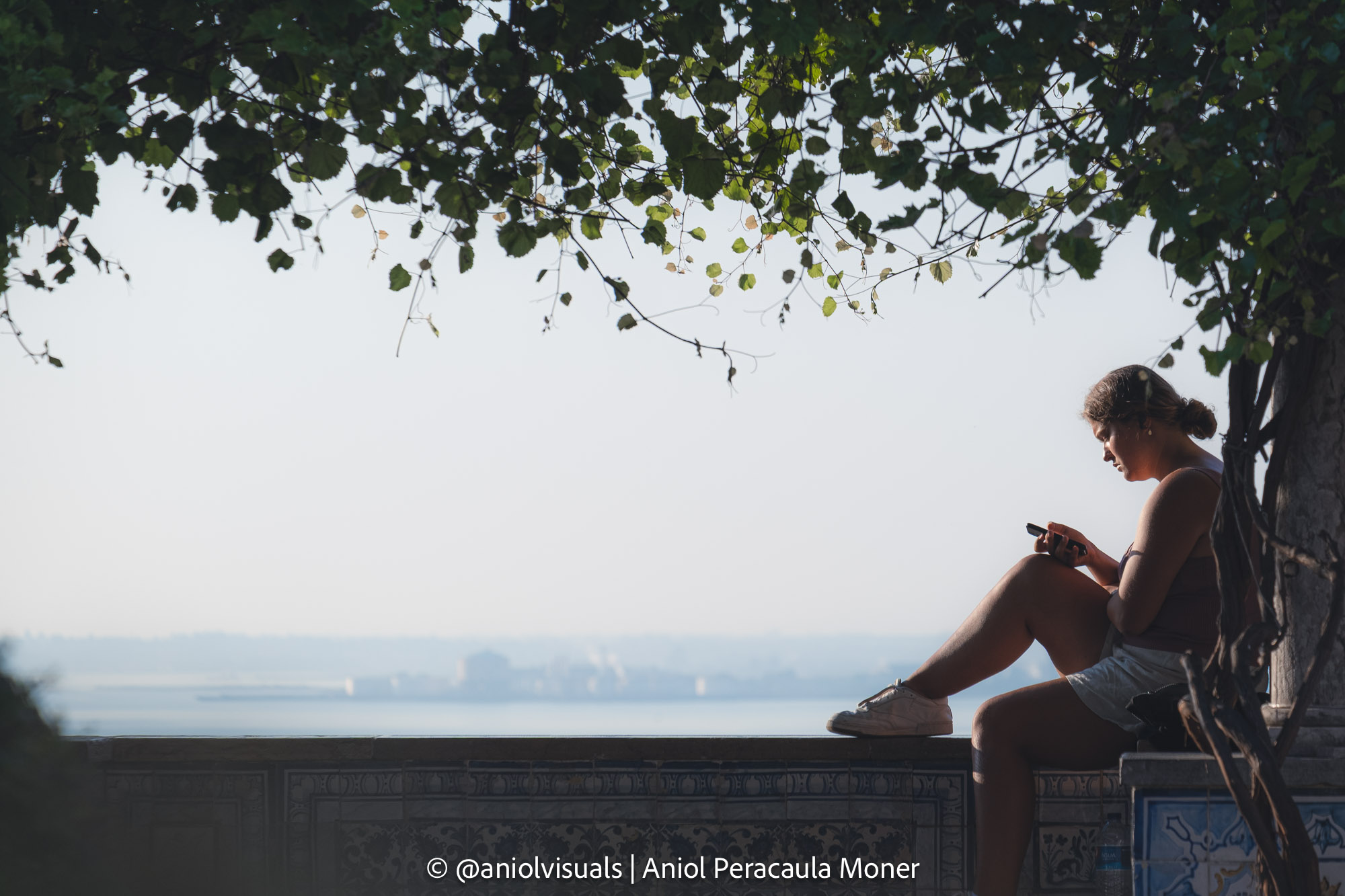
There are many viewpoints in Alfama (and in Lisbon). However, in this section, I only mention two of them, and they are quite close to one another. The Miradouro da Santa Luzia is one of the most famous in the city, and an amazing Lisbon photography spot.
At daytime, it’s full of tourists and tours, people enjoying the views over the city. While the views are nice, I also enjoy taking photos of the people at the viewpoint. From the early morning visitors looking for a bit of silence, to the ones who are seeing the views over the city for the first time.
Beco de Santa Helena
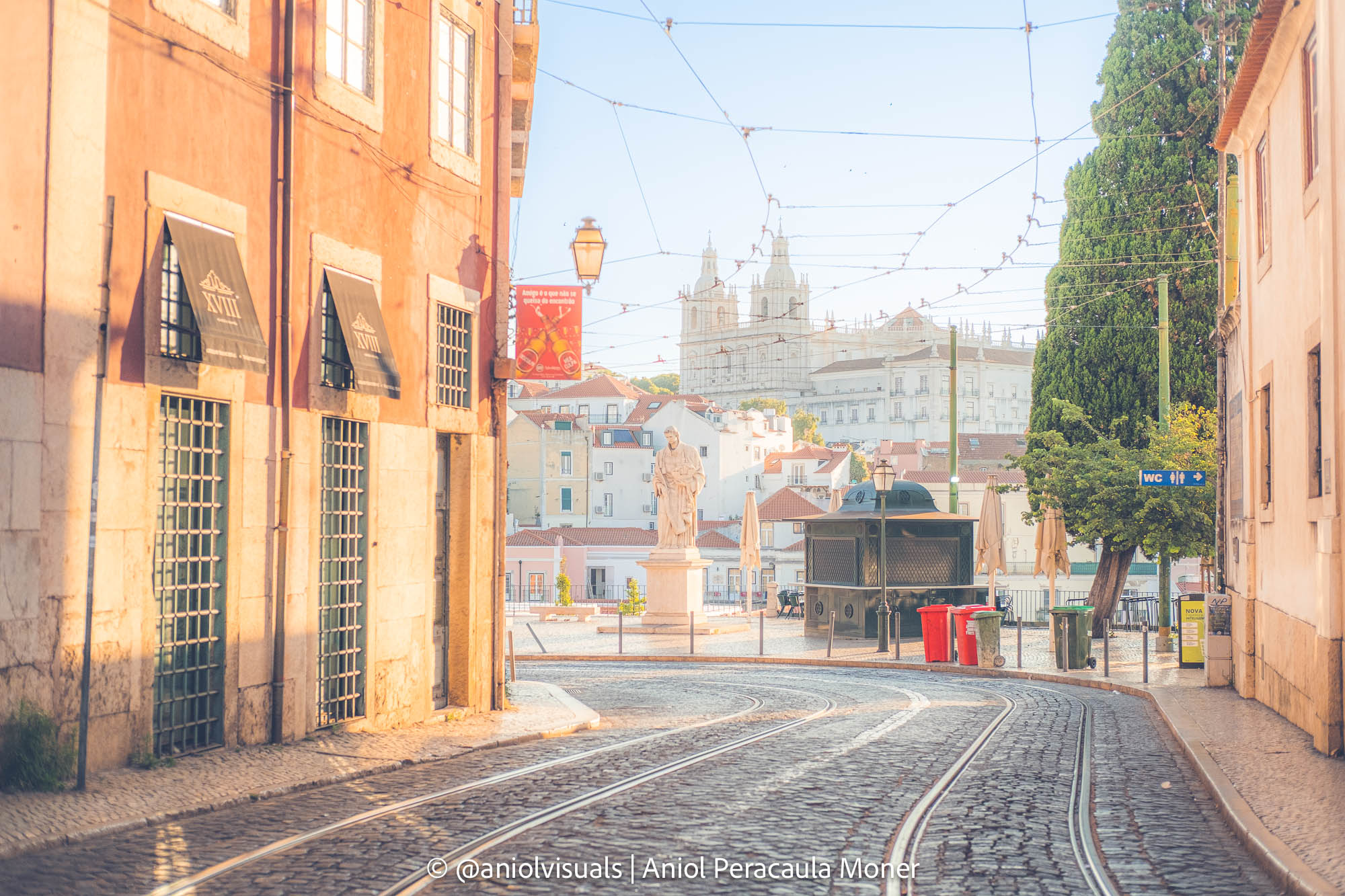
The second viewpoint over the city is at Beco de Santa Helena. I chose this one because, in my opinion, the views are better than at Santa Luzia. Or at least, more unique. This is because from there you can see the Mosteiro de São Vicente de Fora, a beautiful Monastery that can be used as an interesting object in some photos. Moreover, it’s a quite frequented area, and early in the morning, it’s possible to take slightly different photos like the one below.
From all the Lisbon photography spots listed in this guide, this is the one where I took my favourite photos. Again, though, wake up early for photos like the one below.
Other viewpoints
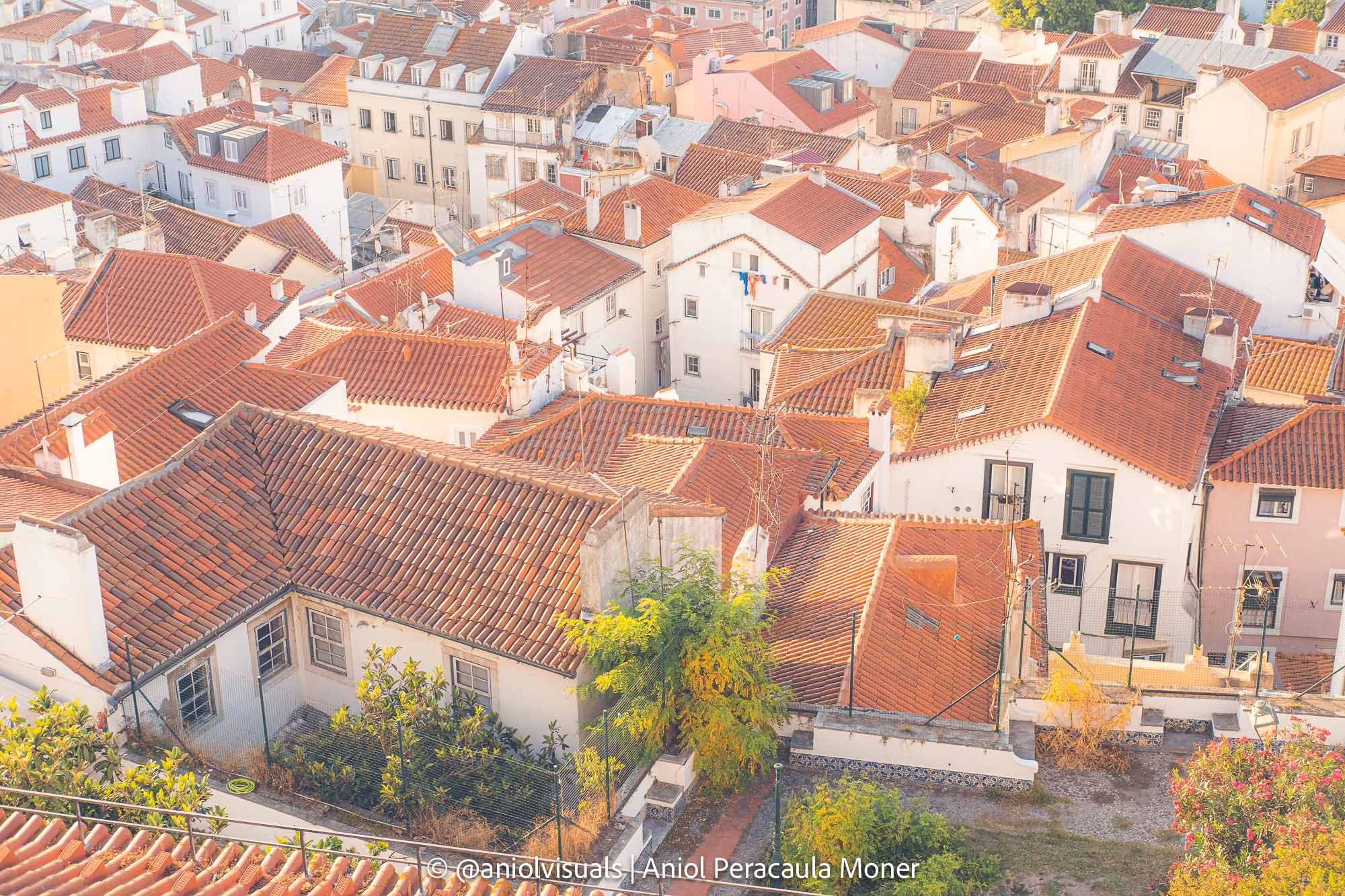
I don’t like listing spots for the sake of making the list longer, so I will not be mentioning all of them here. However, most of them are worth it, although the best view will depend on personal preferences. These are other viewpoints that are great for photography in Alfama:
- Miradouro da Senhora do Monte
- Miradouro da Graça
- Miradouro das Portas do Sol
- Miradouro do Chão do Loureiro
- Santo Estêvão Belvedere
All of them make good Lisbon photography spots, but it’s true that the views from some of them are similar. As a rule of thumb, if you want to see a sunset from them, the higher and more difficult to reach, the quieter they will be.
Alfama Festivities
This is not a spot per se, but a photo opportunity, as this Lisbon photography spots guide goes beyond single spots.
Spending multiple months in Lisbon (during the summer), I had the chance to enjoy the festivities of most neighbourhoods. Among all of them, the one I enjoyed photographing the most was the Alfama one. The streets are decorated, and at night people gather to drink, eat and dance.
However, what I really liked was how the area felt different during these days. The streets had a distinct flair, and it was possible to take different photos. Maybe you don’t get to visit during the Festivities of Alfama, but if during your time in Lisbon, you hear or see that an area is celebrating, go there. Besides traditional food at affordable prices, you’ll get to see a way more authentic Lisbon side. Bonus points if the festivities are not in the city centre.
Panteão Nacional
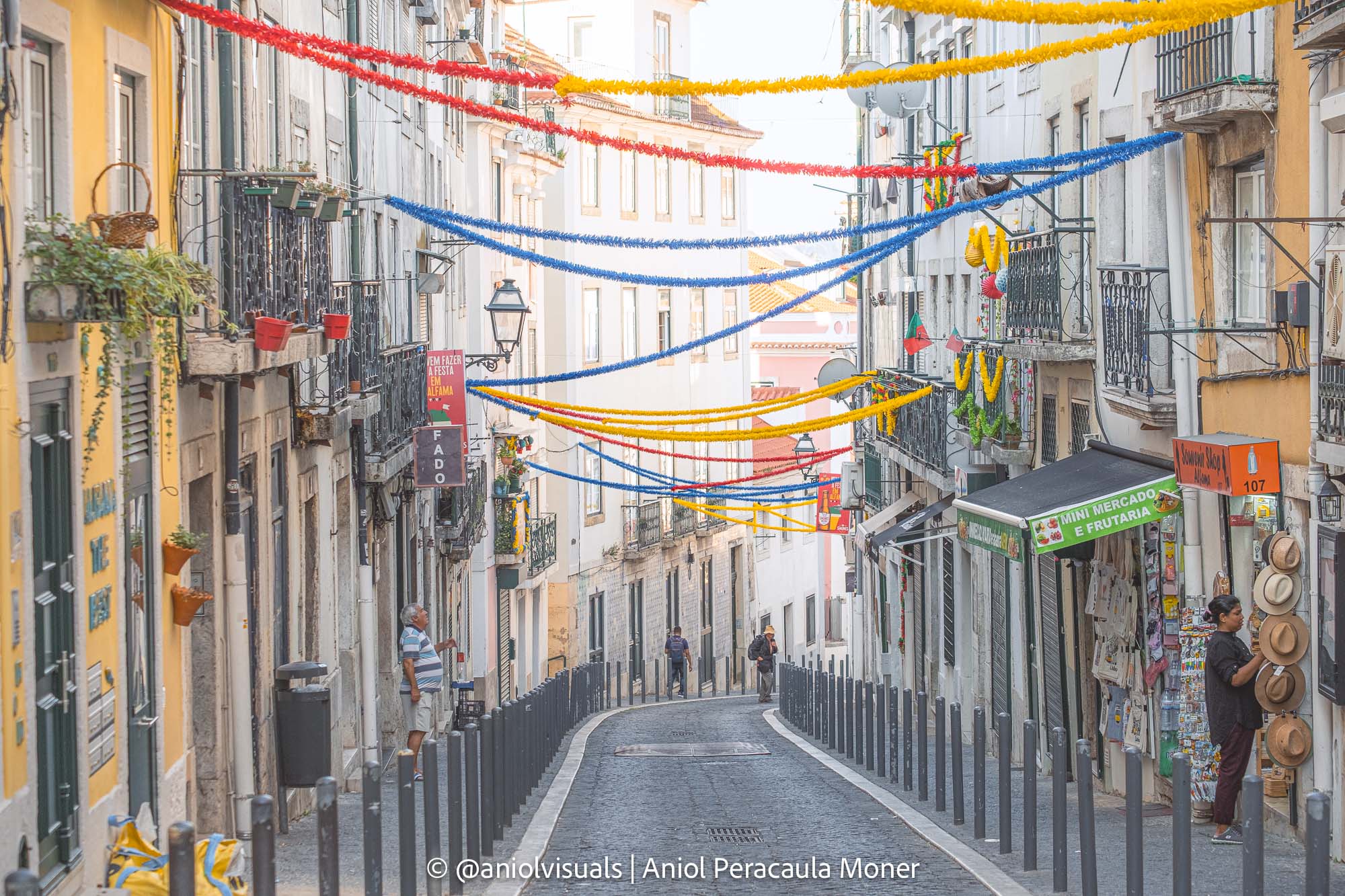
The Panteão Nacional or National Pantheon is technically not in Alfama, but it’s next to it. This is another of the buildings you will see from everywhere in the city. Inside, you can find some famous people buried, including Eusebio, one of the most famous Portuguese football players of all time.
The Pantheon is interesting both from the inside and the outside. However, as with most tourist attractions, you’ll need to pay to access it.
Below a photo from my first trip to Lisbon, back in 2017, shot on film.
Tiles (or Azulejos)
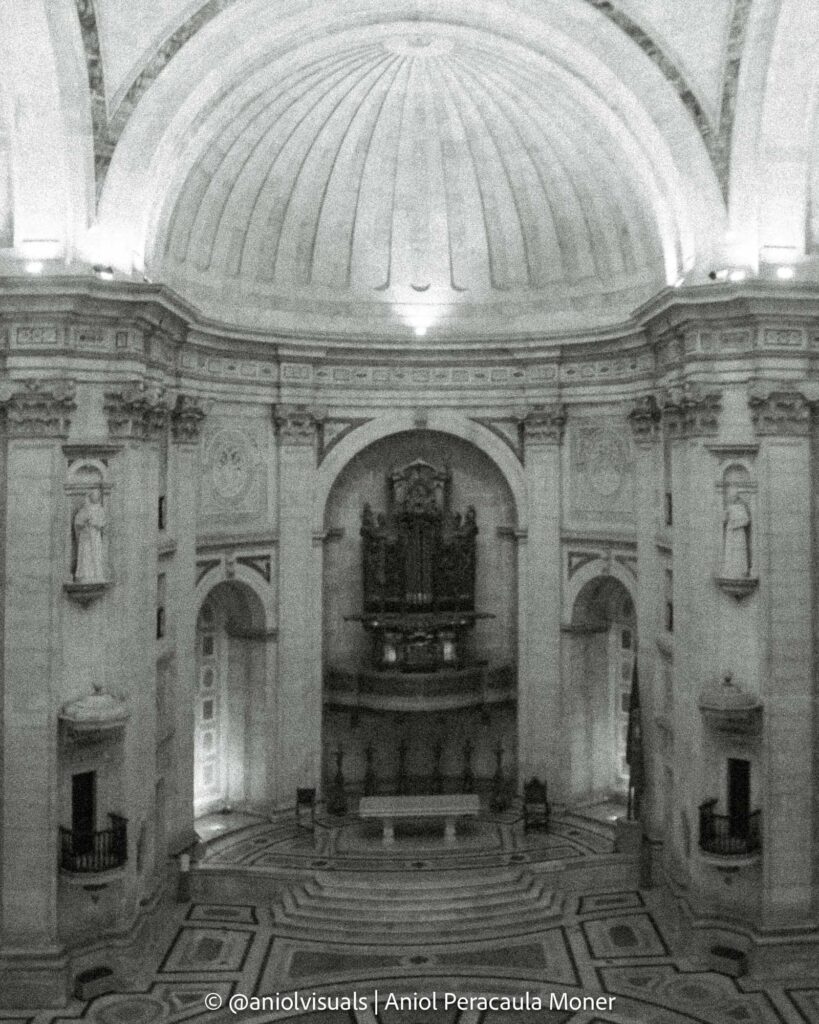
Lisbon is world-famous for its colourful tiles, known as Azulejos in Portuguese. In most of the streets and alleys of Alfama, you will see a unique pattern or a different tile colour. I recommend keeping an eye open for them. They can be great additions to your photos or a nice detail shot representing the essence of Lisbon.
As with other opportunities in this Lisbon photography spots guide, there’s not a single place to photograph tiles.
Castelo de S. Jorge
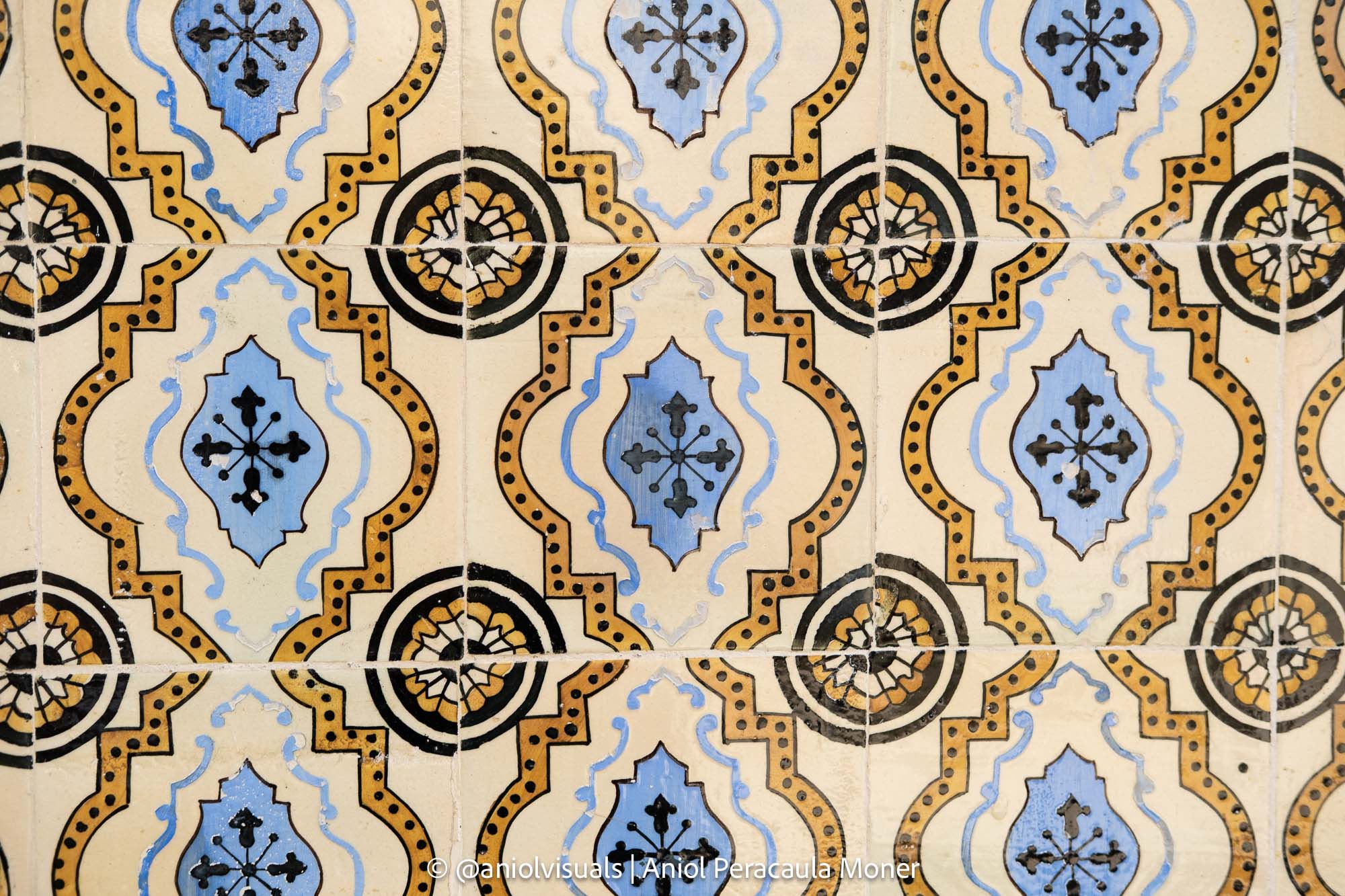
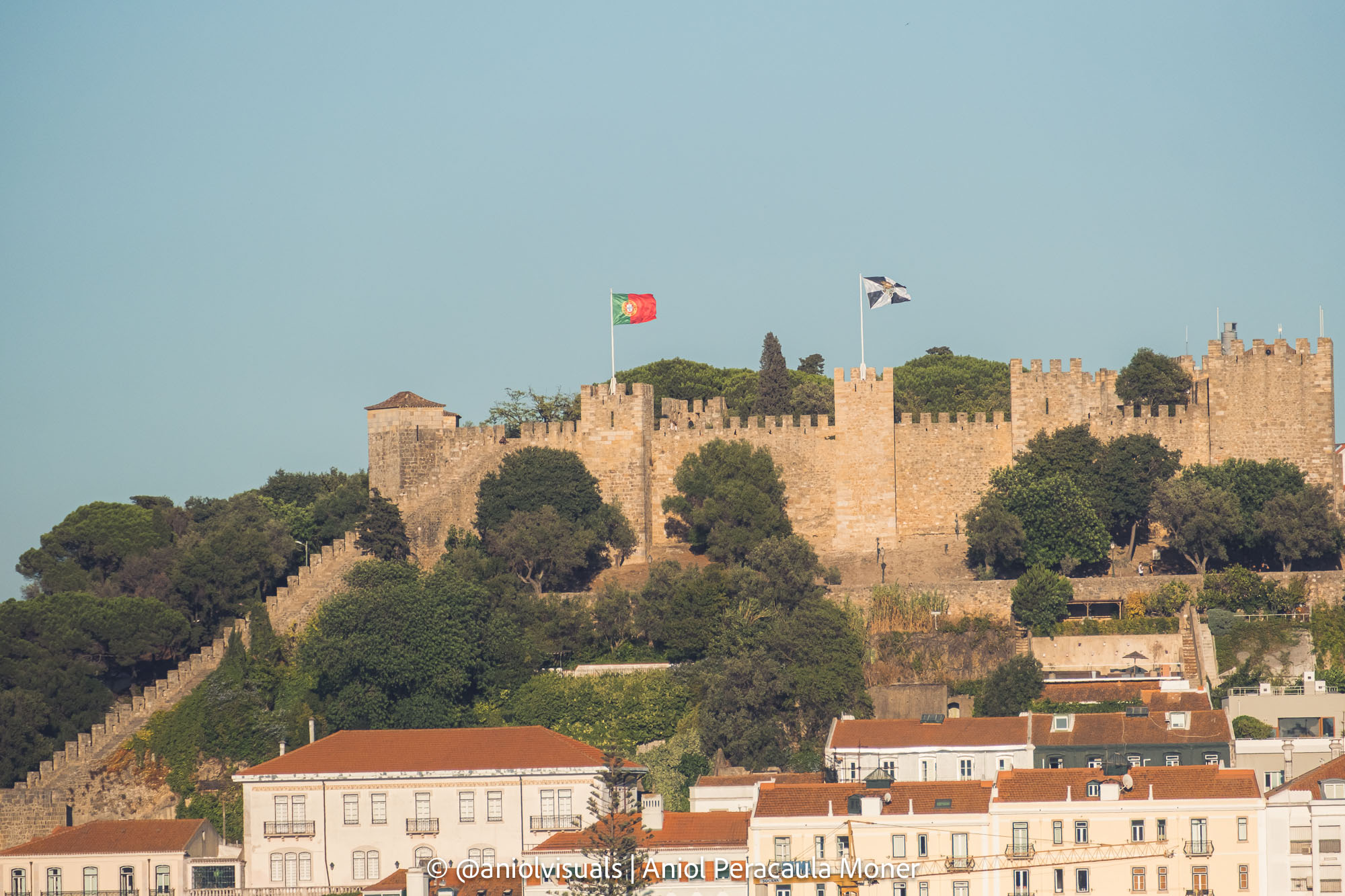
The Castelo de S. Jorge, or St. George Castle, is what’s left of what once was an impressive castle. It’s the last of the Alfama Lisbon photography spots, and I am torn between recommending it or not. My memory of the first time I visited the castle isn’t the best one. It wasn’t that interesting, and from a photography point of view, the only great spot was the view over Barrio Alto and Chiado.
It might be that the experience has changed over the years, but at the time, I felt that paying for it was not worth it. I have not visited it again on my multiple subsequent visits, but if, besides photography, you are into history, it can be a nice place to visit.
Even on a foggy day, views from there can be nice.
Baixa photography spots
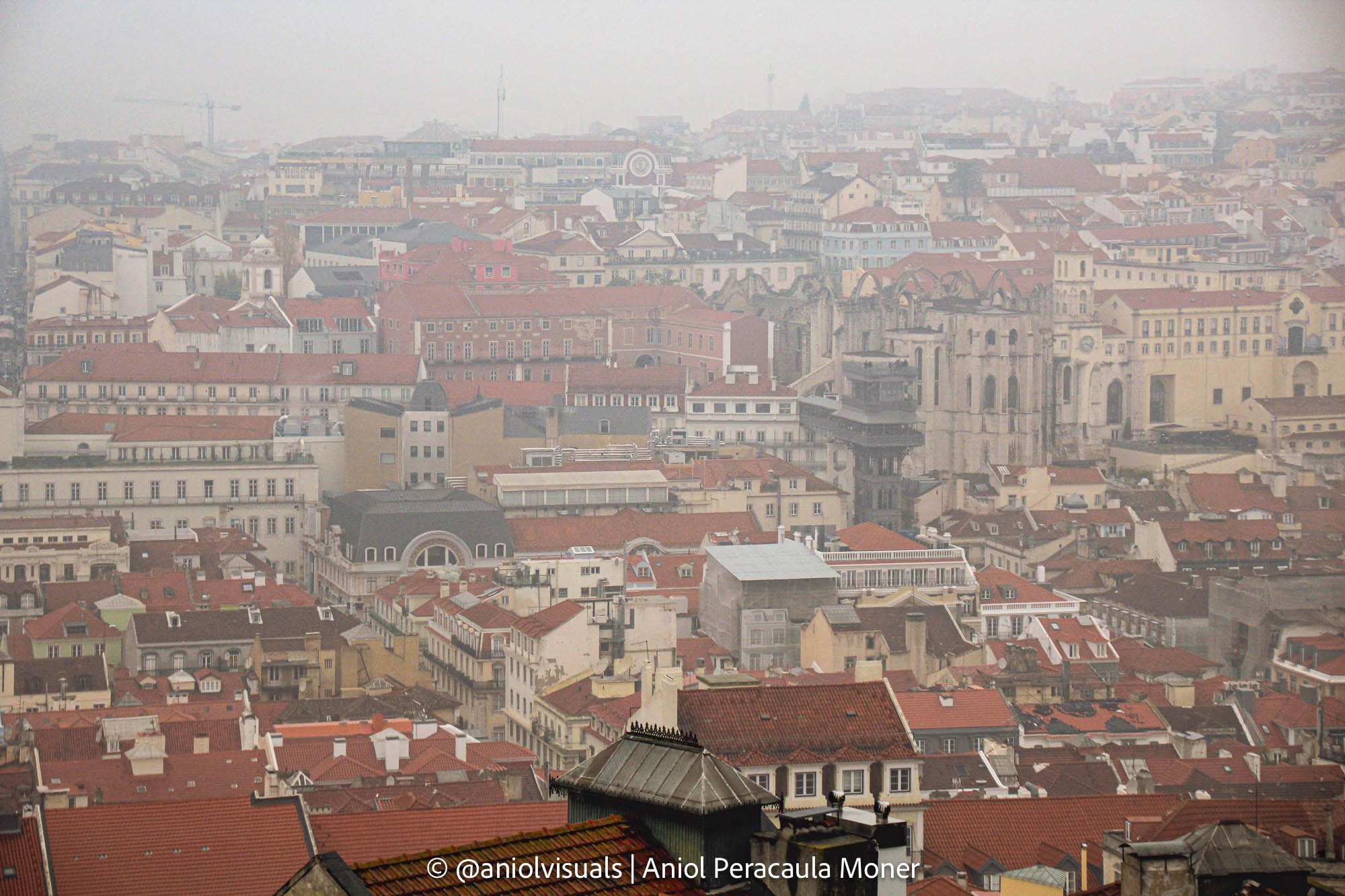
Lisbon is a hilly city. Two of its most famous areas, Alfama and Barrio Alto, are on two hills, separated by Baixa. Baixa literally means low in Portuguese, so this is one of the flattest areas of the city, and the heart of Lisbon. Some of the Lisbon photography spots listed here could also make it to the Chiado & Barrio Alto part, as there are some streets and trams that connect both areas.
In general, this area doesn’t have a lot of specific photography spots, unlike other areas in this Lisbon guide. However, the beauty of Baixa is to walk around, get lost in its alleys, camera in hand and find unexpected moments. Be ready to be surrounded by tourists, as this is as central as it can get in Lisbon.
Praça do Comércio
Comerce Square, or Praça do Comércio, is one of the most visited Lisbon photography spots. This Square is located next to the Tejo Riverside, with Alfama on one side and Barrio Alto on the other. When it comes to photography, there are a few interesting spots. The first one is the Square itself. With the Arco de Rua Augusta at one end and the river at another, no matter the direction you look, you can take great photos.
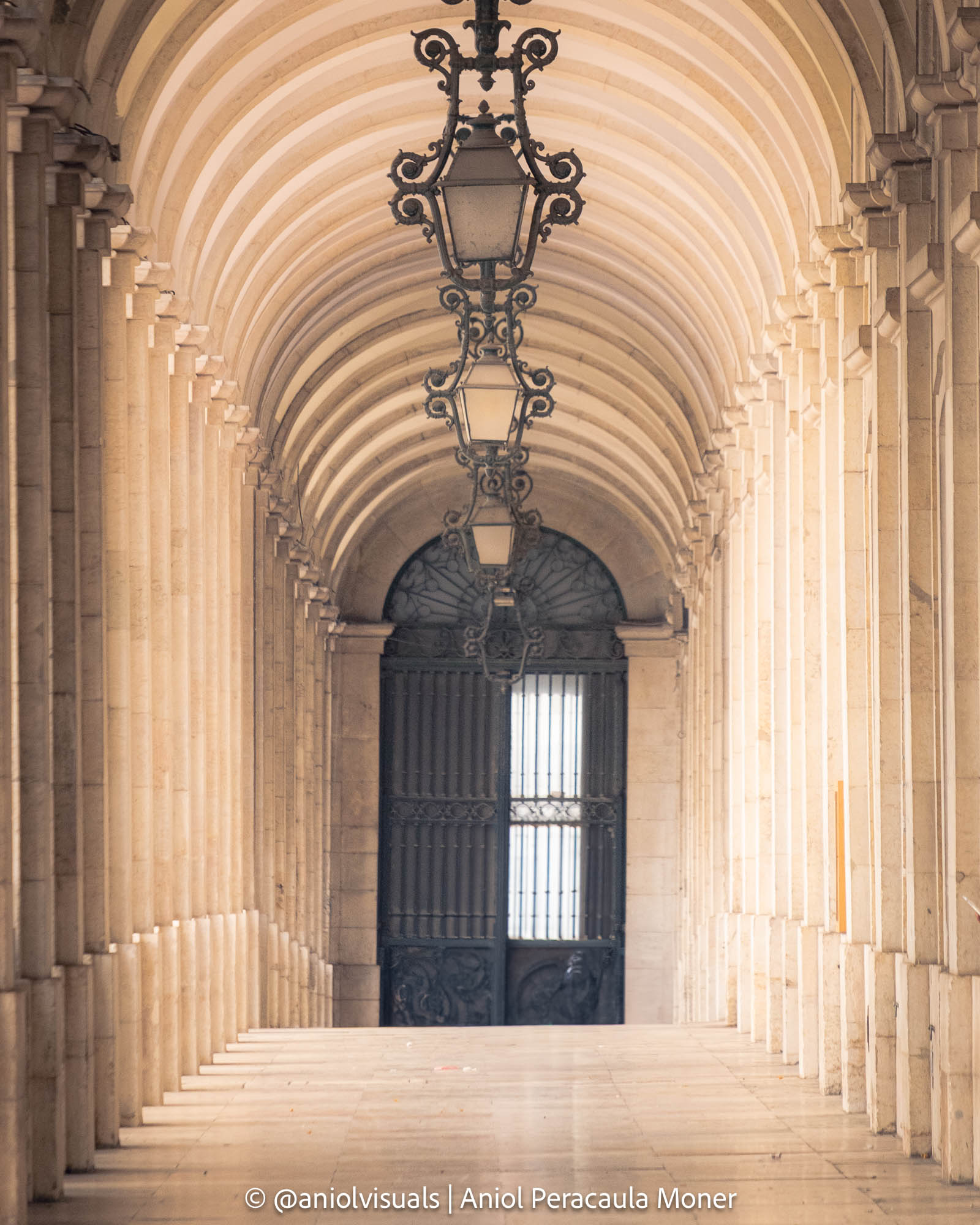
The second photo opportunity is the corridors on each side of the square. The arches make for a nice photo. However, if you want to take a photo like the one below, you’ll need to wake up early, as during the day it’s impossible to get the space without people, due to the multiple bars and restaurants.
Arco da Rua Augusta
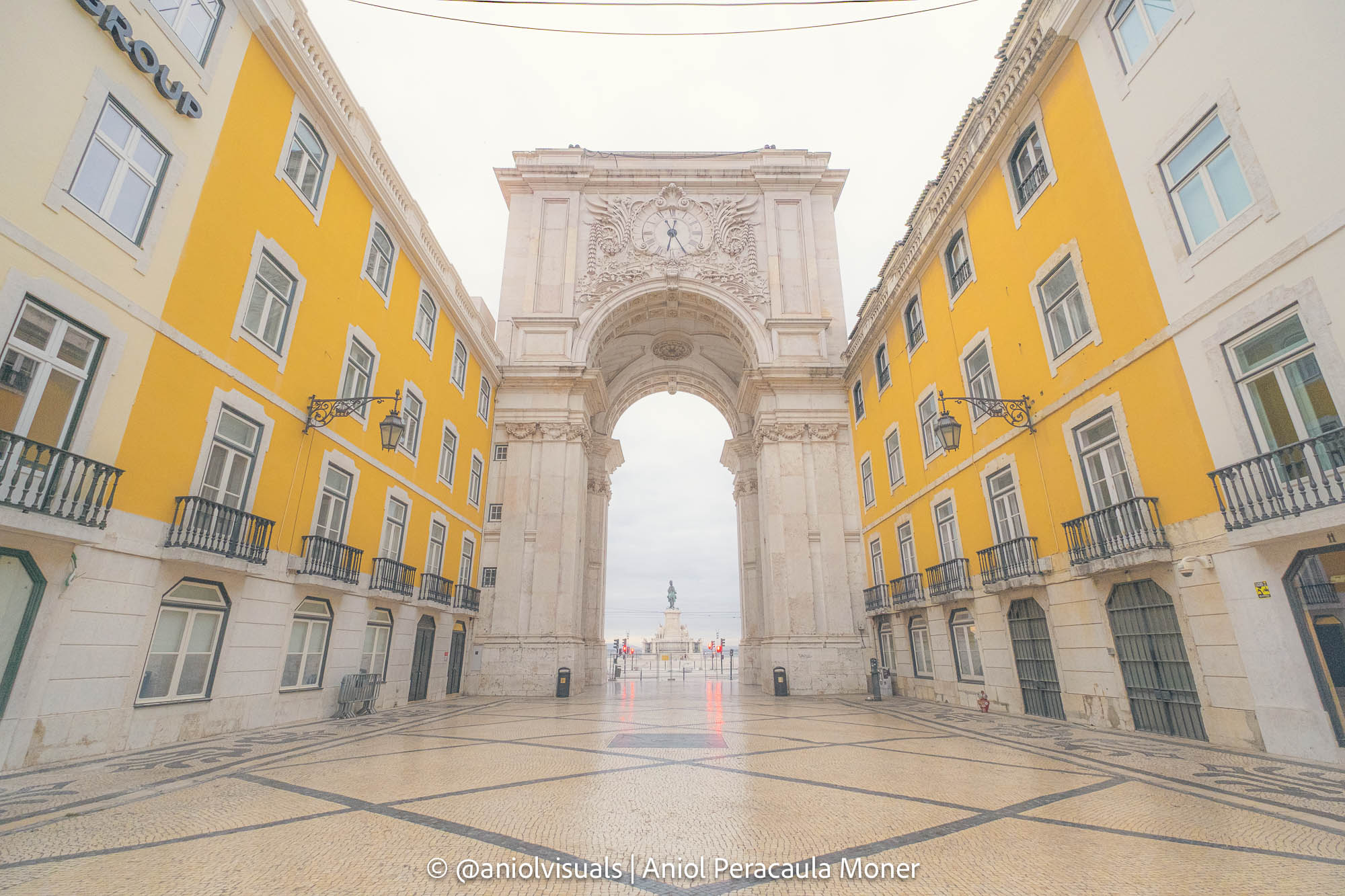
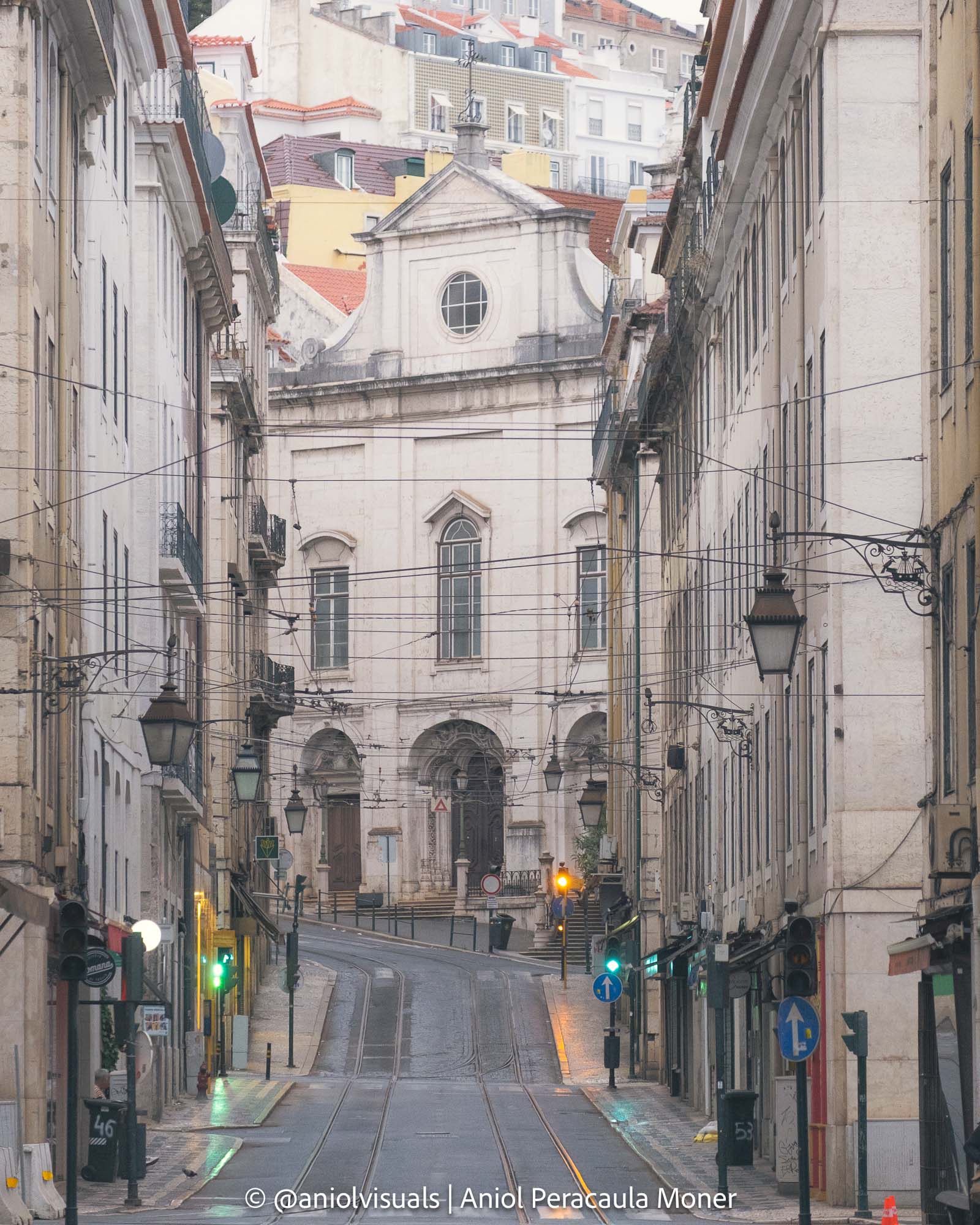
Praça do Comércio is connected to Rua Augusta with Arco da Rua Augusta, or Rua Augusta Arch. This arch is a very characteristic structure, and a very photogenic one. You can get great photos from 2 angles: one from the square itself. The second, from Rua Augusta, with its nice yellow buildings.
It is possible to climb to the top of Arco de Rua Augusta, but I never found the photo from there to be that unique, especially since in recent years, Rua Augusta has always had construction works.
Praça do Rossio
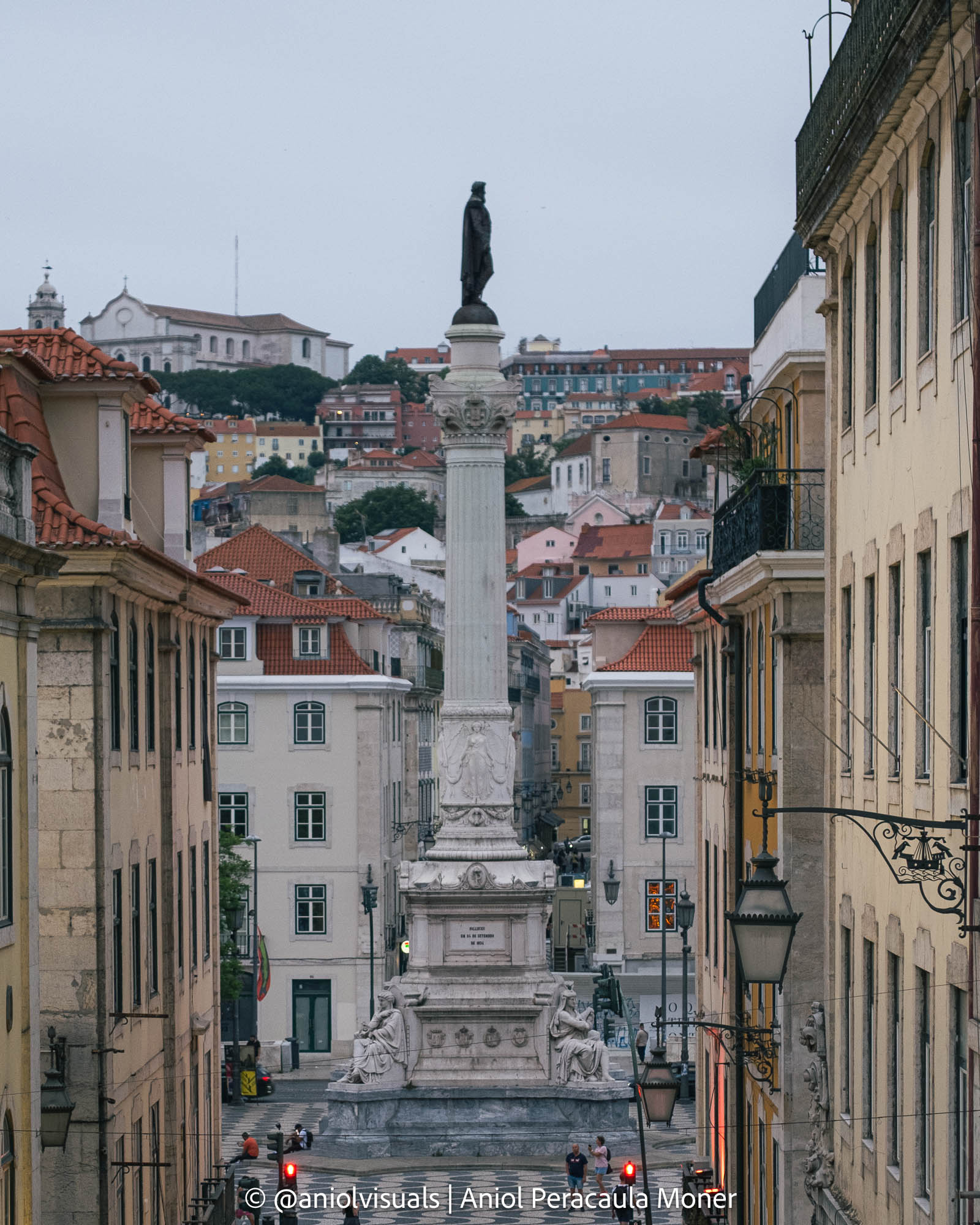
At the end of Rua Augusta, there’s Praça do Rossio, the other big Central Lisbon Square. This is where I recommend getting a taxi to or from if you are going to the Old Town (if you don’t mind walking uphill).
Photographically speaking, the square doesn’t have anything unique, but it’s surrounded by beautiful buildings. Also, it’s where one of the Lisbon Christmas markets is located, and from the square, you can take great photos of the nearby alleys.
But more on the streets and alleys of Baixa below, in the next items of the Lisbon photography spots guide.
Elevador de Santa Justa
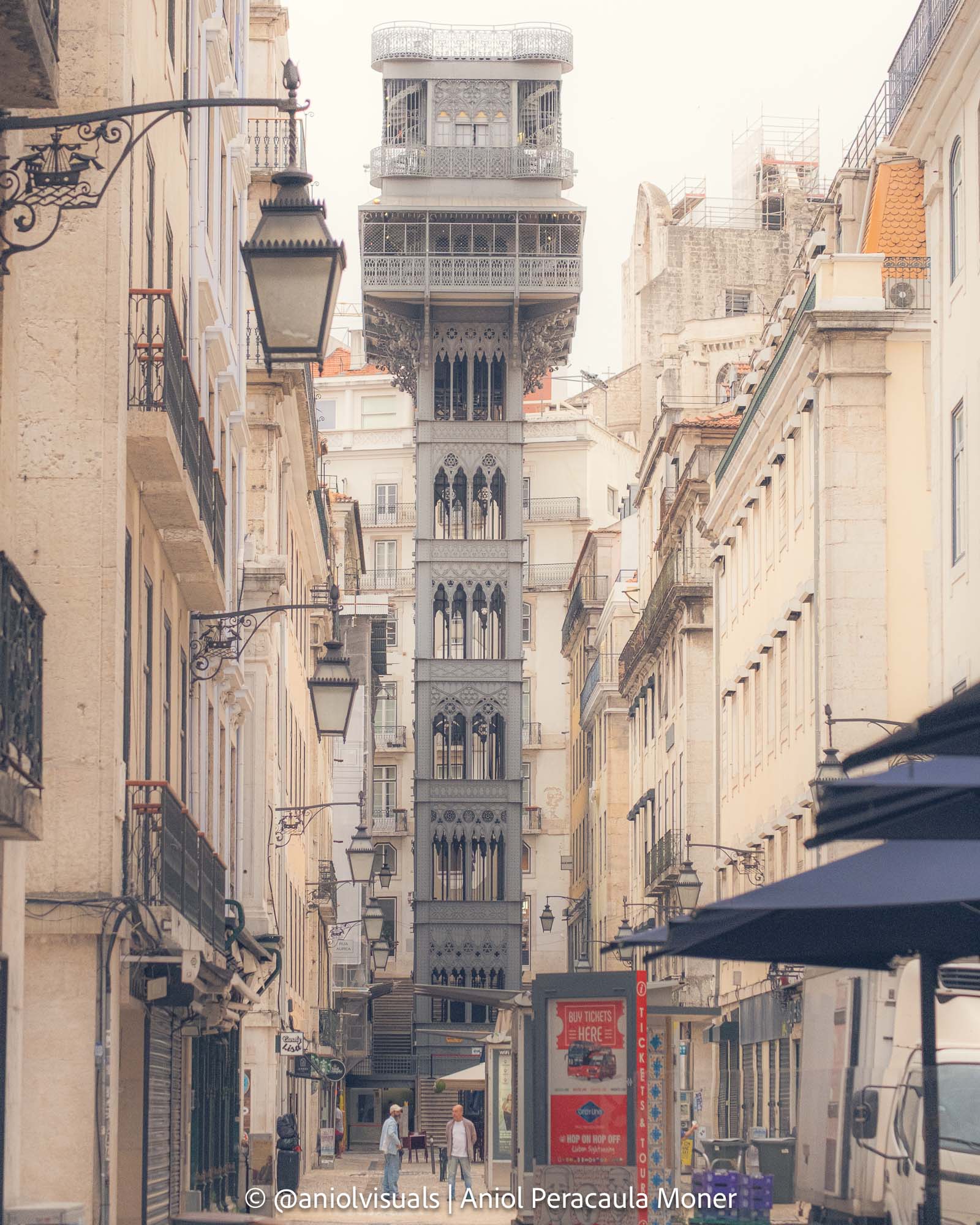
This is one of the most characteristic Lisbon (photography) spots. An old elevator, connecting the Baixa side with Barrio Alto/Chiado. This is a beautiful elevator, but one that I always struggle to photograph. I think it doesn’t allow for a lot of creativity, and the street where it is is full of bars and restaurants.
Thus, this means sunshades and people everywhere. Even if you wake up early, the sunshades are usually around. However, I still list it here because it is a beautiful structure and I’m sure it’s possible to take great photos of it.
Rua da Conceição
Before mentioning the “Other streets” part, I want to highlight Rua da Conceiçao. This is a street that runs perpendicular to Rua Augusta, and what makes it unique is that it is one of the few streets in Baixa with trams.
While you can also find them in Praça do Comércio, some of the other alleys and streets of Baixa are tram-free. Thus, go to Rua da Conceiçao for some great photos of trams in Baixa.
Other streets
I mentioned in the introduction of this section of this Lisbon photography spots guide that Baixa was all about walking around. Thus, don’t go only to the spots I listed above.
Get lost in some of the secondary streets, especially the ones going from Praça do Comércio all the way up to Praça do Rossio. Some of them are full of tourists, while others are way less crowded. Some of my best Baixa photos were taken without a specific goal in mind, just walking around with a camera. I encourage you to do the same 🙂
Belem and Jerónimos photography spots
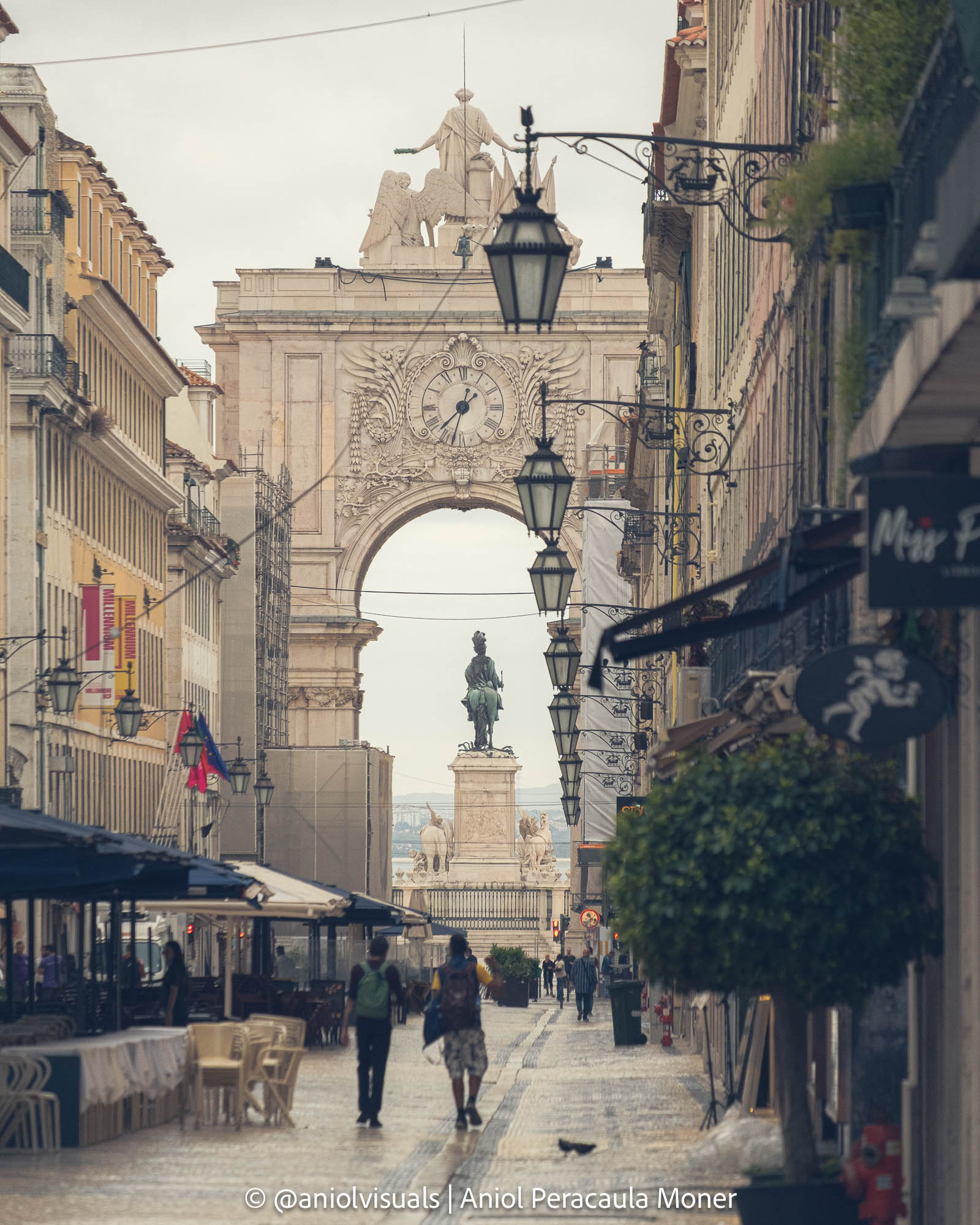
This area of Lisbon is not that close to the city centre. However, it is a very popular area as it has two of the most well-known tourist attractions in the city, Torre de Belem and the Jerónimos Monastery. Of course, these two are listed as Lisbon photography spots in this guide. Besides them, though, there are some other spots worth checking out when in this area of the city.
Jerónimos Monastery
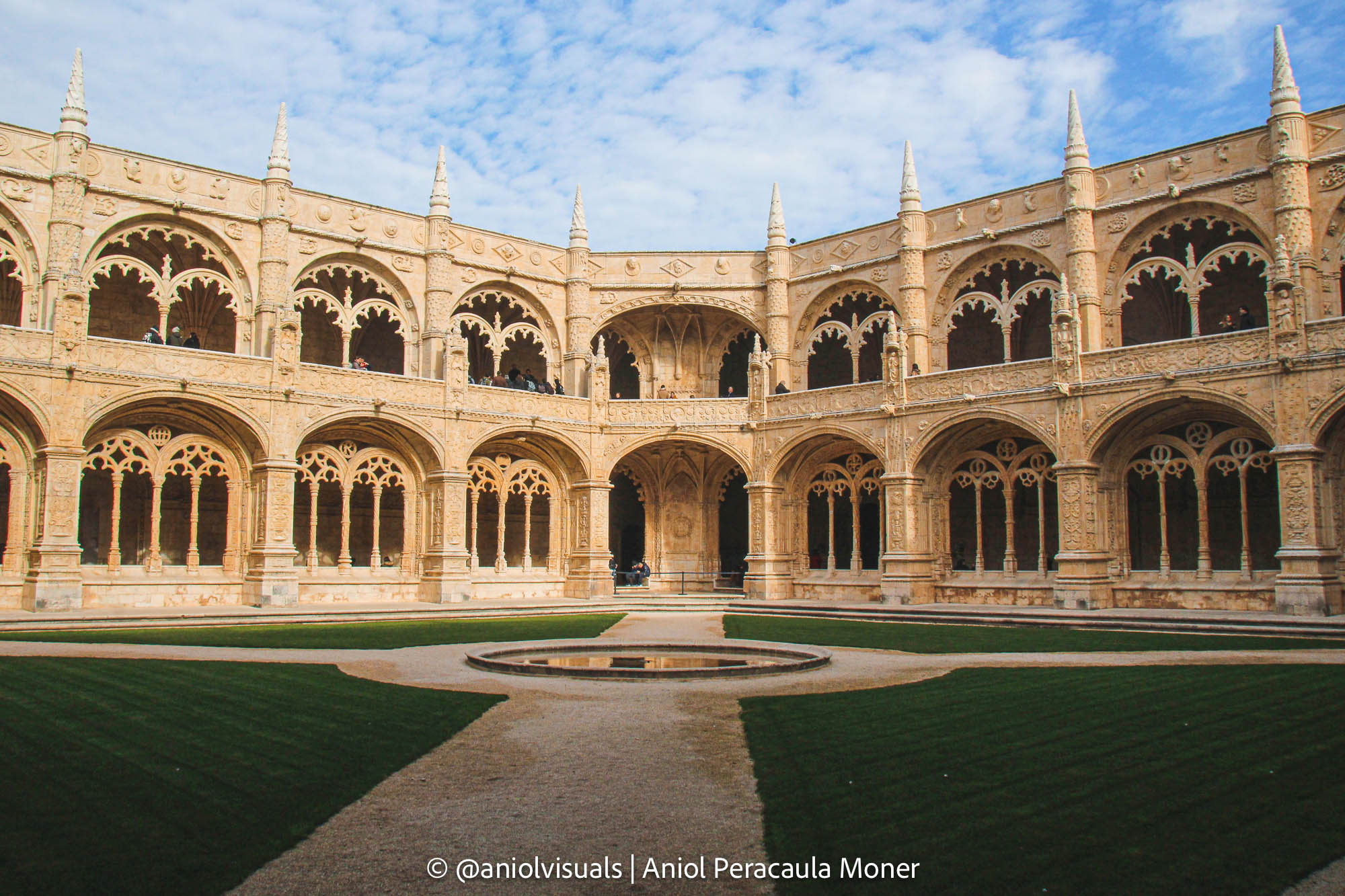
Let’s start with the main tourist attraction of the area. I include it in this guide because it is among the must-visit Lisbon photography spots, but I am not that convinced that it is the best one. Don’t get me wrong, the monastery is amazing, worth a visit. However, it is also a difficult place to photograph, as it is always crowded (even early in the morning).
To access the monastery, you’ll need to pay. I recommend getting the ticket online and being there before the gates open. That’s the only way to get some good photos in the Monastery. The two-level cloister is the main photography attraction, and although it can be difficult to get it to yourself, if you focus on some of the details, it is possible to take interesting photos.
Torre de Belem
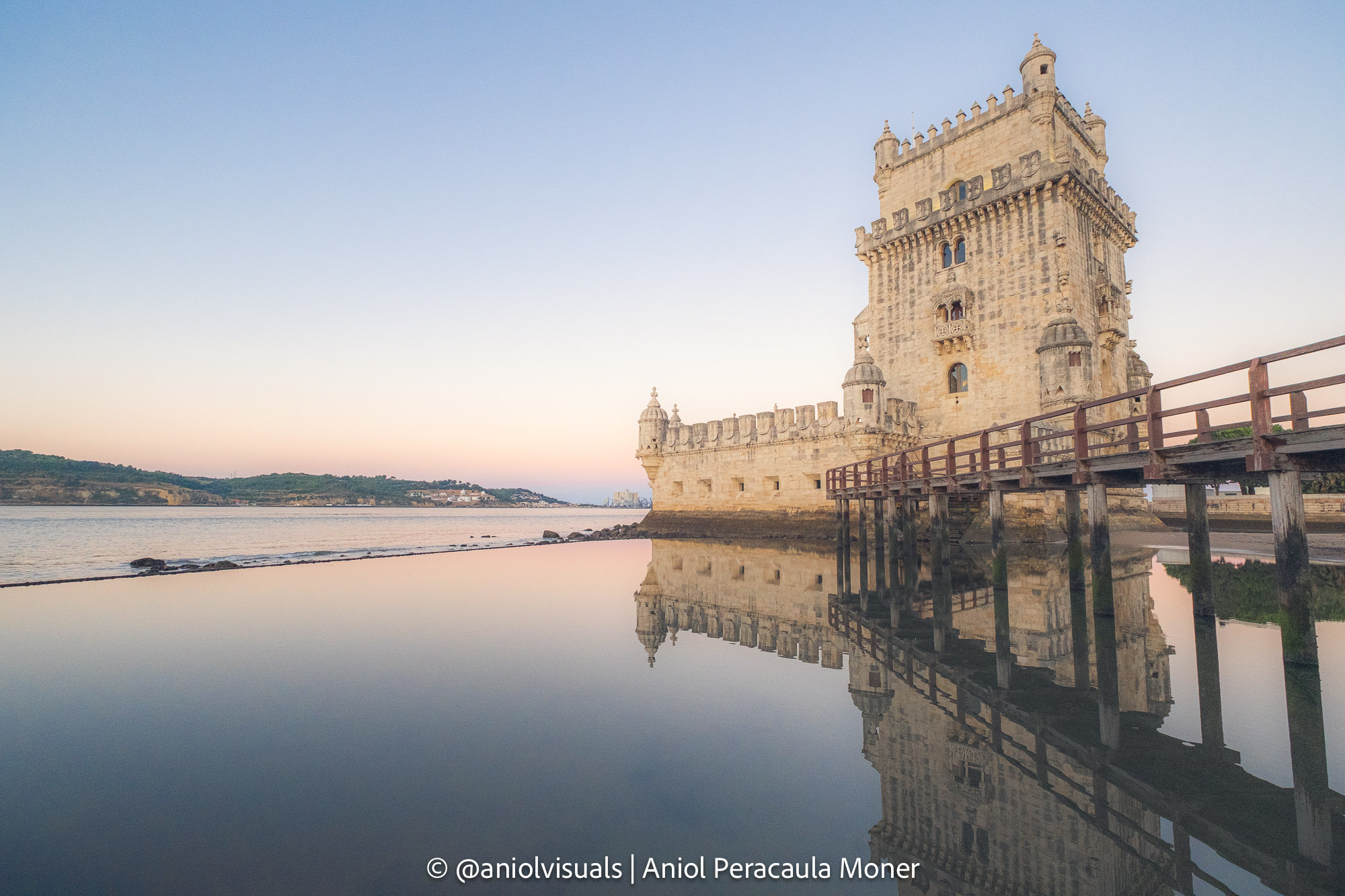
The second famous spot in this area is the Belem Tower or Torre de Belem. Built in the 16th century, although reconstructed multiple times, it was used as a defensive tower and also as a lighthouse. Nowadays, it is an impressive and beautiful structure at the end of the Tejo estuary.
It is a great spot for photography. It’s possible to visit the interior of the tower, but I always found it more interesting on the outside. Depending on the tides, you can get perfect reflections or cool patterns in the sand. Moreover, at sunrise and sunset, it’s easy to get the place for yourself and take different photos.
Like the Jerónimos Monastery, this is one of the most popular Lisbon photography spots, so expect crowds, especially during the summer months and weekends.
Padrão dos Descobrimentos
If you walk from Jerónimos Monastery to the Torre de Belem following the river, you will see an impressive stone structure in the shape of a ship. This is the Padrao dos Descobrimentos, a monument in memory of Prince Henry the Navigator. The structure itself is interesting, due to the ship-like shape.
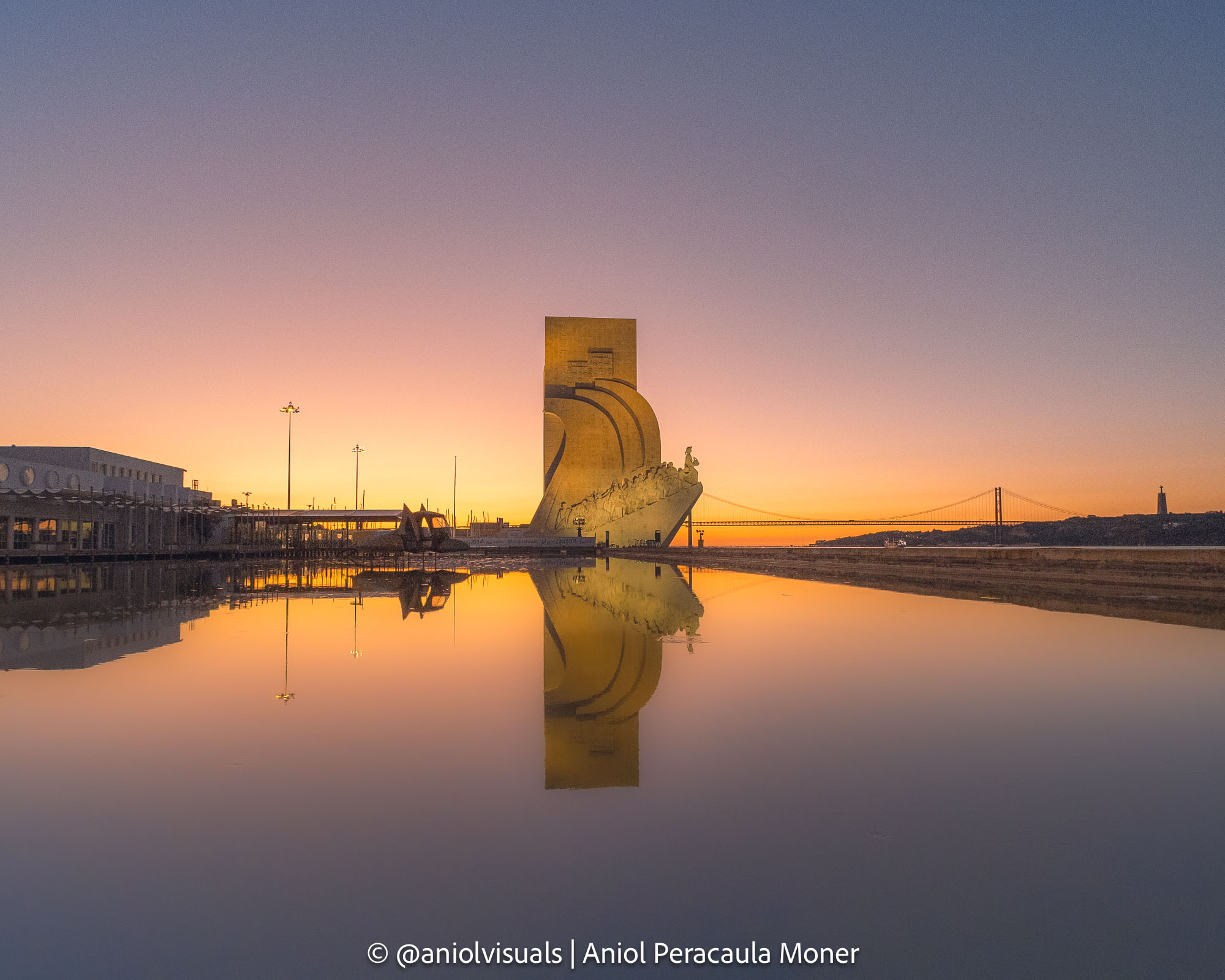
It’s possible to climb to the top of the monument and enjoy nice views over the area, but I don’t think it is worth it, as the views are already nice from the ground level. However, if you are in the area early in the morning, you can get nice photos with the first light and some nearby water ponds.
The whole area around it is one of the best sunrise Lisbon photography spots, as can be seen in the photo below.
Champalimaud Foundation
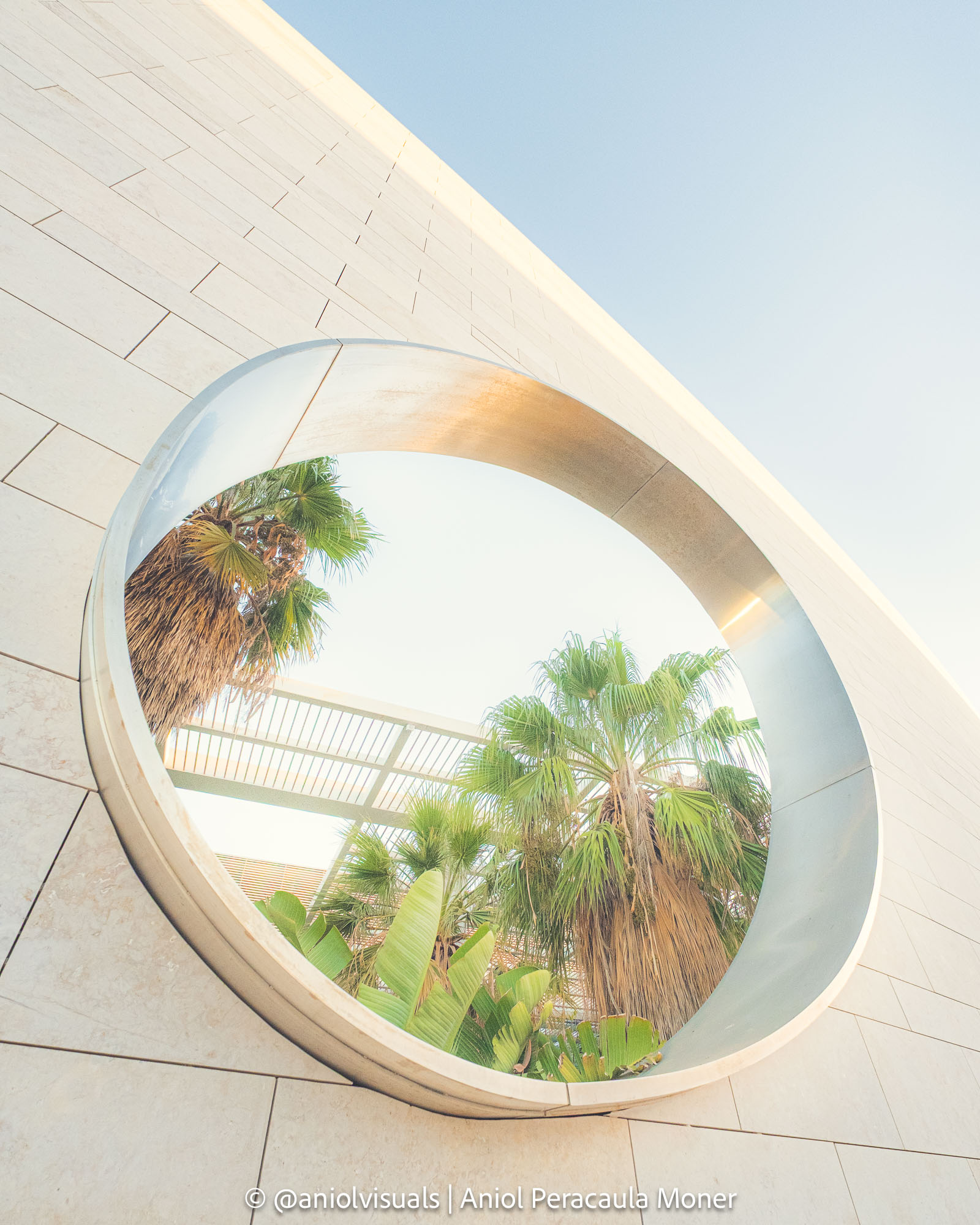
This is my favourite spot in this area (and one of the underrated and hidden Lisbon photography spots). The Champalimaud Foundation is a biomedical research foundation. What makes it interesting from a photography point of view is the architecture of the building.
There are two main things to photograph. First, the building itself. With the big windows you can see in the image below, it is possible to take very unique photos, and get quite creative with different angles. The second are the two tall pillars that overlook the estuary, next to a small artificial pool, from which it’s possible to take nice reflection photos.
It is not as popular with tourists as the previous spots. However, people go there to work, so you might find constant movement of people in the area. Thus, I recommend visiting this area early on a weekend, and you might even have the whole place to yourself!
Parque das Naçoes photography spots
This area is not the most popular one in Lisbon for tourists. In fact, in many Lisbon photography spots guides, it is not even mentioned. However, I have a soft spot for the Parque das Naçoes. Its name translates to Nations Park. This is the area where the 1998 World Exhibition was held. Nowadays, it’s used for events, there’s a massive shopping mall, and the Lisbon Oceanographic Museum. Moreover, it’s a great spot for photography.
People watching
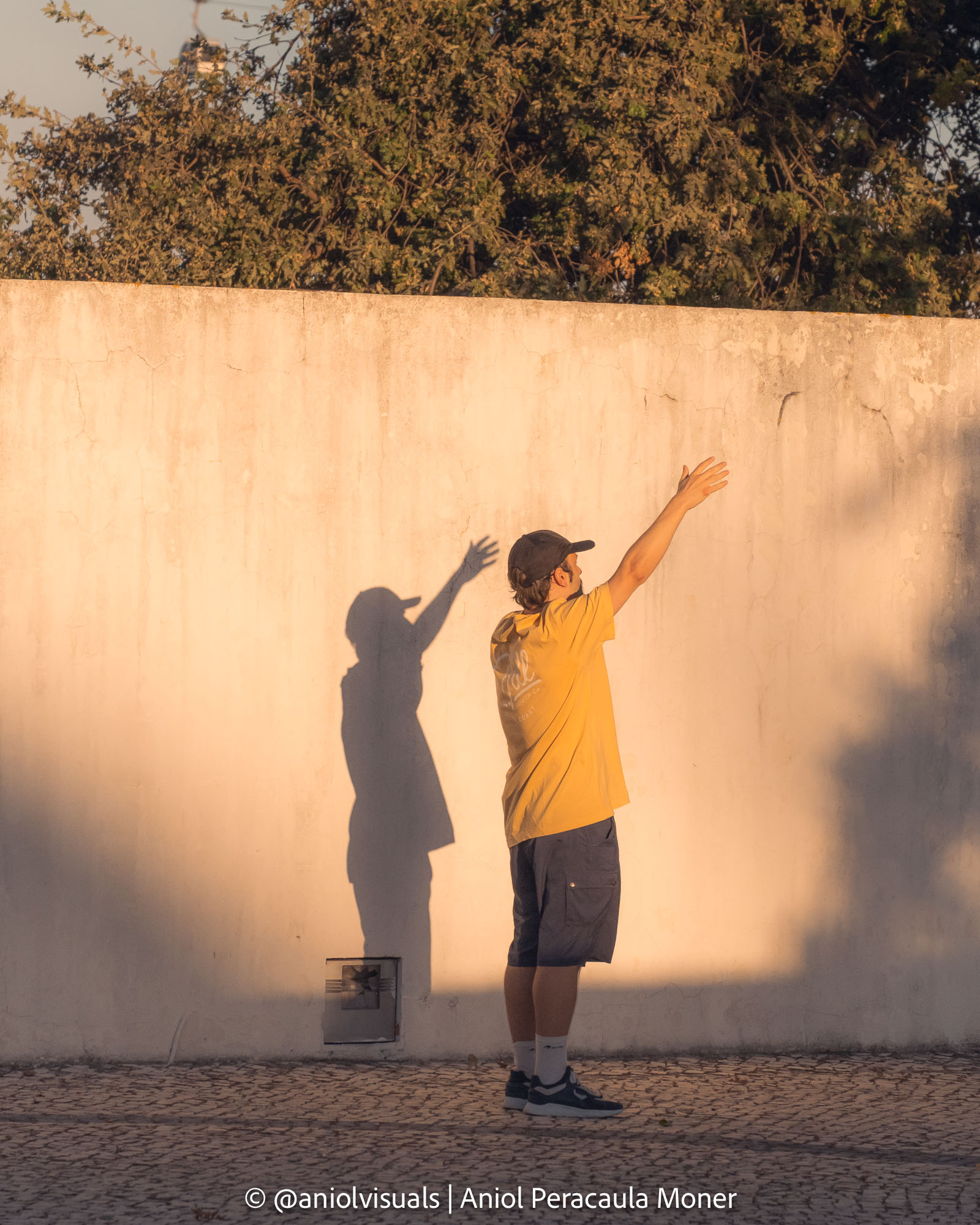
Parque das Naçoes is a place where people gather. The shopping mall, not being in the city centre of Lisbon, and the riverside are great ingredients for people watching. I really enjoyed taking photos of people in that area, especially at sunset or just before it, when the light is amazing, and the weather is not that hot (in summer).
Torre Vasco da Gama
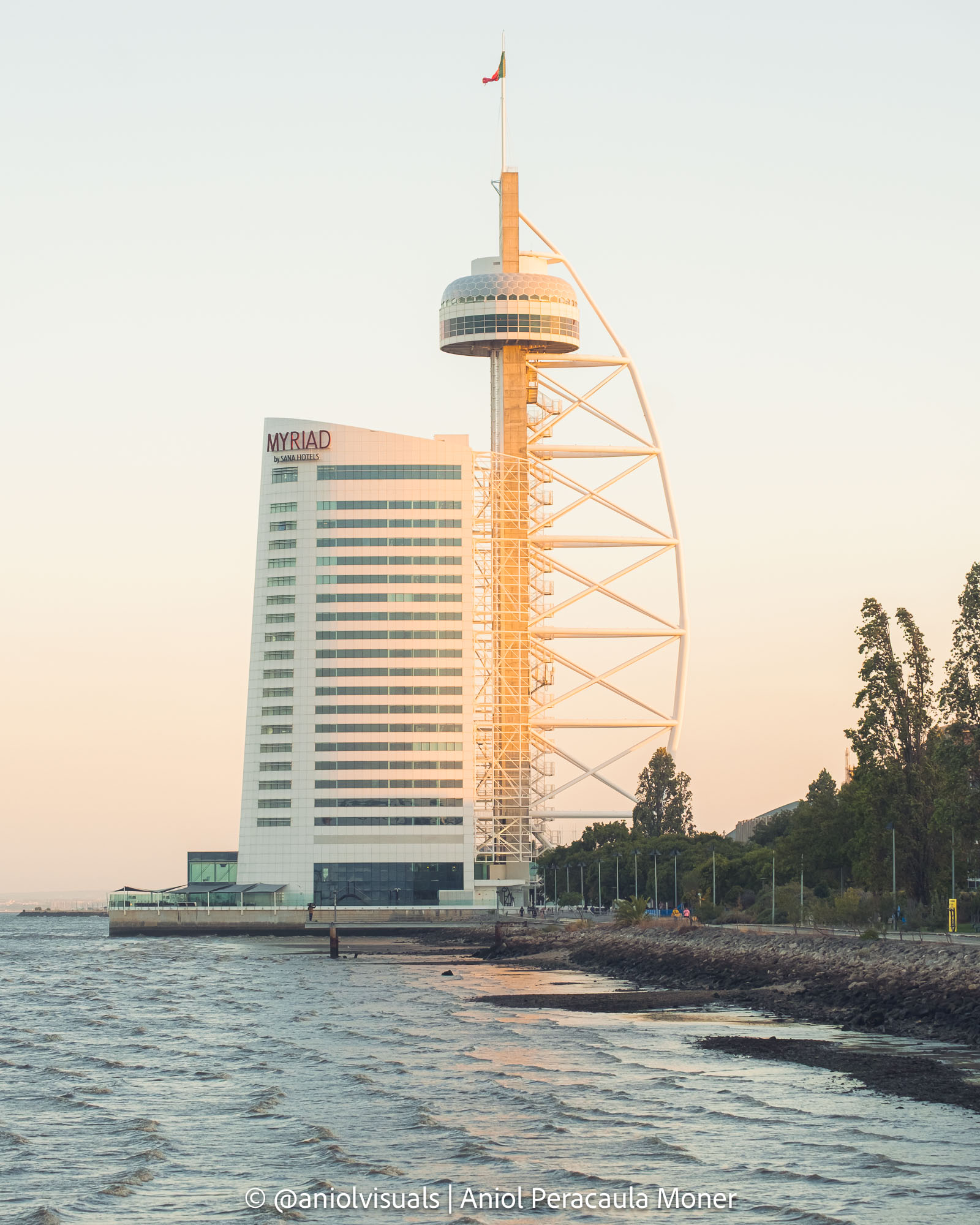
I remember this hotel/viewing platform was under construction the first time I visited Lisbon. Besides being a very nice hotel and having one of the tallest panoramic views over the city, it is a very photogenic building.
Its structure reminds one of a whale carcass, and it offers different photos from multiple angles. As mentioned in other Lisbon photography spots in this guide, the best time to take photos there is at sunrise or sunset. In the case of the photos below, they were taken at sunset.
Ponte Vasco da Gama
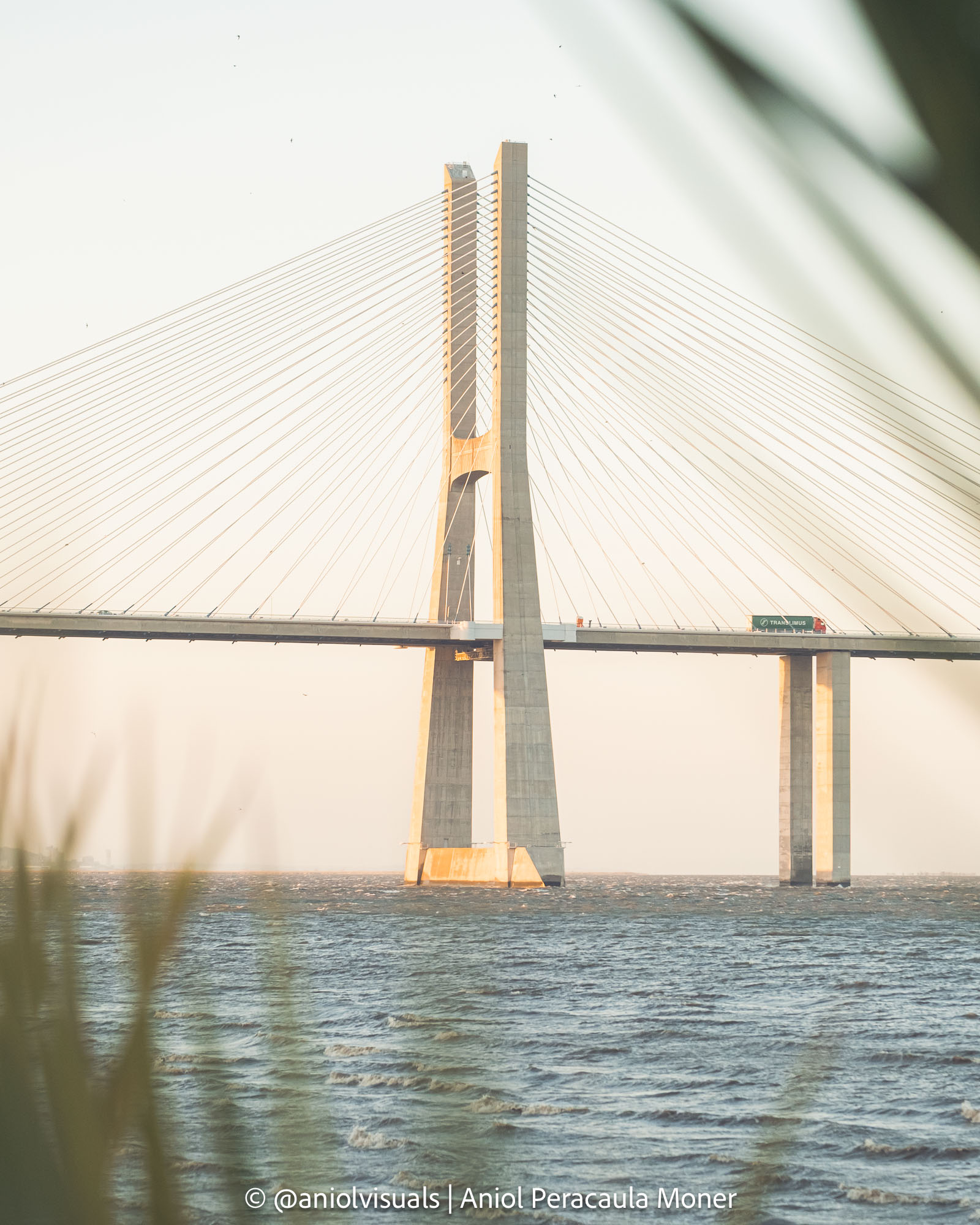
Vasco da Gama was a famous Portuguese sailor, and this bridge is named in his honour. This is the longest bridge in Europe, with over 17km in length. Moreover, it’s a great place to photograph.
The photos you see in this spot were taken at sunset. If you look online, it will be mentioned in some Lisbon photography spots guides as a great sunrise spot. This is because at some moments during the year, the sun rises from behind (or near) the bridge, and it should be possible to create very special compositions.
The bridge is massive, and you’ll need to get either north or south of it, and it takes time to walk around. Thus, scout the location and get there with enough time to adjust, if needed.
Jardim da Água
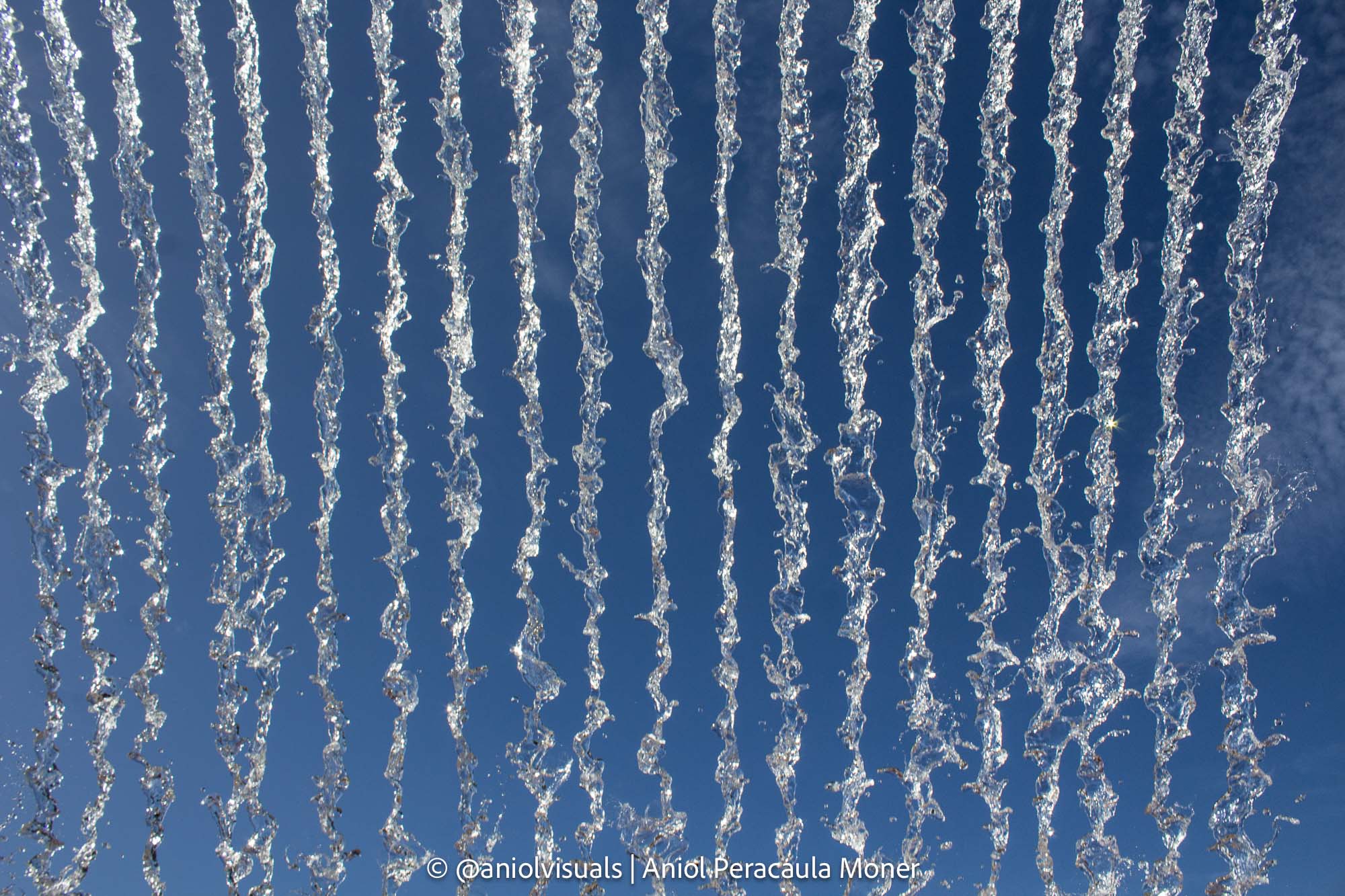
As part of the Parque das Naçoes, there’s the Jardim da Água. The name literally translates into “water gardens”, and that’s what you can expect to find. Mini ponds, a few “interactive” water attractions, and lots of people around.
I listed this spot more for the people than for the gardens. People gather, and especially during the summer months, there’s a lot of activity in the area. Instead, during winter, the last time I visited the gardens, I was almost alone.
Telecabine Lisboa
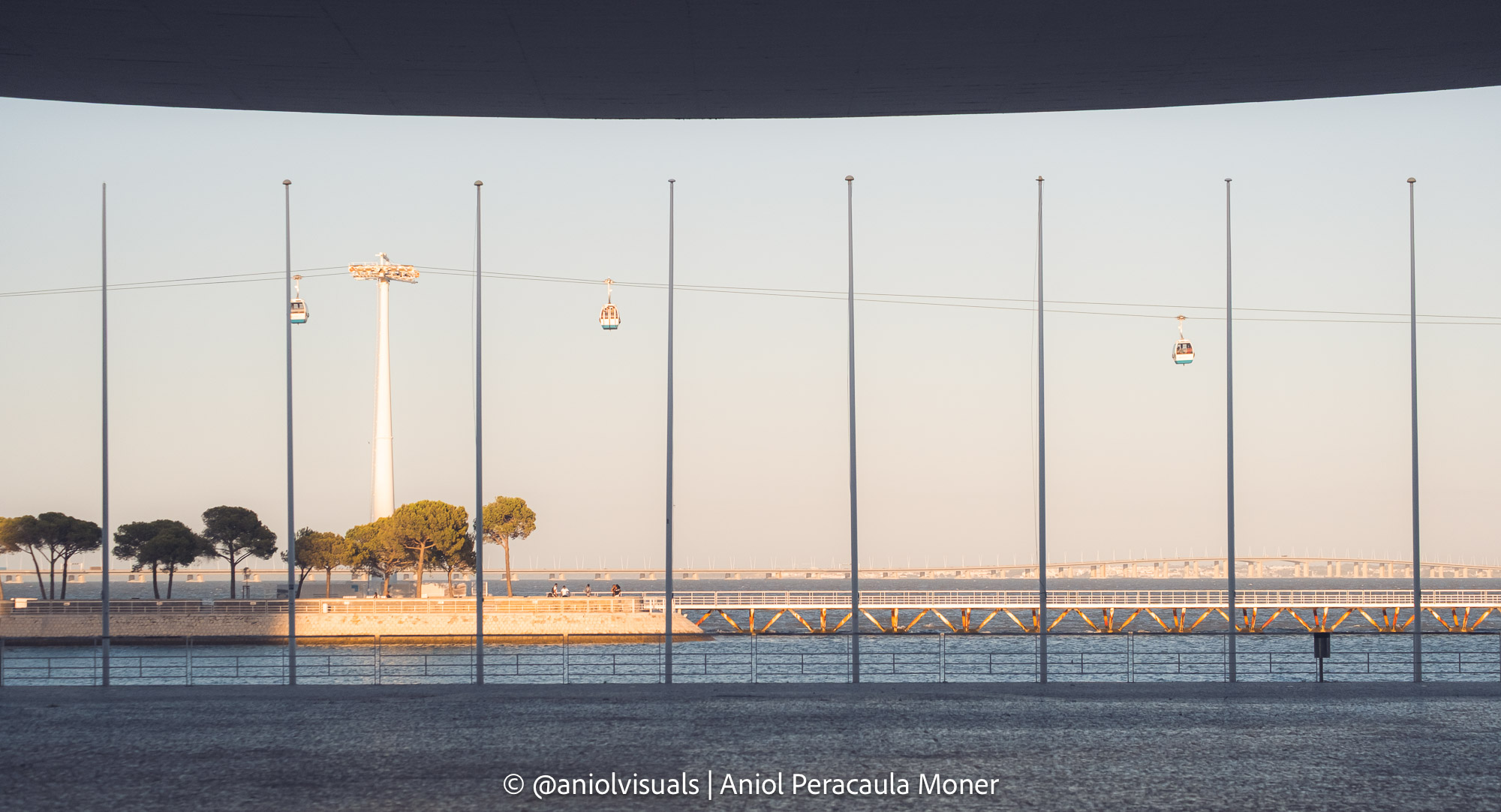
Did you know that Lisbon has a cable car? Located at the heart of the Parque das Naçoes, it connects the two ends of the area. While the cable car itself is a bit of a tourist trap, I found it a great spot for photography. The mix of the cable car, sunset and some of the massive buildings built for the world exhibition can help create nice photos.
If you have some patience, good light, and a good eye for architecture, this can be a fantastic place to take different images.
Oriente train station
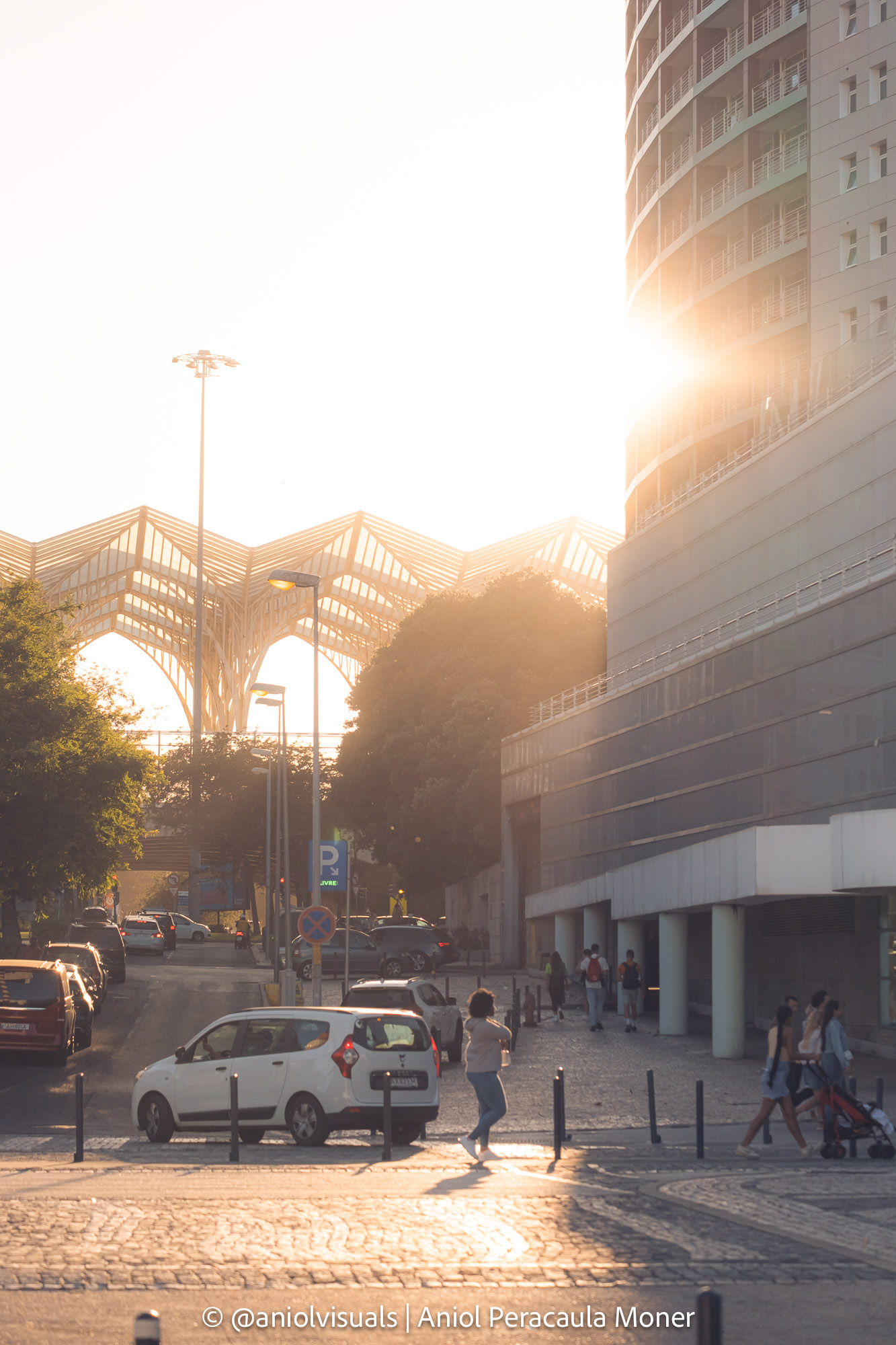
If you visit this area, you will most likely arrive at the Oriente train station (even if you take the metro). The train station itself is a great Lisbon photography spot. From the platforms on the main floor to the interior and its outside structure, it’s possible to take amazing photos there.
However, the main problem will be if you want to get the place for yourself. Being one of the main train stations of Lisbon, even quite early in the morning, there will be some activity. For the street photographers, this is not an issue. Nonetheless, if you want to take architecture or fine art photography, you’ll need some patience and a bit of luck.
Chiado & Barrio Alto photography spots
Chiado and Barrio Alto are not a single neighbourhood. However, instead of separating them into two spots, I decided to mix them. The main reason is that they are attached, and you will be moving indistinctively between them. I include some of the elevated spots in the city, but also some closer to the river, especially in the Cais do Sodré.
To simplify, the Lisbon photography spots on this list are all to the left of Baixa, so opposite to Alfama.
Pink Street
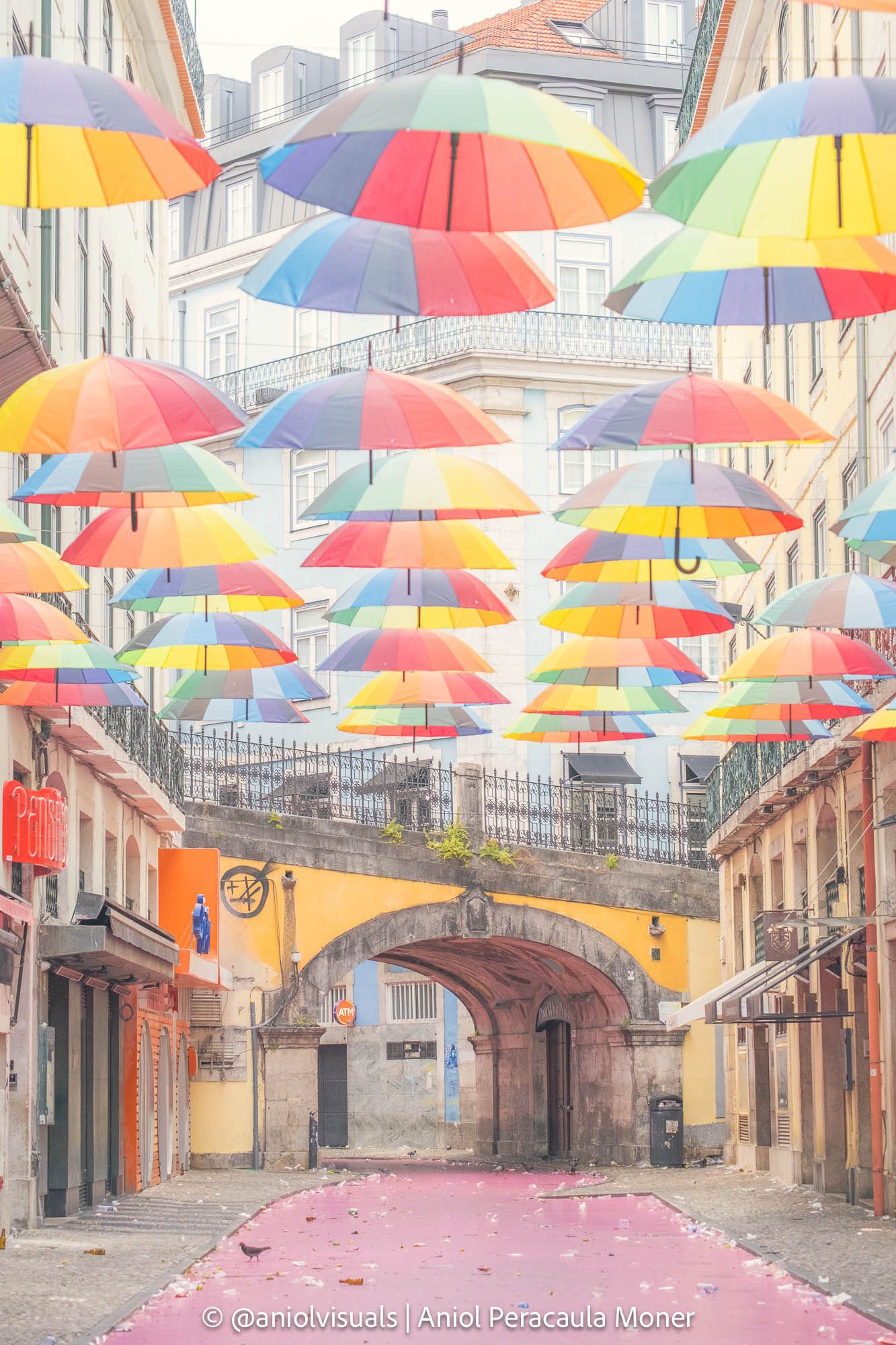
I am not a huge fan of Instagram photo spots. You might have noticed how, in this Lisboa photography spots guide, there aren’t many Instagram-style spots. However, I believe Pink Street is more than an Instagram spot. This street is famous for its hanging rainbow umbrellas. They make for a cool photo, but there’s more.
First, if you wake up early, you’ll be able to capture a darker side of the street. Dirty, full of empty plastic bottles from the previous night’s parties, and also some people looking for leftovers (not drinks, if you know what I mean).
Second, there’s a very nice second photo spot towards Pink Street from the road that can be seen in the photo below.. From there, instead of getting the view from below, you get the one from above. And finally, some of the side alleys near the street also make for a nice photo.
It’s one of the most famous Lisbon photography spots, and despite the volume of people that visit and photograph it, it’s objectively photogenic.
Time Out Market
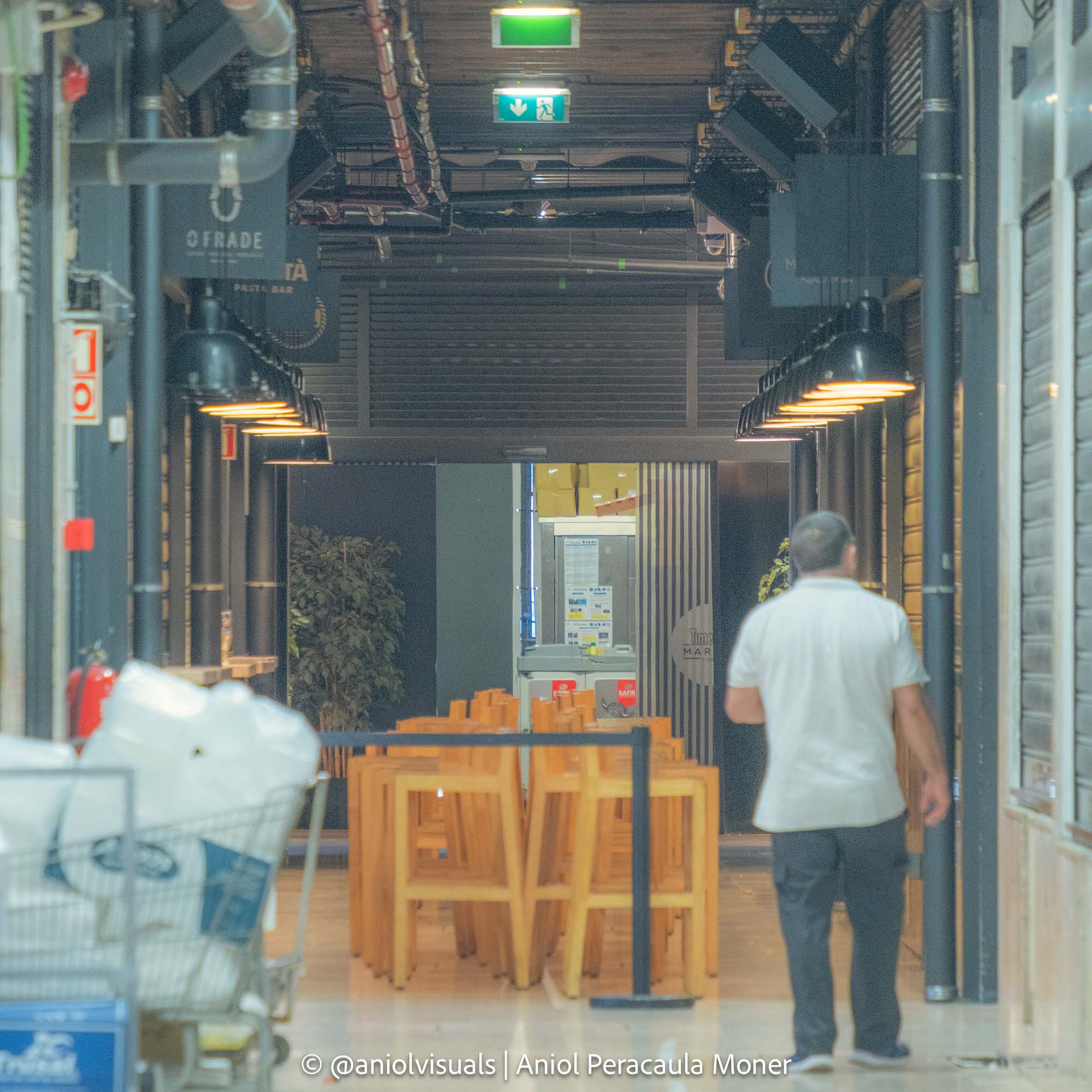
This is the Google Maps name of this market, but what I recommend as a photo spot is exactly the part that is NOT the Time Out market. This market is divided into 2 parts: the first one is a traditional market, with vegetables, fruit, some meat, fish,… great for photography early in the morning. The second part is the Time Out part: only for tourists, and lacking an authentic touch. If you want overpriced traditional food, it’s your place. However, I’d say it’s not the best spot for photography.
Alleys
If you have read all the Lisbon photography spots above, you might think I am repeating myself. Alleys, again? Yes, because the best part of Lisbon is not specific spots, but its streets and alleys.
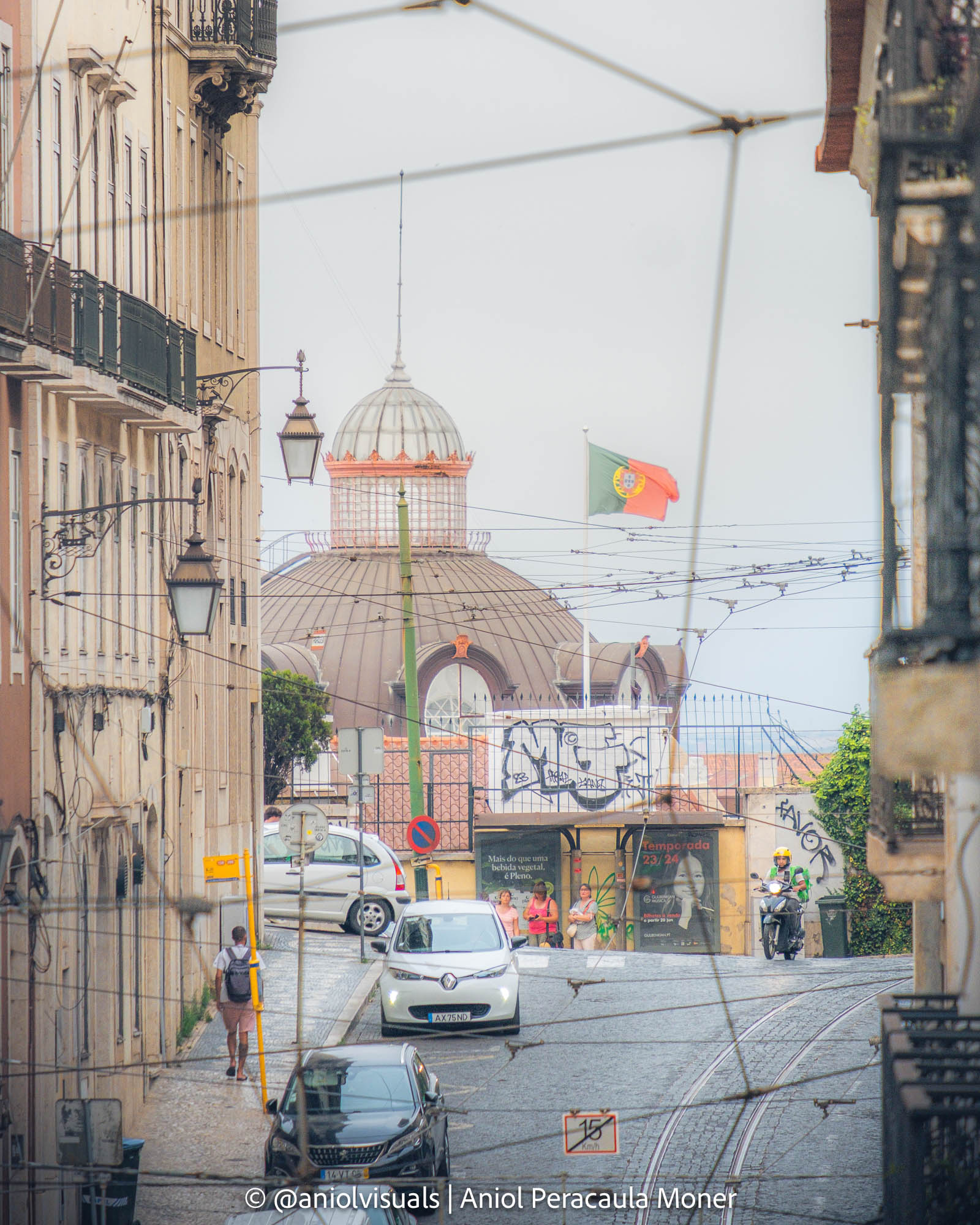
With the characteristic tiles, steep, and a very unique light, Barrio Alto and Chiado side alleys and secondary streets are great for photography. Unlike other spots, waking up early is not mandatory, as they are not always busy or full of people, unlike the main streets.
I spent 3 consecutive months in Lisbon, but even before that, I had already discovered the beauty of its alleys. Do not miss getting lost in them!
Miradouro de São Pedro de Alcântara
While Alfama is full of great viewpoints, Barrio Alto and Chiado don’t have many of them. However, Miradouro de São Pedro de Alcântara is one of my favourite ones in Lisbon. From there, you can get a fantastic view of Baixa, Alfama and the Tejo River. Moreover, you can get clear views of the Cathedral, the Castle, the Pantheon and many other famous Lisbon (photography) spots.
It’s a great spot for sunrise or sunset. If you go on an evening and sunset photography walk across Lisbon, this could be a great place to finish your walk, and enjoy the transition from day to night.
Igreja do Carmo
This is one of the few Lisbon photography spots on this list that is not free, and that I recommend paying to get in.
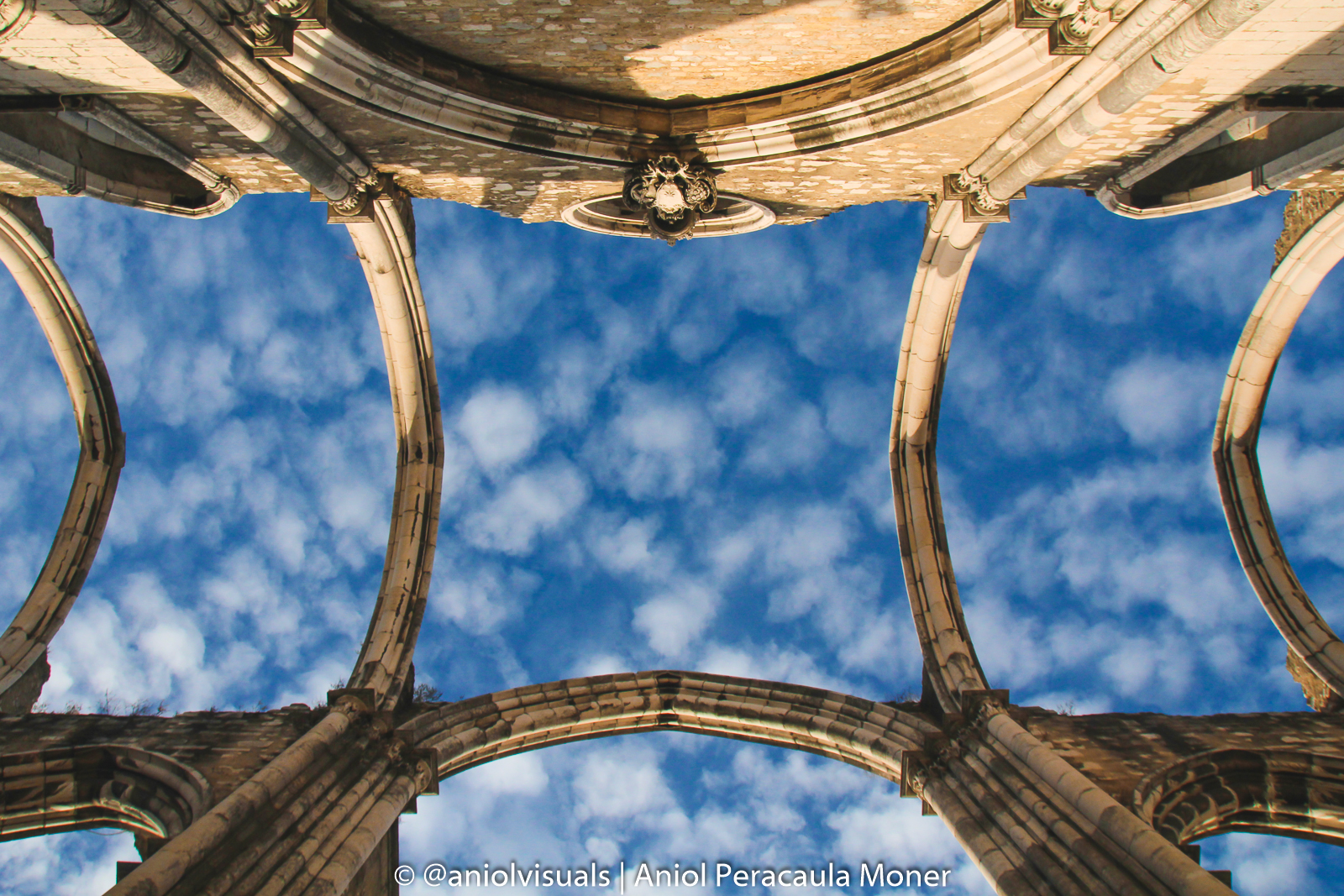
The Igreja do Carmo is an old church (and Monastery) in Chiado, but that has a very unique feature: it has no roof. It’s one of the few buildings that survived Lisbon’s 1755 earthquake, and it has been kept as it is. I really enjoy taking photos inside the church, as if you point your camera upwards, you will be able to take quite unique photos.
Elevador da Glória
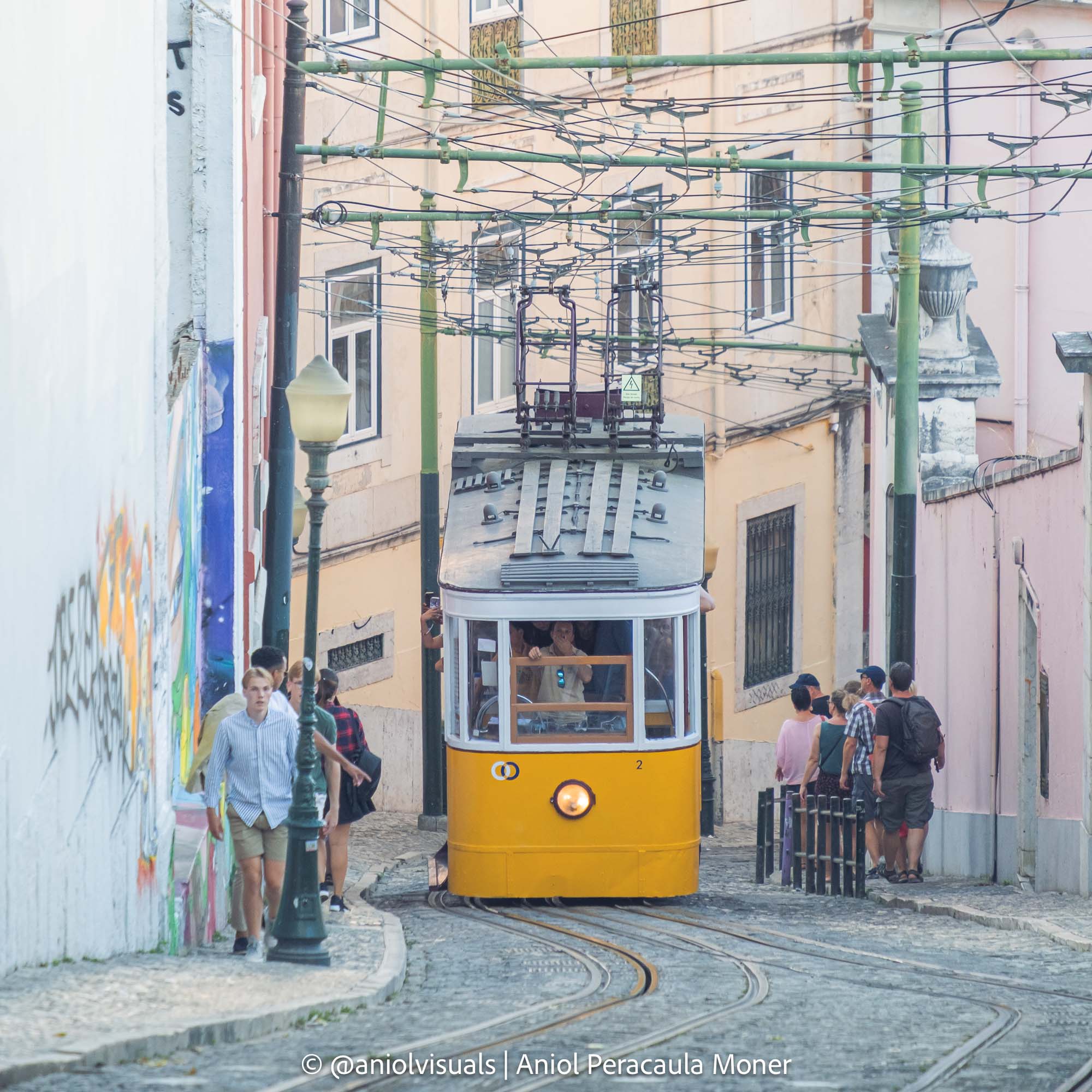
This is the first elevador (or inclined tram) of this section of the guide. The Elevador da Glória is my least favourite of the two. This doesn’t mean it’s a bad photo spot (otherwise I would not include it), but the other one for me is the best one in Lisbon.
The reason why I don’t like this Elevador as much is that on one of the sides of the inclined road that connects Baixa with Chiado, there’s just a wall. I think it’s not as photogenic as the elevador da Bica (see below), but very worth it.
2025 update: Sadly, this is the Elevador where the tragic incidents of September 3, 2025, happened. Thus, this spot will not be available for some time. Photography is the last one of the priorities at this time.
Plaça Luís de Camões
If you walk from Baixa to Barrio Alto, chances are you will make it to Luis de Camões. This square connects multiple main streets in this elevated part of the city, and is a great place to people-watch. There is a lot of activity there: trams, people, cars, tourist groups,… but people are moving around; they are only passing through the square. Stay there, and in a brief period of time, you will get lots of potential photos. If you like street photography, this is a great spot for it in Lisbon.
Elevador da Bica
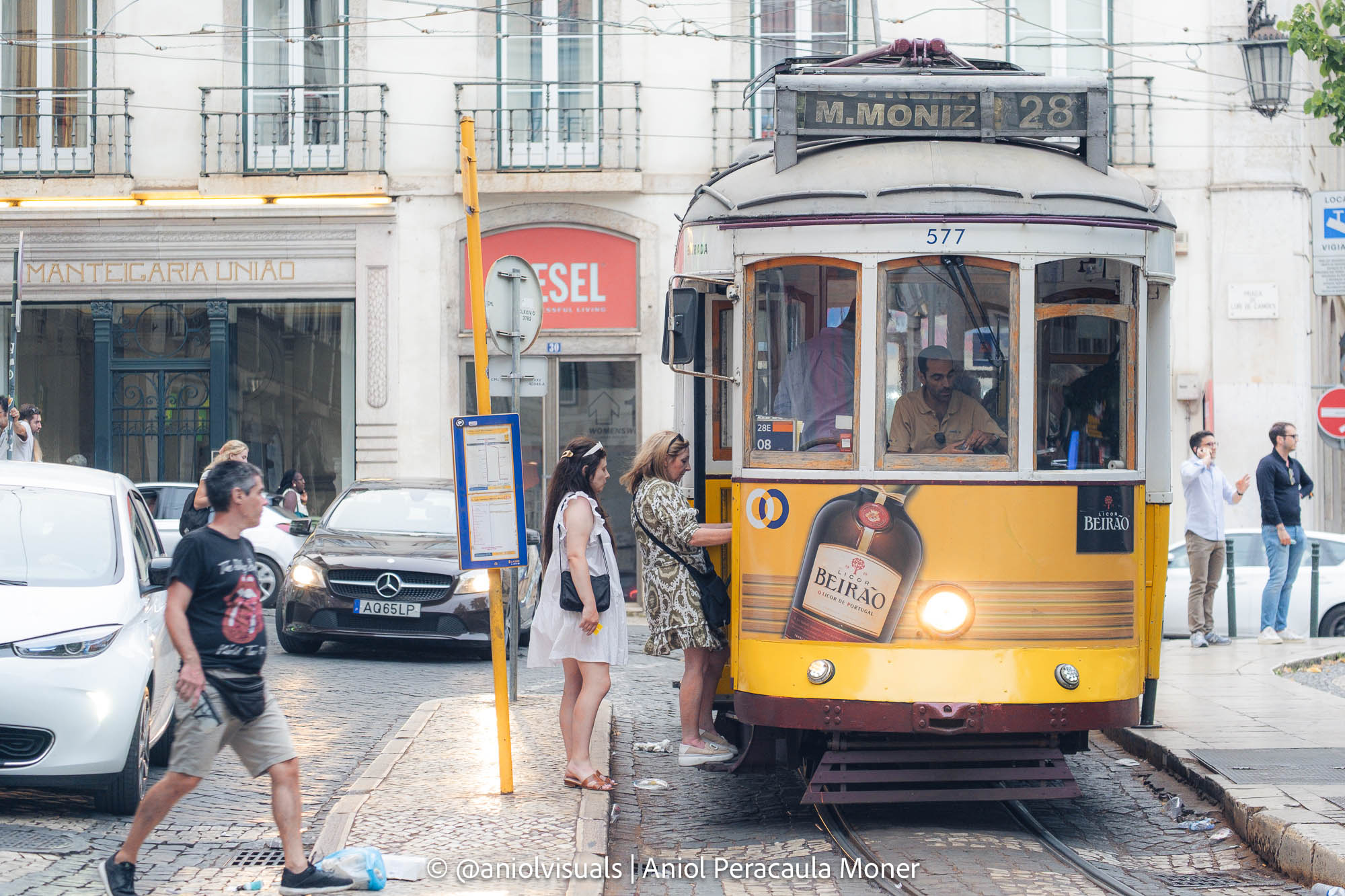
If Elevador da Glória is not my favourite one in Lisbon, it is because of Elevador da Bica. This is probably the most photographed tram in Lisbon. You get views over the river from the top, a cute street, and two beautiful yellow trams connecting the riverside with Barrio Alto.
Here are a few tips to take good photos of Elevador da Bica:
- Do not ride it. It’s expensive and you won’t get good photos from the Elevador.
- Check the timetable. Trams only start running at a certain hour. While early morning is the best time to get the street to yourself, if the tram isn’t running, you will not get good photos.
- Be patient. There are two trams, and they run simultaneously. Find a good spot and then wait for the tram. Oh, and be patient with other tourists, as they will get in your way while taking the photo. Being one of the most popular Lisbon photography spots, you will find other people, regardless of the time of day.
Tram 28
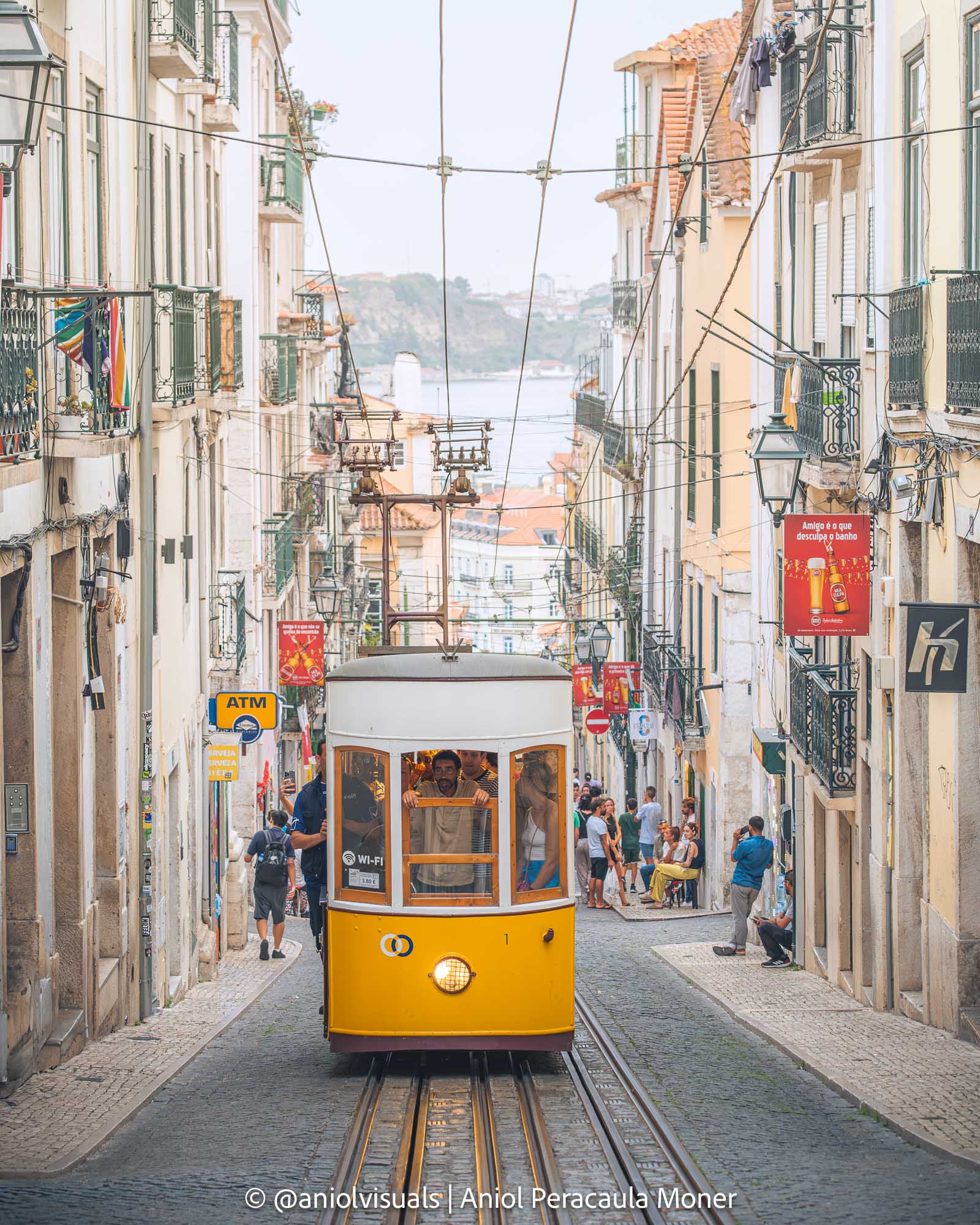
You will find many Lisbon photography spots guides (and guides in general) that mention the tram 28. Its route makes it ideal to explore the old town, as it connects Alfama and Barrio Alto.
However, my recommendation is not to take it but to photograph it. As I mentioned in previous points, check when it starts running and when it stops running, and be ready, trams can go quickly, and photo opportunities don’t last forever. Unlike the elevators, which are a bit more predictable, trams are a bit more random, so keep your camera close.
Tejo Riverside photography spots
Earlier in this Lisbon photography spots guide, I covered the Belem and Jerónimos photo spots. However, this is only one tiny part of the Tejo Riverside. This is one of my favourite areas to take photos in Lisbon for two reasons. First, because it is not as touristy (with some exceptions) as the city centre of the Jerónimos area. Second, because of the contrasts between the new and old that this area offers. Let’s go to some of its best photo spots.
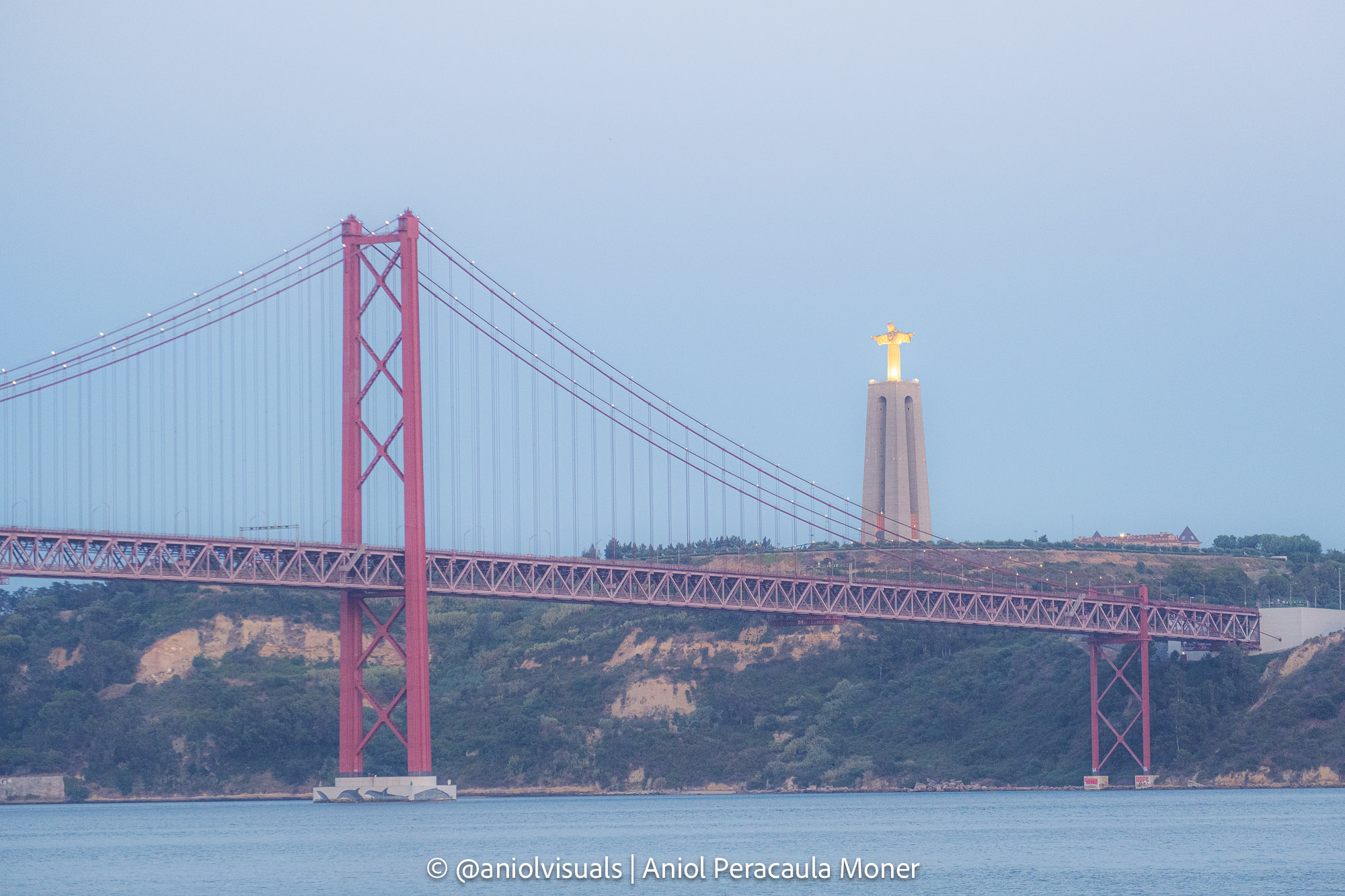
25 of April Bridge
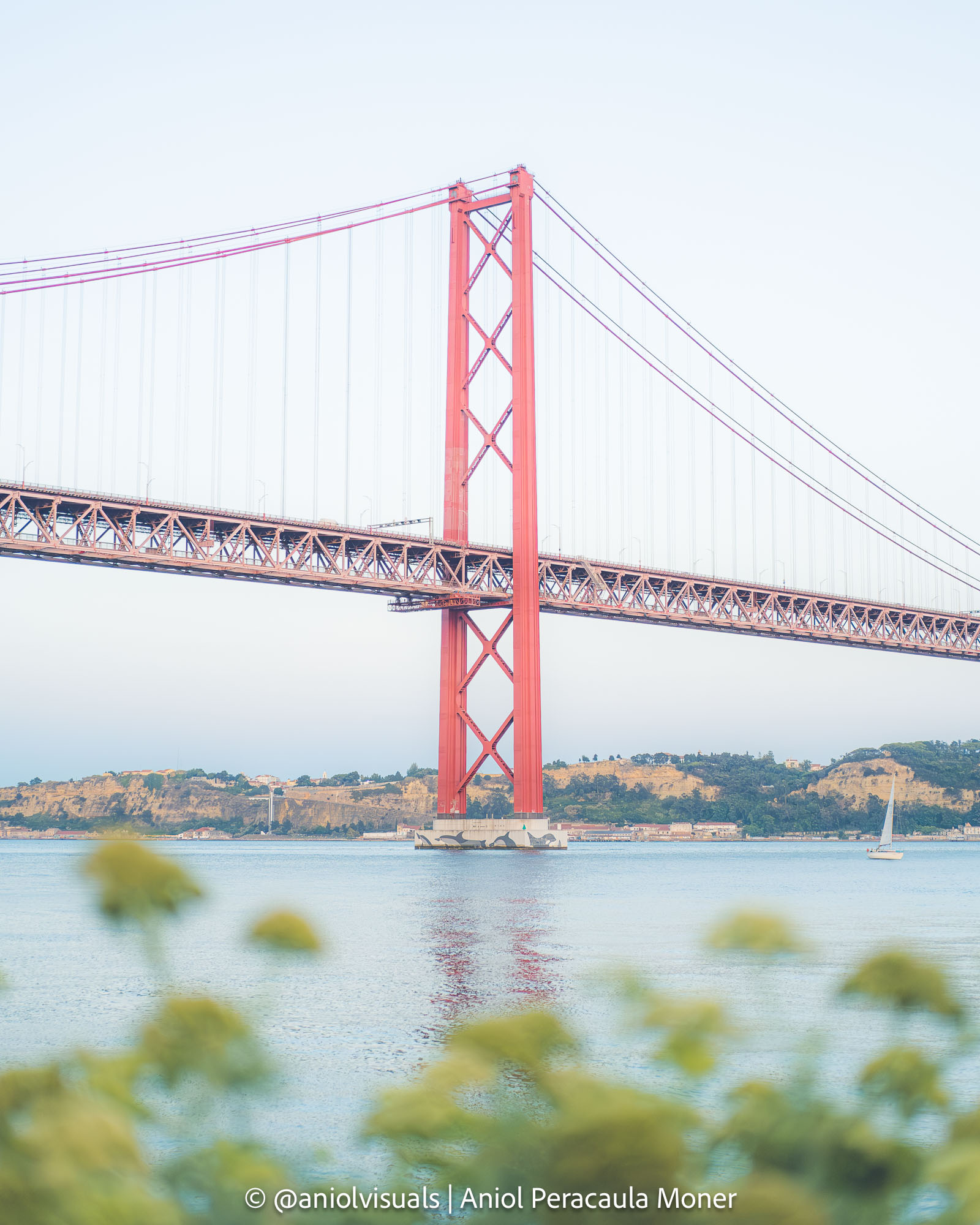
This is the Golden Gate Bridge in Lisbon. Same colour, similar structure, and very visible from the city and many spots. This is a really nice bridge to photograph and add to your photos.
It is not possible to cross the bridge on foot, only by train or car, but it’s not really needed to photograph it. In order to take great photos of the bridge, you will need to take some distance from it, so you can get a more complete view. A great option for getting your steps in is to walk from the LX factory (see below) all the way to Belem. You will see most of the spots in this section, and you can take some unique photos, especially at sunset.
LX factory
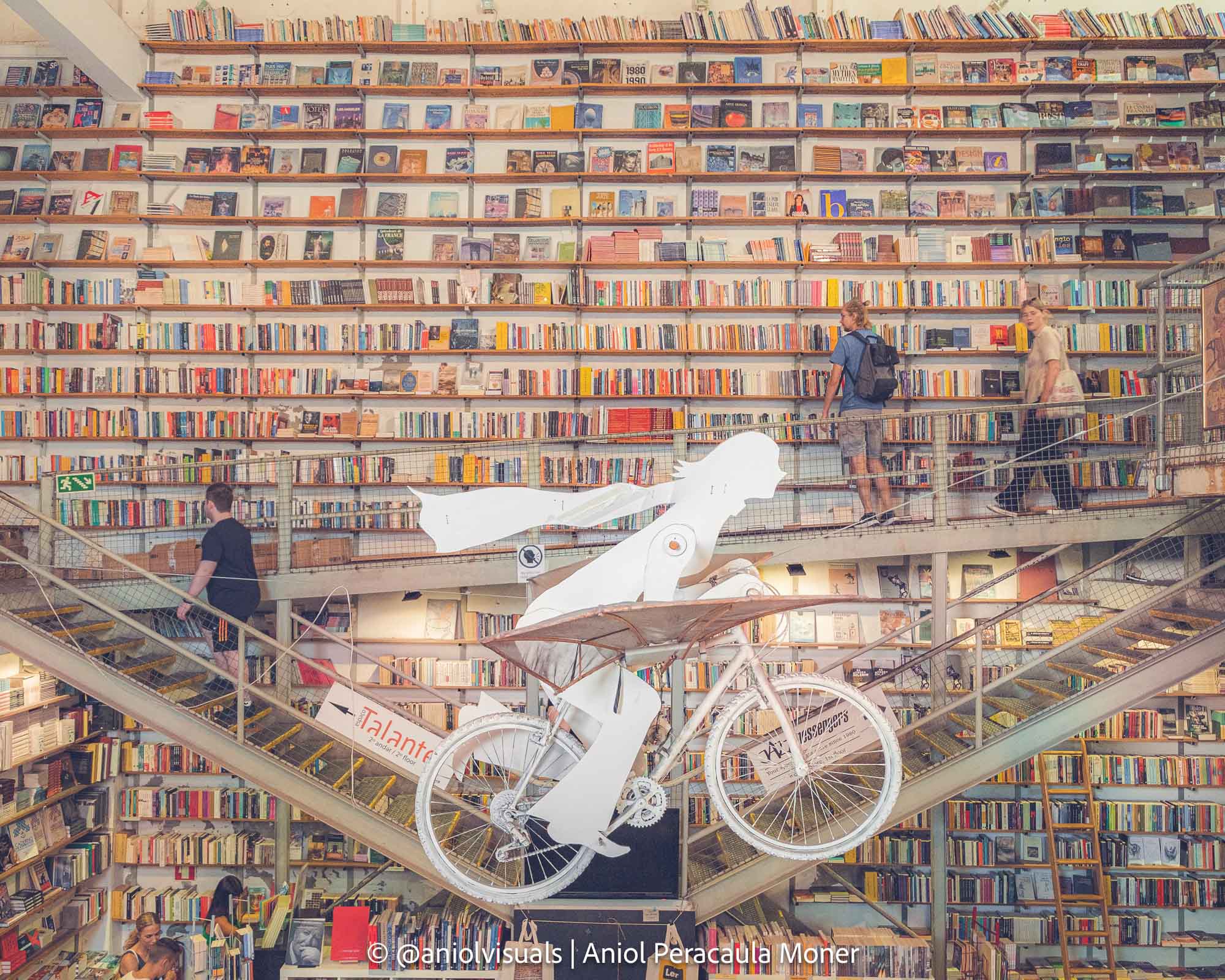
This is an old factory that has been repurposed as a “hipster” or artsy area. Thus, you can find slightly overpriced restaurants and bars, interesting shops, and lots of photo opportunities. The area has been evolving since I first visited it in 2017. Back then, it was way more industrial and less touristy. On my last visit, I saw many new shops, bars and restaurants, but it is still a nice place to visit and take some photos.
It has slowly become one of the most Instagrammed Lisbon photography spots. While it’s certainly photogenic, it’s not the best place in Lisbon for photography, and it can be a bit disappointing if you have high hopes about it.
MAAT: Museu de Arte, Arquitetura e Tecnologia
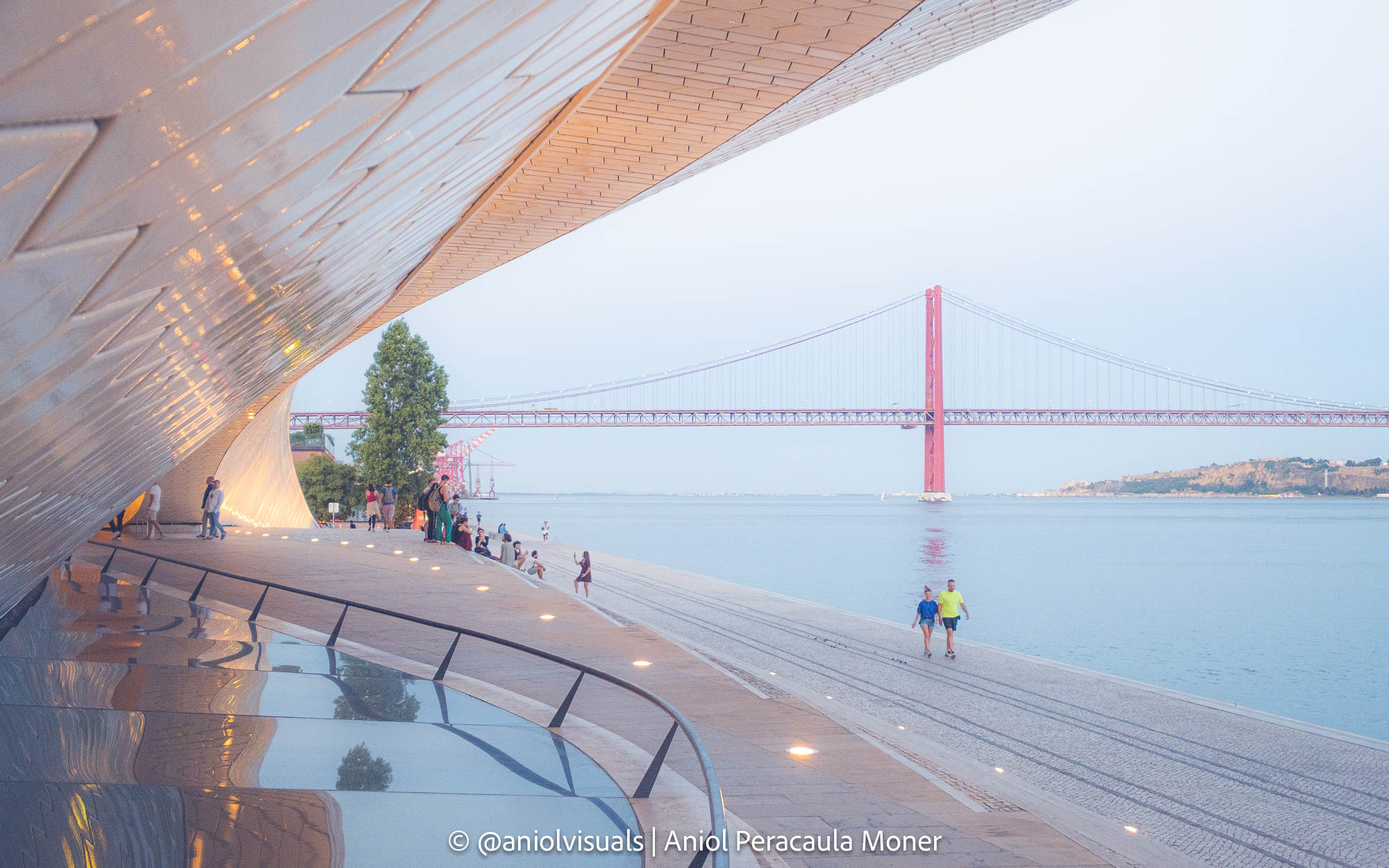
This is one of the most underrated Lisbon photography spots. The MAAT is a modern building right next to the Tejo estuary, at a relatively short walking distance from LX and Jerónimos. There are a few easy shots (as the one below), but I believe it’s possible to take different photos using this building. Its shape and structure, the proximity to the 25 of April Bridge, and its strategic position near the water are ingredients for success.
I can’t say if the museum itself is interesting, but the building is one of the most distinct in Lisbon, that’s for sure. This is a place that is gaining traction on social media lately, so it might be that you’re not alone when photographing it.
Santuário de Cristo Rei
Lisbon has a strong Brazilian influence. Although it’s not the Cristo of Rio, Lisbon has its own Christ statue overlooking the city, the Santuario de Cristo Rei. There are 2 photos there: one is from the Sanctuary. Getting there is not particularly easy, but the views from the top are nice. However, what I prefer is including it in other photos, either with the 25th of April bridge, or even from the MAAT.
To take such photos, though, you will need some type of zoom lenses, ideally above 150-200mm if you want a close-up from a distance.
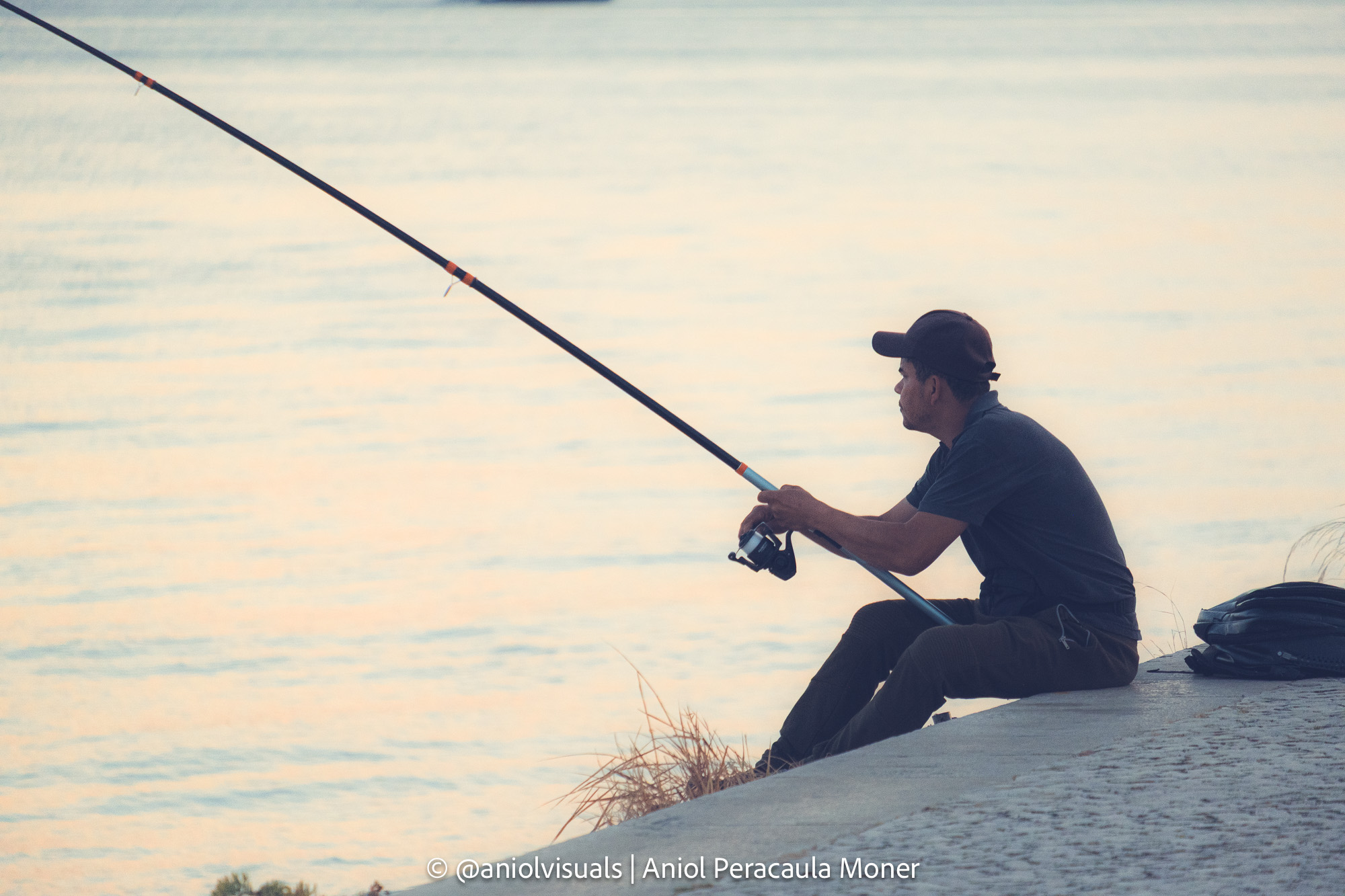
Fishermen
This is not a specific spot, but a photo opportunity. All along the Tejo estuary, especially at sunrise and before sunset, it’s common to see fishermen with their rods. There are many photo opportunities there. From using them as an extra element in a photo with some other spots listed on this list, or taking detail shots of the rods at sunrise or sunset.
If you do the walk from LX all the way to Jerónimos (or vice versa), keep an eye on the fishermen.
This is the end of the Lisbon photography spots guide, with its best spots, but also photo opportunities. If you have further questions about photographing Lisbon, you can schedule a free 30-minute call with me using the link below!
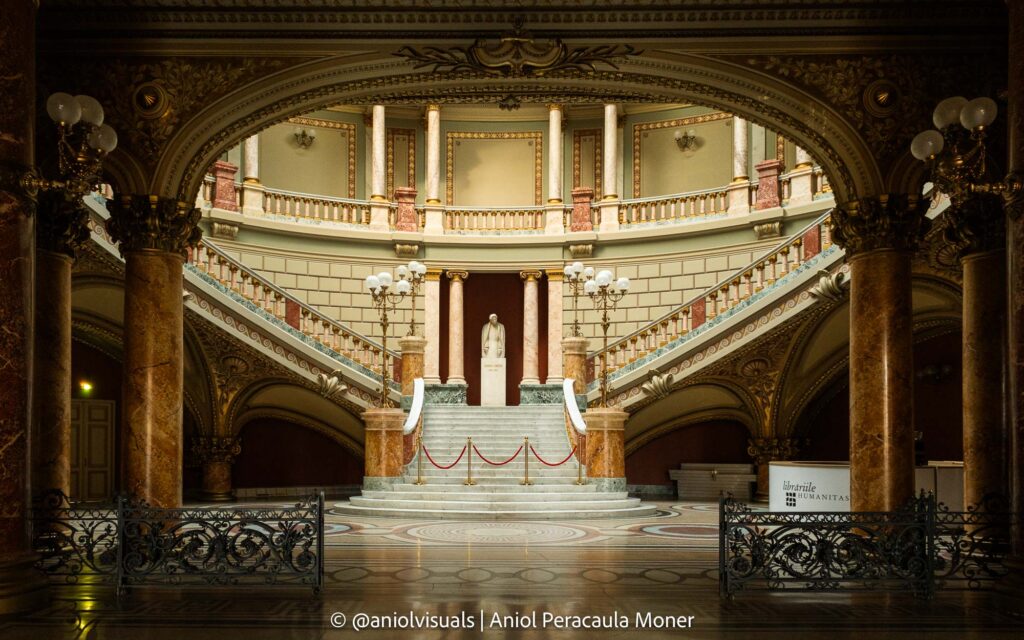
Best Bucharest photography spots: complete guide (10+ spots)

Best Funchal photography spots: a complete guide
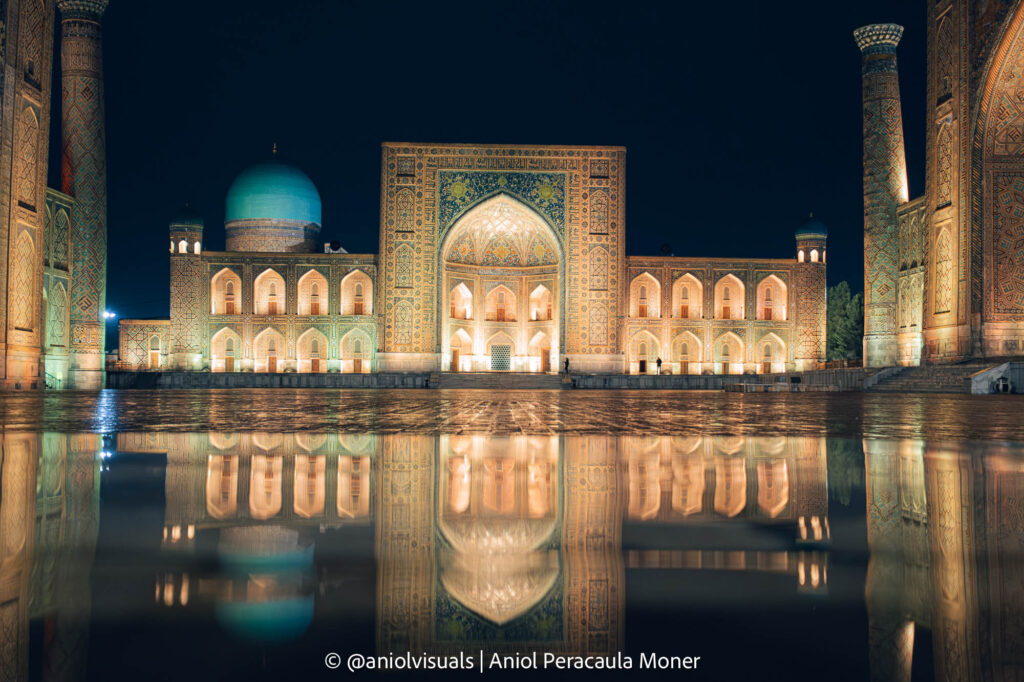
10 best Samarkand photography spots: a complete guide
Moynaq and Aral sea photography spots: a complete guide
Best Sarajevo photography spots: a complete guide